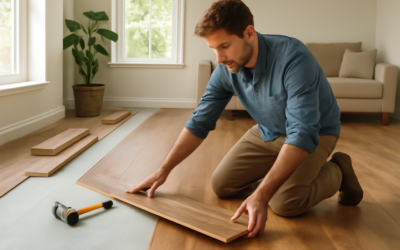
Real wood floors used to require a nail gun or a trowel of adhesive; now a growing slice of the market snaps together like laminate. Click lock hardwood flooring uses machined interlocking profiles — the same Välinge and Unilin locking systems that made laminate a DIY staple — milled into genuine wood planks, so the floor floats over an underlayment with no fasteners at all. It is a legitimate category with real advantages: faster installation, concrete-friendly, and immediately walkable. But an honest guide has to say two things up front: nearly all click-lock wood is engineered rather than solid (and there are good physical reasons solid click barely exists), and floating installation brings trade-offs in feel and sound that nail-down owners notice. Here is the full picture.
How the Locking System Works
Instead of a plain tongue and groove, each plank edge is milled into a precise hook-and-channel profile. Long edges typically engage at an angle and rotate down; short ends either angle in, tap together, or use a fold-down plastic or wood insert that clicks as the plank drops. Once engaged, the profile resists both vertical separation and horizontal pull-apart, turning hundreds of planks into a single connected raft. That raft floats: it rests on a foam, cork, or rubber underlayment and expands and contracts as one unit, which is why every wall and pipe gets a 3/8 to 1/2 inch expansion gap covered by trim.
Profile quality varies enormously and is the main thing separating a $4 click floor from an $8 one. Licensed locking systems (Uniclic, 5G, 2G) machined into dense multi-ply cores hold tight for decades. Loose, chippy profiles in soft cores are where gaps and peaking start.
Why Almost All of It Is Engineered
Milling a click profile requires material that is dimensionally stable and strong in thin cross-sections. Engineered planks — a hardwood veneer over 5 to 11 plies of cross-laminated wood or an HDF core — are ideal: the core layers run in alternating directions, so the profile does not blow out and the plank does not shrink across its width enough to unzip the joints. Solid wood is the opposite. A 3/4 inch solid oak plank moves so much across the grain seasonally that a floating solid floor would open its own joints, and the short-grain sections of a click profile cut into solid lumber snap easily. A few manufacturers have sold solid click products over the years, mostly in narrow widths and specific species, but they remain rare, restrictive, and honestly not the smart buy. If a seller offers “solid click hardwood” at a bargain price, scrutinize it — the category barely exists for physics reasons, not marketing ones.
The Case For Click Lock
- DIY-realistic installation. A competent DIYer lays 200 to 300 sq ft a day with a saw, spacers, and a tapping block. No nailer rental, no adhesive mess, no cure time — walk on it the same afternoon.
- Concrete and condo friendly. Floating floors go over slabs, gypsum underlayments, and existing hard floors where nailing is impossible, with just a vapor barrier and pad beneath.
- Lower installed cost. Pro labor for floating installs runs $2 to $4 per sq ft versus $3 to $6 for nail-down and $4 to $8 for glue-down. DIY drops labor to zero.
- Reusable and repair-friendly at the edges. Planks near a wall can be unclicked and swapped; a whole floor can, in principle, come up and move with you.
- Radiant heat compatible on most engineered products (verify the rating, typically 80-85°F max surface temperature).
The Case Against — Stated Plainly
Floating floors feel and sound different. Because the raft sits on foam rather than being fastened down, footfalls produce a slightly hollow sound and a touch of flex that nail-down floors do not have. A quality rubber or cork underlayment ($0.50 to $1.00 per sq ft) narrows the gap substantially; a cheap 2 mm foam pad advertises the difference with every step. Other honest limits:
- Subfloor flatness is non-negotiable: 3/16 inch over 10 feet. Floating planks bridge dips, flex there underfoot, and eventually stress the locking profiles.
- Mid-room repairs are painful. Replacing a damaged plank in the middle of a click floor means disassembling to it from a wall or cutting it out and gluing a replacement.
- Large areas need breaks. Runs beyond roughly 30 to 40 feet often require transition moldings per manufacturer specs.
- Refinishing a floating floor is trickier. Thin-veneer product (under 2 mm) cannot be sanded at all, and even thicker veneers refinish best with light, even passes because the floor gives slightly under a big machine.
What It Costs
Materials run $4 to $9 per sq ft for quality engineered click product with a 2 to 4 mm veneer — oak dominates, with hickory, maple, and walnut widely available in 5 to 7-1/2 inch widths. Budget lines dip to $3; premium wide-plank European oak click reaches $10 to $12. Add underlayment ($0.15 to $1.00 per sq ft; pre-attached pads are common), and either your weekend or $2 to $4 per sq ft in labor. A 500 sq ft DIY install can realistically land under $3,000 all-in — roughly half the cost of the same square footage in professionally nailed solid oak.
Buying and Installing It Right
- Prioritize the wear layer: 2 mm minimum, 3 mm+ if you want a future refinish.
- Favor licensed locking systems (Uniclic, 5G) and inspect a sample’s profile for clean, dense machining.
- Check the core: multi-ply hardwood cores handle moisture swings better than HDF cores, which are more laminate-like in wet rooms.
- Flatten the subfloor first — patch and grind to spec; this hour of prep determines how solid the floor feels forever.
- Acclimate cartons 48-72 hours, use a vapor barrier on concrete, leave true expansion gaps, and never fasten anything (including kitchen islands, per most specs) through a floating floor.
Common Mistakes That Sink Click Floors
Most click-floor complaints trace to a handful of preventable errors. Skipped acclimation tops the list — planks installed straight off a cold delivery truck expand in place and peak at the joints. Insufficient expansion gaps come second: a floor pinned tight against a wall, a stair nosing, or a pipe has nowhere to move and lifts instead. Heavy fixed objects are the sneaky third — a 300-pound bookcase on one side of a room and a wall on the other can trap the raft between them, so spread heavy loads or plan the layout around them. Finally, tapping planks together with a hammer directly on the tongue crushes the profile; always use a proper tapping block. Each of these mistakes costs nothing to avoid and hundreds to fix.
The Bottom Line
Click lock hardwood flooring is the right call when you want real wood over concrete, a DIY-achievable install, or the lowest professional labor bill — and you are willing to accept a slightly softer, floatier feel in exchange. Buy a thick veneer on a proven locking system, spend real money on underlayment, and prep the subfloor flat. Skip it if you want the dead-solid, permanent feel of nailed-down wood and have the plywood subfloor to do it; that remains the one thing a floating floor cannot fully imitate.
Prefer to explore on your own?
See how new flooring looks in your actual room in seconds — free, no signup.
Try the free Floor Studio →