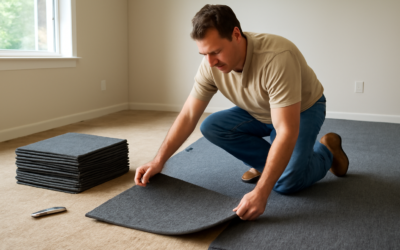
A 40,000 square foot tenant fit-out on a Class A office tower has nothing in common with a kitchen remodel, and the contractors who do them well are different breeds. Commercial flooring specialists deliver schedules, certifications, insurance levels, and product specifications that residential installers simply do not carry. Hiring the wrong firm for a commercial project costs you weeks of delay, six-figure penalty clauses, and a flooring system that fails inspection. The right one quietly meets every milestone and disappears the day the punch list closes.
- What Sets a Commercial Specialist Apart
- Project Types and Typical Vendors
- How to Find Qualified Specialists
- Bidding the Project Properly
- Contract Terms That Protect You
- Pricing Benchmarks
- Schedule and Site Coordination
- Warranty and Long-Term Maintenance
- Final Thoughts on Commercial Flooring Specialists
What Sets a Commercial Specialist Apart
Three things distinguish a commercial flooring specialist from a residential contractor. First, they hold the certifications: Starnet, Floor Covering Industry Foundation, ICRI moisture mitigation, and product-specific training from manufacturers like Interface, Shaw Contract, Armstrong, and Tarkett. Second, they carry the insurance: $2 million general liability minimum, $5 million umbrella, and project-specific bonds when the GC requires them. Third, they understand the schedule: a commercial install runs night shifts, multiple crews, off-hour deliveries, and elevator reservations.
None of those costs nothing. Expect to pay 20 to 40 percent more per square foot than the cheapest residential bid. The tradeoff is the project actually finishes on the date stamped on the lease.
Project Types and Typical Vendors
- Office tenant fit-out: carpet tile, LVT, walk-off matting; vendors like Diversified Carpet Service, Continental Flooring, Empire Today Commercial
- Retail rollouts: consistent install across multiple stores; vendors like Stonhard, ProSource, Spectra Contract Flooring
- Healthcare: sheet vinyl with heat-welded seams, antimicrobial backing; specialists certified by Forbo, Tarkett, Mannington Commercial
- Education: rubber sport flooring, terrazzo, polished concrete; firms with school district master agreements
- Hospitality: broadloom carpet, area rugs, decorative concrete; firms working with brand-standard programs (Marriott, Hilton, Hyatt)
- Industrial and warehouse: epoxy and polished concrete; firms certified by Sherwin-Williams Resinous, Sika, BASF
How to Find Qualified Specialists
Start with the manufacturer. Every major commercial flooring brand maintains a certified installer directory keyed to your zip code. Interface’s Mission Zero installer network, Shaw Contract’s Approved Installer program, and Armstrong’s Master Builder Network all publish vetted lists. Bidders pulled from those directories almost always carry the right credentials.
Cross-reference with Starnet, the largest commercial flooring cooperative in North America. Starnet members are independent firms, vetted for financial stability, technical capacity, and warranty support across all 50 states. The directory at starnetflooring.com is searchable by region.
Trade publications run annual rankings. Floor Covering Weekly’s Top 50 Contract Dealers and Floor Covering Installer Magazine’s Annual Industry Report list the largest commercial firms by revenue, useful for benchmarking who is doing big-box work in your market.
Bidding the Project Properly
A commercial flooring bid runs on a measured plan, not a walkthrough. Provide bidders with architectural drawings, finish schedules, product specifications, and the project schedule. Allow at least three weeks for proper takeoffs and subcontractor pricing. Bids returned in 48 hours are guesses; trust the firms that took the time.
Compare bids line by line. Square footages should match within 2 percent across all bidders working from the same drawings; large variances signal that someone misread the plan. Material allowances, prep scopes, transition strips, and exclusions reveal far more than the bottom line. The cheapest bid usually excluded something the others priced in.
Contract Terms That Protect You
- AIA A132 or AIA A401 form contracts: standard commercial language that allocates risk fairly
- Liquidated damages clause: daily penalty for late completion, typically $500 to $5,000 per day
- Performance and payment bonds: required on projects above $500,000 or any public work
- Lien waivers: conditional with each pay app, unconditional with final payment
- Substantial completion definition: spelled out specifically, not left to interpretation
- Two-year warranty on labor and installation beyond the manufacturer’s product warranty
Pricing Benchmarks
National average commercial install rates for 2025, before regional adjustment:
- Carpet tile install: $2.25 to $4.50 per sqft labor, plus $4 to $12 material
- LVT/LVP commercial glue-down: $3 to $5 labor, plus $5 to $14 material
- Sheet vinyl with heat-welded seams: $4 to $7 labor, plus $4 to $9 material
- Polished concrete: $4 to $11 per sqft turnkey
- Epoxy resinous floor: $5 to $14 per sqft turnkey
- Walk-off mat systems: $25 to $90 per sqft installed
Coastal cities run 15 to 30 percent above these averages; secondary markets run 10 to 20 percent below.
Schedule and Site Coordination
Commercial flooring is almost always the last finish trade in. Coordinate with the GC for substrate readiness, including moisture testing, surface profile, and humidity logs. ASTM F2170 RH probes are now the standard moisture test for concrete; demand the report and the calibration certificates before installing any moisture-sensitive product.
Off-hour and night-shift work is common in occupied buildings, retail, and healthcare. Build crew premiums of 25 to 50 percent into the bid for second shift, 50 to 100 percent for third shift and weekends.
Warranty and Long-Term Maintenance
The product warranty handles material defects; the installation warranty handles labor errors. Get both in writing on letterhead. Many specialists offer ongoing maintenance contracts that maintain the warranty in exchange for scheduled cleanings and inspections; for facilities managers, this is often the lowest-friction way to keep a commercial floor performing for its full design life.
Final Thoughts on Commercial Flooring Specialists
The right commercial flooring specialists save more in avoided delays and warranty claims than they ever cost in markup. Vet credentials through manufacturer programs and Starnet, demand AIA contract language, benchmark pricing against industry averages, and coordinate the schedule from day one. Cheap commercial install almost never stays cheap; it costs three times the savings in callbacks, lease penalties, and reputational damage.
Prefer to explore on your own?
See how new flooring looks in your actual room in seconds — free, no signup.
Try the free Floor Studio →