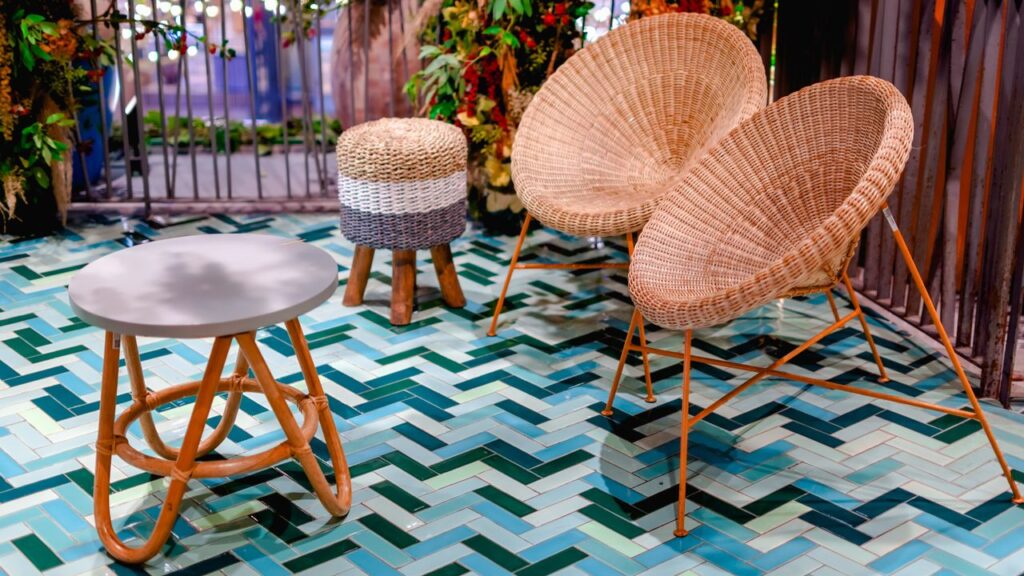
The composite category has exploded in the last five years and the marketing terms have followed — SPC, WPC, rigid core, EVP, hybrid tile. Cut through the names and composite tile flooring is any tile-format product that blends two or more materials to balance hardness, water resistance, and underfoot comfort. The right pick depends on the room, the subfloor condition, and how much weight you put on quiet versus durable.
Part of our Tile & Grout guide — explore the full guide →
What Counts as Composite Tile Flooring
Three product families dominate the composite tile space. Stone Plastic Composite (SPC) blends limestone powder with PVC and stabilizers into a dense, rigid core topped with a printed vinyl wear layer. Wood Plastic Composite (WPC) swaps the limestone for wood flour, producing a softer, warmer tile that floats better over uneven subfloors. Porcelain composite tiles combine traditional porcelain with embedded fiberglass for thinner, lighter formats — great for upper floors where weight matters.
The terminology gets muddier with each product launch. SPC and WPC are sometimes lumped together as “rigid core LVT” or marketed as luxury vinyl tile. Read the spec sheet rather than the marketing — look for core density, wear layer thickness in mils, and the warranty in years.
SPC vs WPC Compared
- SPC core density: 1.9 to 2.2 g/cm³ — much harder than WPC
- WPC core density: 1.0 to 1.4 g/cm³ — softer and warmer
- SPC underfoot: Firmer, more like tile
- WPC underfoot: Slightly cushioned, quieter
- SPC heat resistance: Up to 140°F — better for sunrooms
- WPC heat resistance: Up to 110°F — can warp under intense sun
- SPC waterproofing: 100 percent — limestone core does not swell
- WPC waterproofing: 100 percent on intact planks, may swell at damaged edges
Where Each Type Wins
SPC composite tile is the right pick for kitchens, basements, and slab-on-grade ground floors. The dense core resists indentation from heavy appliances and survives the temperature swings of an uninsulated basement. Most SPC products tolerate refrigerators, full-size washers, and even occasional rolling office chairs without permanent dents.
WPC works better in bedrooms, living rooms, and upper floors where comfort matters more than indentation resistance. The softer core absorbs footsteps, making it a favorite for second-story rooms above bedrooms. The trade-off is that high-heeled shoes and heavy furniture leg pads can leave permanent impressions. Adding wide felt pads under furniture mitigates the issue.
Porcelain Composite Tile
A newer entry in the composite category, porcelain composite tile uses a thin porcelain face bonded to a fiberglass-reinforced backer board. The result is a tile that delivers true porcelain looks at half the weight and twice the impact resistance. Tile sizes up to 48 by 96 inches are now common in this category — impossible with standard porcelain at that thickness.
Costs are steeper. Expect $7 to $12 per square foot for product and $5 to $9 per square foot for installation. Total installed cost runs $12 to $21 per square foot — comparable to high-end natural stone but lighter and more forgiving on subfloors not engineered for stone loads.
Composite Tile Costs Broken Down
Builder-grade SPC composite tile starts at $1.99 per square foot at Floor & Decor or LL Flooring. Mid-grade products from Shaw, Mohawk, and CoreTec run $3.50 to $5.50. Premium SPC with a 22-mil wear layer tops $7 per square foot. WPC pricing is similar to SPC for comparable wear layers — pick based on use case, not price.
Professional installation costs $1.50 to $3 per square foot for click-lock products. Glue-down installs run $2.50 to $4 per square foot but offer better dimensional stability in large open rooms. Add $0.50 to $1.50 per square foot for self-leveling underlayment if your subfloor needs it.
Installation Tips That Save Headaches
Composite tile floors fail most often because of subfloor issues, not product defects. Check flatness with an 8-foot straightedge — any dip or hump greater than 3/16 inch needs to be addressed with self-leveling compound before laying anything down. Skip this and you will get telegraphing through SPC and hollow-spot squeaks under WPC.
Acclimate the product for 48 hours in the room where it will be installed. Manufacturers used to claim composite tiles needed no acclimation — most have walked that back after callbacks from gapping and buckling in extreme climates. Keep the room between 60 and 85 degrees F with humidity between 35 and 65 percent during install and for 48 hours afterward.
Maintenance and Cleaning
Composite tile is forgiving on cleaning compared to natural stone or hardwood. A dry microfiber mop handles daily dust. For weekly cleaning, use a damp mop with plain water or a mild pH-neutral cleaner like Bona for LVT/LVP. Avoid steam mops — most manufacturers void the warranty if you use one, and the moisture can sneak under planks at click joints.
For tough spots like dried paint or shoe scuffs, isopropyl alcohol on a microfiber cloth lifts most marks without damaging the wear layer. Skip oil soaps like Murphy’s — they leave a residue that attracts dirt and dulls the finish over time.
Warranty Considerations
Composite tile warranties range from 10 years residential to lifetime on premium products. Read the fine print carefully. Most warranties require professional installation, climate-controlled conditions, and proof of moisture testing on slabs. Commercial warranties are typically 5 to 15 years and prorated heavily after year 5.
Verdict by Room
For most homes, SPC composite tile is the best balance of price, durability, and waterproofing. WPC wins in upper-floor bedrooms and family rooms where comfort matters. Porcelain composite is a premium choice for showcase rooms with large-format tile budgets. All three outperform standard LVP and laminate in lifespan and water resistance — just pick the type that matches the room.
Prefer to explore on your own?
See how new flooring looks in your actual room in seconds — free, no signup.
Try the free Floor Studio →