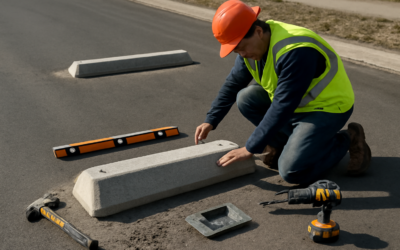
That wedge-shaped concrete wall you drive past in every construction zone weighs about as much as a small car — roughly 4,000 pounds for a standard 10-foot section. Concrete jersey barriers were engineered in the 1950s for the New Jersey State Highway Department to redirect errant vehicles without flipping them, and the profile worked so well it became the default worldwide. Today they show up far beyond highways: securing storefronts, blocking unauthorized access to private land, retaining material in bulk storage bays, and anchoring event perimeters. Here is what they actually cost, what the dimensions and weights are, and what to know before you order a truckload.
The Jersey Profile and Why the Shape Matters
A jersey barrier is not just a concrete wall — the sloped face does specific work. The bottom 3 inches rise nearly vertical, then a 55-degree slope carries up to about 13 inches, and the face steepens to near-vertical up to the 32-inch crown. When a car strikes it at a shallow angle, the front tire climbs the lower slope, the suspension compresses, and the vehicle is lifted slightly and steered back into the travel lane instead of slamming to a stop or vaulting the wall. That energy management is why the profile has barely changed in 70 years.
You will also hear the terms K-rail (the California DOT name for the same thing), F-shape (a refined profile with the slope break at 10 inches, which handles small cars better), and constant-slope barrier (a single 9.1-degree face, common in Texas and California). For private-property use the differences rarely matter; for anything in a public right-of-way, your state DOT dictates the profile and the crash-test rating, now governed by MASH (Manual for Assessing Safety Hardware) criteria.
Standard Dimensions and Weights
Specs vary a little between precast yards, but the common numbers are consistent enough to plan around:
- Height: 32 inches standard; 42-inch and 51-inch tall versions exist for glare screening and higher containment
- Base width: 24 inches, tapering to a 6-inch top
- Length: 10 feet is the standard section; 12-foot and 20-foot highway sections and short 6-foot units are also made
- Weight: roughly 400 pounds per linear foot — about 4,000 lbs for a 10-foot barrier and 8,000 lbs for a 20-footer
Ends are cast with connection hardware: pin-and-loop is most common (steel loops that interlock, joined by a dropped steel pin), with tongue-and-groove, J-J hooks, and grouted channel splices as alternatives. Connected barriers act as a chain, which is where much of the redirect capability comes from — a single free-standing section can slide 3 feet or more under a serious impact, while a pinned run of ten sections moves inches.
What Concrete Jersey Barriers Cost
Buying new from a precast plant, expect $400 to $700 per 10-foot section depending on region and rebar spec. Used barriers from contractors and auctions run $150 to $350 and are perfectly serviceable if the loops are intact and cracking is cosmetic. The number that surprises people is transport: at 2 tons per section you need a flatbed and a crane, boom truck, or heavy forklift at both ends. Delivery with offloading typically costs $300 to $800 for a local haul carrying 4 to 8 barriers, and long hauls quickly exceed the price of the concrete itself. Buy as close to the site as possible.
Renting flips the math for temporary jobs. Rental rates run $25 to $75 per barrier per month, with delivery, placement, and pickup billed separately — commonly $20 to $50 per barrier each way. For an event weekend or a six-month construction project, renting nearly always beats buying and then paying to dispose of them. Water-filled plastic barriers rent cheaper still and move by hand, but empty they weigh about 130 pounds and stop nothing; treat them as channelizers, not protection.
Common Uses On and Off the Highway
Around homes, farms, and small businesses, jersey barriers earn their keep in ways the original designers never pictured:
- Access control: blocking field entrances, dead-end turnarounds, and vacant-lot dumping spots where a gate would be cut in a week
- Storefront and pedestrian protection: shielding fuel pumps, outdoor dining, and building corners from vehicle strikes
- Material bins: three-sided bays for mulch, gravel, sand, and salt — the 24-inch base handles loader push-back far better than block walls
- Erosion and traffic separation: temporary channeling on private roads during grading or paving work
- Security perimeters: standoff barriers for events and utility sites; for true anti-ram vehicle security, engineered and anchored crash-rated barriers are the correct tool, but pinned jersey walls still add meaningful resistance
One caution on retaining use: barriers are designed for lateral vehicle impact, not for continuous soil pressure with poor drainage. Keep piled material below the top, slope it back, and expect sections to creep on smooth pavement unless they are pinned to each other or keyed against something solid.
Placement and Site Prep
Barriers want a firm, level surface — asphalt, concrete, or compacted gravel. On soft ground the leading edge digs in and the run develops a lean within a season. Setting them is a machine job: a 5,000-pound-minimum forklift with fork extensions, a skid steer rated for the load, or a boom truck with a barrier clamp or chain slings through the lifting slots cast into each unit. Never lift by the connection loops unless the manufacturer says they are rated for it.
Leave the sections tight and pinned if redirect capability matters; leave 4-to-6-inch gaps if you only need to stop vehicles but want water to pass through — a solid barrier run across a drainage path becomes a dam, and more than one parking lot has flooded because a barrier wall blocked the sheet flow. In freeze-thaw climates, set barriers on a couple inches of crushed stone rather than bare soil so they do not heave unevenly and crack at the joints.
Regulations and Liability
On private property, placing barriers is generally your call, though municipalities may treat long runs as fences or structures requiring a permit, and fire departments can order removal if you block a required fire lane or hydrant access. In any public right-of-way — even the apron of your own driveway — barriers require DOT or municipal approval and usually must be MASH-rated and installed per the agency’s standard drawings. Skip the temptation to drop an unapproved barrier along a public road edge; if a vehicle hits it, liability lands on whoever placed it.
Mark barriers in dark areas with reflective tape or object markers. A gray 32-inch wall at night is nearly invisible, and courts have not been kind to owners whose unmarked barriers caused crashes.
Moving, Removing, and Reselling Barriers
Plan the exit before the entrance, because a barrier that cost $200 to buy can cost $400 to make disappear. When a project wraps, you have three realistic options. Resell locally — Craigslist, Facebook Marketplace, and equipment auctions move used barriers steadily at $100 to $250 each, and “buyer loads and hauls” listings shift the expensive part of the transaction to the purchaser. Return or sell them to a precast yard or barrier rental outfit; many buy back sound units at 30 to 50 percent of new price when local demand is strong. Or repurpose them on site as bin walls, bank stabilization, or equipment bollards, which is where a surprising number of farm barriers spend their retirement.
Disposal is the worst-case outcome. Landfills charge concrete by the ton — figure $30 to $80 per barrier in tipping fees plus hauling — though crushing outfits will sometimes take them free as clean fill feedstock if you deliver. Relocating barriers around your own property is straightforward with the right machine: a compact tractor with a loader rated under 3,000 pounds will tip and drag one but not lift it safely, so match the equipment to the 4,000-pound reality and use rated chains through the lift slots, never a single wrap around the middle where the load can slide. Budget 10 to 15 minutes per barrier for an experienced operator to lift, carry, and reset one, which is also a fair basis for checking a contractor’s placement quote.
Buying Tips and Alternatives
Inspect used barriers for exposed or torn connection loops, spalls deeper than an inch over rebar, and full-height vertical cracks — surface scars are fine, structural breaks are not. Ask the yard whether units are highway spec (typically 4,000 to 5,000 psi air-entrained concrete) or lighter-duty site-cast copies. If your need is a bin wall rather than impact protection, consider interlocking concrete blocks — the 2x2x6-foot “mafia block” style at $50 to $120 each — which stack, cost less per foot of wall, and handle soil loads better. But when the job is stopping or redirecting a vehicle, nothing at the price competes with a pinned run of genuine jersey barriers: cheap, nearly indestructible, and holding their value at resale for decades.