A sunken slab rarely needs to be replaced — it needs to be lifted, at about a quarter of replacement price. Average concrete leveling cost runs $500 to $1,800 for typical residential jobs, with mudjacking pricing around $3 to $8 per square foot and polyurethane foam lifting at $5 to $15 per square foot. The spread between the two methods, and between a one-slab sidewalk fix and a settled garage floor, is wide enough that quotes for the same driveway can differ by $2,000. Here’s how the pricing actually works, method by method and project by project. (For how the lifting process itself works — drilling, injection, and why slabs sink in the first place — see our concrete leveling guide; this article stays on the money.)
The Two Methods and Their Price Logic
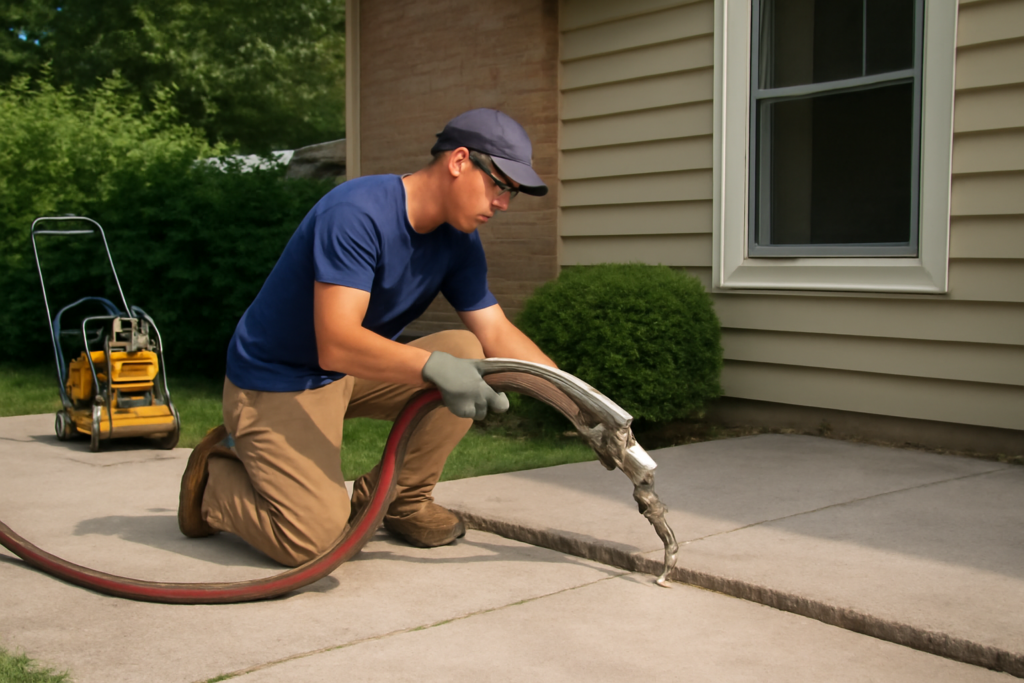
Both techniques drill through the slab and pump material underneath to raise it, but the materials drive very different cost structures. Mudjacking pumps a cement-sand slurry through 1-5/8-inch holes; the material is dirt cheap, so you’re mostly paying for crew time and equipment, which keeps rates at $3 to $8 per square foot. Polyurethane foam lifting (polyjacking) injects expanding two-part foam through 5/8-inch holes; the resin is expensive — often $8 to $15 per pound installed — pushing rates to $5 to $15 per square foot, but a fraction of the material weight does the same lifting.
Why anyone pays the foam premium: smaller patch holes, cured-in-15-minutes turnaround versus 24 to 48 hours for slurry, roughly 4 pounds per cubic foot of added weight versus 100+ for slurry (which matters over already-weak soil), and waterproof material that won’t wash out. Mudjacking counters with price and rock-solid performance on big, heavy lifts. Neither fixes the reason the slab sank — poor compaction, erosion, or tree roots — so ask every bidder what they’ll do about the cause, not just the symptom.
Cost by Project Type
Most companies price by the job, not strictly by the square foot, because mobilization dominates small work. Typical 2026 ranges:
- Sidewalk or single walkway slab: $150 – $500. Trip-hazard fixes are the cheapest jobs in the industry; many firms have a $250 – $400 minimum that covers one or two panels.
- Front steps / stoop: $300 – $1,000 depending on drop and access.
- Patio: $500 – $1,500 for a typical 200 – 400 sq ft slab.
- Driveway: $600 – $2,500. A two-car driveway with one settled side usually lands $800 – $1,500; severe multi-slab settlement can reach $3,000+.
- Garage floor: $600 – $2,000, complicated by interior access and the slab’s thickness.
- Pool deck: $800 – $3,000 — foam is strongly preferred here for weight and water resistance.
- Basement or interior floor: $1,000 – $3,500; small holes and low mess make foam nearly universal indoors.
What Moves the Number Up or Down
Four factors explain most quote-to-quote variation. Void size and lift height matter most — raising a slab 3 inches consumes several times the material of a 1-inch lift, and large washout voids under a slab (common after downspout erosion) get billed as added material, foam especially. Slab condition is next: a cracked slab can still be lifted, but each broken piece is lifted separately, adding time; badly shattered concrete may not be liftable at all. Access — rear patios with no gate, interior floors, tight lot lines — adds hose runs and labor. And soil cause can add scope: if erosion is active, reputable firms bundle in downspout rerouting or joint caulking ($100 – $400) so the fix holds.
Regional labor swings the ranges about 20 percent either way — metro Northeast and West Coast at the top, rural Midwest and South at the bottom.
Leveling vs. Replacement: The Math That Sells Itself
Tear-out and replacement runs $8 to $15 per square foot once demolition, disposal, base prep, and new 4-inch concrete are counted. A 400 sq ft driveway section: roughly $4,000 to $6,000 replaced, versus $900 to $2,000 leveled — and the leveled slab is drivable the same day (foam) instead of after a 7-day cure. Leveling wins whenever the slab is structurally sound, sunk less than about 4 inches, and not crumbling. Replacement wins when concrete is badly cracked or spalled, has already been lifted repeatedly, or when settlement stems from soil problems (deep fill, expansive clay) that injection can’t stabilize. A useful rule from estimators: if leveling costs more than half of replacement, replace.
DIY Foam Kits: The Tempting Middle Path
Hardware stores and online retailers sell DIY slab-lifting foam kits ($100 to $300 for small-job quantities), and the math looks irresistible next to a $900 professional quote. The honest assessment: they’re viable for very small, low-stakes lifts — a single sidewalk panel, a stoop corner — and risky beyond that. Professional rigs meter two-part foam at controlled temperature and pressure with gauges showing lift in real time; kit foam gives you far less control, and over-lifting is a one-way mistake. Raising a slab 1/4 inch too far means grinding or re-drilling, and foam injected into an unmapped void wanders — there are plenty of contractor stories about DIY foam appearing in floor drains and sewer laterals. Between hammer-drill rental, a 5/8-inch bit, patch mortar, and the kit itself, the true DIY cost of a one-panel job runs $150 to $350 against a $250 to $400 professional minimum that includes a warranty. The savings rarely justify the downside on anything larger than a doormat-sized slab.
Getting Quotes That Mean Something
Concrete leveling is quoted free by essentially every operator, so collect two or three bids and compare like for like. Make each bidder specify: method and material (foam density if poly — 4-pound structural foam is the residential standard), number of injection points, how voids are billed (included, or per-pound overage?), warranty terms (2 to 5 years against re-settlement is standard; lifetime warranties usually have soil-movement exclusions worth reading), and whether cause-correction like caulking joints or regrading is included. Be wary of per-square-foot-only pricing on small jobs — a $4/sq ft rate sounds cheap until the 40 sq ft sidewalk hits the $350 job minimum anyway.
Timing the Work for a Better Price
Leveling has an off-season, and it’s negotiable. Demand peaks late spring through fall; late winter and early spring bookings (in climates where the ground isn’t frozen) routinely come in 10 to 15 percent under peak-season quotes, and crews can schedule within days instead of weeks. Bundling helps more: the mobilization cost of getting a rig to your address is the same whether they lift one slab or five, so pricing the sidewalk, the garage corner, and the patio step as one visit beats three separate calls by hundreds of dollars. Some firms also discount neighborhood clusters — if two neighbors have heaved sidewalks (they usually do; the same soil is under everyone), a same-day pair of jobs is worth asking about. One timing caution in the other direction: don’t defer a badly undermined slab through a wet winter to chase a discount. Voids grow with every storm, and material volume is the variable part of the bill.
Bottom-Line Budget Numbers
One adjacent cost question comes up on nearly every estimate: what about the cracks? Lifting closes many cracks visually but doesn’t heal them; polyurethane crack sealing or caulking joints after the lift typically adds $100 to $400 and is worth taking, since sealed joints are what keep water from re-eroding the base you just paid to fill. Grinding a stubborn high edge that won’t lift flush runs $50 to $150 per spot.
Plan around these figures: $250 to $500 for a sidewalk trip hazard, $800 to $1,500 for a typical driveway or patio lift, $5 to $15 per square foot if foam, $3 to $8 if mudjacking, and a same-day return to service with foam. Against $8 to $15 per square foot for replacement, concrete leveling cost is the rare home-repair line item that’s both the cheap option and, for a sound slab, the right one.