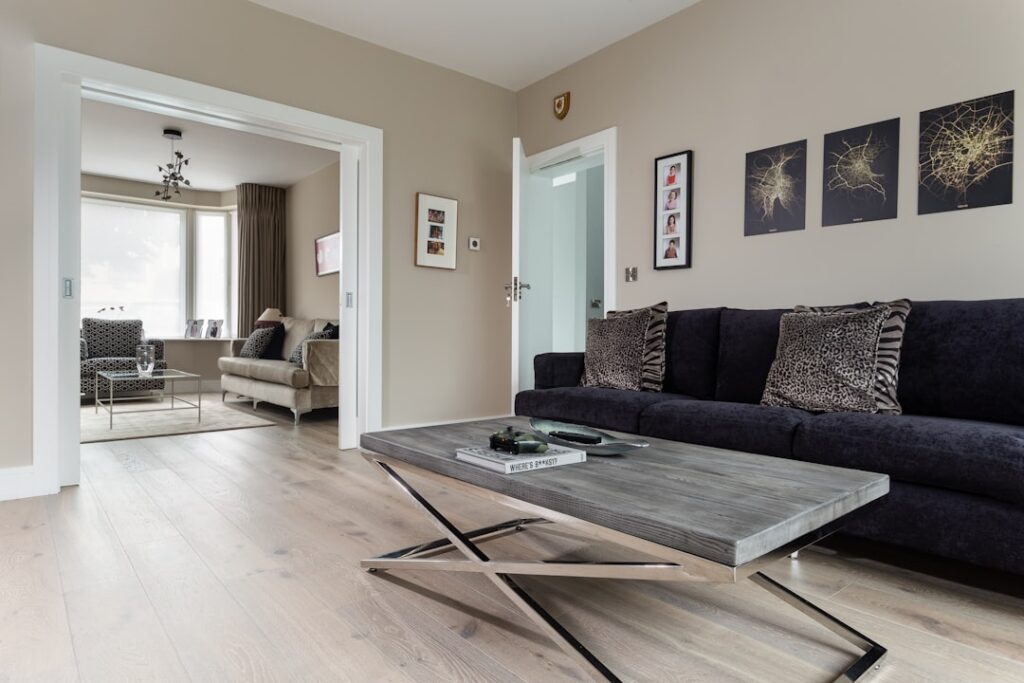
Laminate shed its shiny, plasticky reputation about a decade ago, and most homeowners haven’t caught up. Today’s contemporary laminate flooring uses wide planks, dead-matte surfaces, and realistic embossing that tracks the printed grain, giving you the clean, light, minimalist look that defines modern interiors at a fraction of hardwood’s cost. If you ruled out laminate years ago because it looked fake and glossy, the current generation deserves a second look.
- What Makes Laminate Look “Contemporary”
- Popular Contemporary Styles
- Understanding AC Ratings
- Pros of Going Contemporary Laminate
- The Drawbacks to Weigh
- Where Contemporary Laminate Works Best
- Installation and Underlayment Tips
- How Contemporary Laminate Compares to Vinyl
- Caring for a Matte Laminate Floor
- Final Recommendation
What Makes Laminate Look “Contemporary”
Three design choices separate a modern floor from a dated one. First is plank width: contemporary boards run 7 to 9 inches wide, sometimes more, versus the narrow 4- to 5-inch strips of older lines. Wider planks read calmer and more current. Second is finish, where matte and low-sheen surfaces have replaced the high-gloss laminates of the early 2000s. Third is color, with cool greys, washed-out whites, and pale natural oaks dominating modern palettes.
Realism does the rest. Embossed-in-register texture aligns the surface grain with the printed image, so the floor feels like wood under bare feet instead of a smooth photo.
Popular Contemporary Styles
Modern laminate leans into a handful of looks that pair well with minimalist rooms.
- Light Scandinavian oak: Pale, near-white planks that brighten small or north-facing rooms.
- Cool grey: From soft dove to deep charcoal, grey reads instantly modern and hides dust.
- Wide matte plank: Low-sheen surfaces that diffuse light and downplay scratches.
- Concrete and stone visuals: Tile-format laminate that mimics polished concrete for an industrial edge.
- Herringbone laminate: Short planks laid in a chevron pattern for a contemporary spin on a classic.
Understanding AC Ratings
The single most useful spec on a laminate box is the AC rating, which grades abrasion resistance from AC1 to AC5. For a modern home, ignore AC1 and AC2 entirely. Choose AC3 for normal residential rooms, AC4 for busy households with kids and pets, and AC5 for light commercial or heavy-traffic entryways. A higher rating costs a little more but protects the matte surface that gives contemporary laminate its appeal.
Pair the AC rating with plank thickness. Boards 10 to 12mm thick feel more solid underfoot and quieter than the 7mm budget lines.
Pros of Going Contemporary Laminate
The value proposition is strong, which is why laminate keeps selling despite the rise of vinyl.
- Cost: Quality contemporary laminate runs $2 to $5 per square foot, well under engineered hardwood.
- Scratch resistance: The melamine wear layer shrugs off scuffs that would mark real wood.
- Easy installation: Click-lock floating systems make it one of the most DIY-friendly options.
- Realistic looks: Embossed-in-register texture and matte finishes convince at floor level.
- Low maintenance: A dry mop and occasional damp clean keep it looking new.
The Drawbacks to Weigh
Laminate isn’t perfect, and the limits matter most in certain rooms. Water remains its weak point: standing spills can swell the fiberboard core at the joints, though water-resistant lines now offer 24- to 72-hour protection. It also can’t be sanded and refinished, so a heavily worn floor must be replaced rather than restored. And while embossing has improved, the most discerning eye can still tell premium laminate from real hardwood up close.
Sound is another consideration. Without a quality underlayment, laminate can sound hollow and click underfoot, so budget for an acoustic pad.
Where Contemporary Laminate Works Best
Living rooms, bedrooms, hallways, and home offices are ideal, where the look pays off and water exposure is low. Open-plan spaces especially benefit from wide planks run in a single direction to draw the eye through the room. For kitchens, choose a water-resistant line and wipe spills promptly. Skip standard laminate in bathrooms and laundry rooms entirely; a vinyl product handles those wet zones far better.
Installation and Underlayment Tips
Acclimate the planks in the room for 48 hours before laying so they adjust to humidity. Leave a 3/8-inch expansion gap around every wall and fixed object, hidden later by baseboard or quarter-round. A combined foam-and-vapor-barrier underlayment cuts noise and protects against moisture rising from concrete. Run planks parallel to the longest wall or the main light source for the cleanest contemporary look, and stagger end joints by at least 8 inches so the pattern reads random rather than stepped.
How Contemporary Laminate Compares to Vinyl
The biggest question shoppers face today is laminate versus luxury vinyl plank, since both target the same modern look at similar prices. The honest answer is that each wins in different rooms. Laminate generally feels more solid and warmer underfoot, and its high-density fiberboard core gives a more authentic wood-like step than some thinner vinyls. Many people also find the surface texture and matte realism of premium laminate convincing. Where laminate loses is water: even water-resistant lines can swell at the joints under standing water, while rigid-core vinyl is fully waterproof.
For living rooms, bedrooms, and hallways where spills are occasional and quickly wiped, contemporary laminate is an excellent, often better-feeling choice. For kitchens, bathrooms, mudrooms, and basements, lean toward waterproof vinyl. Some homeowners run laminate through the dry areas of an open-plan home and switch to a matching vinyl in the wet zones, getting the best of both.
Caring for a Matte Laminate Floor
Keeping a modern matte laminate looking sharp is simple but specific. Sweep or vacuum regularly with a hard-floor setting to clear grit that would otherwise scratch the wear layer over time. Damp-mop with a well-wrung microfiber and a laminate-safe cleaner, never a steam mop, since heat and forced moisture can damage the core and seams. Skip oil soaps, wax, and “shine” products, because they leave a film that ruins the deliberate low-sheen finish and creates streaks. Wipe spills promptly rather than letting them sit at the joints, and add felt pads under furniture plus a walk-off mat at entries to keep abrasive dirt off the floor entirely.
Final Recommendation
Contemporary laminate hits a sweet spot of looks, durability, and price that’s hard to beat for living areas and bedrooms. Choose a wide matte plank in a light oak or cool grey, insist on at least an AC3 rating with AC4 for busy homes, and pair it with a good acoustic underlayment. Stick with water-resistant lines anywhere near moisture and accept that you’ll replace rather than refinish someday. For the modern minimalist look on a real-world budget, today’s laminate delivers more than its reputation suggests.
Prefer to explore on your own?
See how new flooring looks in your actual room in seconds — free, no signup.
Try the free Floor Studio →