Cork is the quietest, warmest kitchen floor you can install for under $10 per square foot. It compresses 40 percent under load and bounces back, so dropped wine glasses bounce instead of shatter and dropped dishes only break half the time. A cork flooring kitchen install also cuts sound transmission to rooms below by 53 decibels — a full conversation on the floor above becomes a muffled hum. But cork is not bulletproof. It dents under refrigerator feet, fades in direct sun, and requires vigilant sealing. This guide covers what cork does well in a kitchen, where it fails, and which products are worth the investment.
Part of our Kitchen Remodeling guide — explore the full guide →
Why Cork Works in a Kitchen
Three properties make cork unusually well-suited to kitchen duty. First, the closed-cell structure (roughly 40 million air cells per cubic inch) provides natural cushion for standing — cooks report 30 to 50 percent less leg and back fatigue after long sessions compared to tile or hardwood. Second, the same air cells give cork an R-value of 1.1 per inch, so the floor stays 8 to 12 degrees F warmer than ceramic tile in winter. Third, cork has a natural waxy compound called suberin that resists mold, mildew, and most common liquid spills when properly sealed.
Where Cork Falls Short
Cork is a soft plant-based material, and the kitchen is a high-abuse zone. Heavy refrigerators and stoves leave permanent indentations after 6 to 12 months — use 3 inch x 3 inch felt or cork coasters under all appliance feet to spread the load. Direct sunlight through unshaded windows fades cork by 15 to 30 percent in its first year; UV-resistant window film solves this cheaply. Standing water left longer than 15 to 20 minutes swells the joints on click-lock cork, so a leaking dishwasher or burst icemaker line can damage a floor that tile would shrug off.
Solid Cork vs Engineered Cork
Two construction types dominate:
- Solid cork tile (glue-down): 4 to 6 mm thick tiles, glued to a plywood or concrete substrate, sealed on-site. $4 to $8 per sq ft material, plus $3 to $5 installation
- Engineered cork plank (floating): 10 to 12 mm click-lock planks with an HDF core sandwiched between cork veneer layers. $5 to $10 per sq ft material, installs like laminate
Engineered cork is more dimensionally stable over concrete slabs and much easier for DIY installation. Glue-down solid cork produces a more seamless look and holds up better to appliance point loads.
The Sealing Question
Most modern cork flooring arrives pre-finished with 3 to 7 coats of UV-cured urethane. That factory finish handles normal kitchen wear for 5 to 10 years. After that, plan on refinishing with 2 coats of water-based polyurethane every 5 to 7 years. Unfinished solid cork tile requires immediate sealing during install — skip this step and the first dropped coffee stains the cork permanently in 30 seconds.
For heavy-use kitchens, add a topical wax or penetrating oil every 12 months at seams and high-traffic zones. Pay special attention to the area directly in front of the sink — that is where 80 percent of long-term wear shows up.
Brands Worth Considering
Four cork manufacturers have long track records in residential kitchens. APC Cork (Amorim) offers engineered planks with 10 to 12 year wear warranties in the $5 to $9 per sq ft range. Expanko manufactures high-density commercial-grade cork that handles food-service abuse. WE Cork produces domestic and European-made planks at mid-tier pricing. US Floors Natural Cork is a popular entry-level line at $4 to $6 per sq ft — adequate for light-use kitchens but showing wear faster than higher-density options.
Color and Pattern Choices
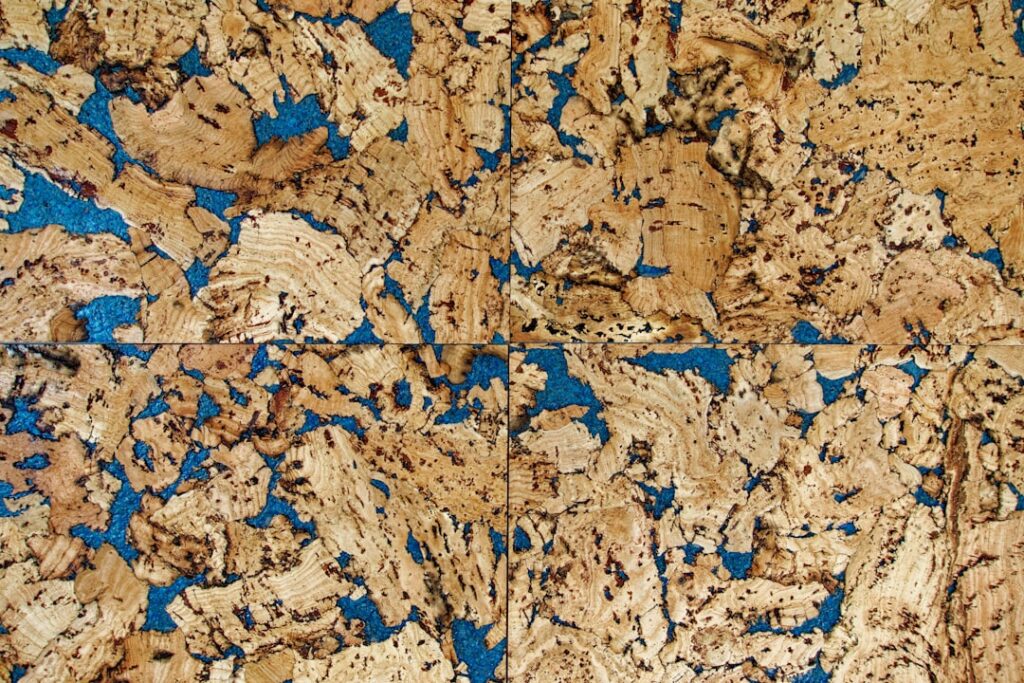
Cork ranges from pale champagne to espresso brown depending on the species and the finishing process. Traditional cork shows a granular or burled pattern that reads as busy — fine in rustic or craftsman kitchens, overwhelming in modern spaces. Modern cork manufacturers also produce wood-look and stone-look visuals with digital print layers over cork cores. A plank with a white oak visual and a cork core gives you the look of hardwood with cork’s comfort properties.
Installation Notes for Kitchens
The subfloor must be flat within 3/16 inch over a 10 foot span — cork telegraphs every high spot under load. Install a 6 mil polyethylene vapor barrier under floating cork on concrete. Leave a 3/8 inch expansion gap around the perimeter and at all transitions, hidden with quarter round or base shoe. Cut openings around dishwasher, refrigerator, and range with 1/2 inch clearance for appliance pull-out and service.
Plan to replace toe-kick and base shoe after installation. New flooring height almost always changes the trim reveal by 5 to 12 mm.
Cost Breakdown for a Typical Kitchen
For a 180 sq ft kitchen:
- Budget build (engineered click-lock, DIY): $900 to $1,400 total
- Mid-range build (engineered click-lock, professional): $1,500 to $2,400 total
- Premium build (solid glue-down tile, professional with custom seal): $2,200 to $3,800 total
Compare that to porcelain tile at $2,700 to $4,500 installed in the same footprint and cork earns its place in the kitchen conversation.
Is a Cork Flooring Kitchen Right for You?
Yes, if you prioritize comfort, sound dampening, and warmth underfoot and you are willing to use felt pads, avoid direct sun, and re-seal every 5 to 7 years. No, if your kitchen doubles as a mudroom for wet boots, you own a large Saint Bernard, or you have a history of ignored dishwasher leaks. Cork is a premium-feel floor with a mid-range price and a demanding maintenance rhythm — get those three things aligned and it is one of the best kitchen floors on the market.
Prefer to explore on your own?
See how new flooring looks in your actual room in seconds — free, no signup.
Try the free Floor Studio →