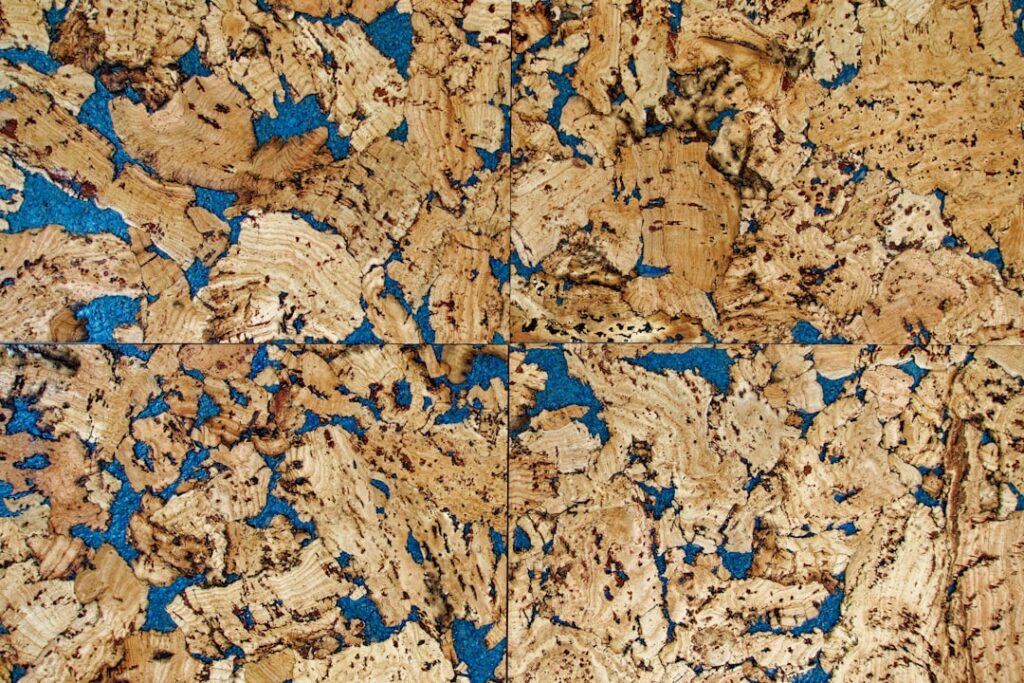
Walk into a third-floor condo with thick rugs and you might still hear your neighbor’s heels overhead. Walk into the same condo with proper acoustic underlayment beneath the hardwood and the room goes quiet. Cork flooring underlayment earned its place under engineered wood, laminate, and stone because compressed cork granules absorb both impact and airborne noise better than foam at the same thickness. The catch is that not every cork roll is built for the same job.
Why Cork Beats Foam Underlayment
Cork is closed-cell, naturally elastic, and recovers almost 100 percent from compression after years of foot traffic. That recovery is what stops floors from developing soft spots in front of the refrigerator or sofa. Standard 3 mm foam compresses and stays compressed, which is why click-lock laminate over old foam starts squeaking after five years.
The acoustic numbers tell the story. A 6 mm cork roll from Amorim or QEP delivers an Impact Insulation Class (IIC) rating in the 65 to 71 range when tested under engineered hardwood. Compare that to 3 mm foam underlayment, which usually scores 50 to 58 IIC.
Thickness Picks by Project
3 mm rolls suit residential floors over concrete or plywood where the subfloor is flat to within 3/16 inch over 10 feet. This is the most common thickness for floating laminate or engineered wood and runs about $0.45 to $0.75 per square foot.
6 mm rolls are the condo and HOA standard. They hit the IIC 60 to 65 threshold most building bylaws require and absorb the small subfloor imperfections that telegraph through thinner products. Cost: $0.75 to $1.40 per square foot.
12 mm sheets exist for podium-level commercial work, gymnasiums, and ballet studios. Most homeowners never need this. Expect $2 to $3 per square foot.
Vapor Barriers and Concrete Slabs
Cork is not waterproof. Install it over concrete and you need a 6 mil polyethylene sheet between the slab and the cork, with seams overlapped 8 inches and taped with house wrap tape. Skip the barrier and rising slab moisture will rot the cork from below in two to four years.
Some products come with a peel-and-stick PE film already laminated to the cork. QEP CorkSafe Pro and Roberts Super Felt Cork sell at this premium, around $1.10 to $1.50 per square foot, and they cut install time roughly in half on slab jobs.
What Cork Works Under
Cork pairs beautifully with floating engineered hardwood, laminate, and floating bamboo. It works under nail-down 3/4 inch solid hardwood only if the manufacturer specifically allows it, since the nails compress the cork around the staples and can loosen over time. Mohawk and Mannington both publish approved underlayment lists by SKU.
Under LVP or SPC, skip cork entirely. Vinyl plank floors are rigid, lock tight, and need a thin 1 mm to 1.5 mm pad that does not allow the joints to flex. Cork at 3 mm or more lets the click joints work loose under heavy point loads from a piano leg or refrigerator wheel.
STC vs IIC and Why Both Matter
Sound Transmission Class measures airborne sound: voices, TVs, barking dogs. Impact Insulation Class measures footstep impact. For multifamily housing, building codes usually require both numbers to clear 50 in the assembly. Cork underlayment punches well above its weight on IIC but adds only modest STC, so pair it with a resilient drywall ceiling for high-rise installs.
Independent lab reports from Riverbank Acoustical Laboratories or NGC Testing back the IIC numbers on Amorim and QEP product sheets. Always ask for the test report, not just the rating, before buying for a condo job.
Brand Picks Worth the Money
Amorim is the parent of most premium cork sold in North America. Their Acousticork S-Plus 3 mm is the everyday spec for residential laminate jobs. QEP Cork Underlayment is the value pick at big-box stores like Lowe’s and ships in 200 square foot rolls for around $90.
Roberts First Step Felt with cork-blend backing is technically a hybrid, not pure cork, but it adds vapor resistance and ships at $0.40 per square foot. For a kitchen-bath remodel where moisture exposure is real, the Roberts hybrid earns its keep.
Install Steps That Save You Trouble
Acclimate the cork in the install room for 72 hours at 60 to 80 degrees Fahrenheit and 35 to 65 percent relative humidity. Roll out the cork, leave a 1/4 inch gap at every wall, and butt seams (do not overlap). Tape the seams with linen tape or the brand-specified PE tape. Skip duct tape entirely, since the adhesive bleeds and stains the cork.
For nail-down installs, install the underlayment first and nail straight through it into the subfloor using the wood manufacturer’s required staple length. Most call for a 1-3/4 inch cleat with 6 mm of cork below.
Radiant Heat Compatibility
Cork works over radiant heat with one important caveat: the floor build must keep the top of the cork below 81 degrees Fahrenheit (27 degrees Celsius) per the Cork Quality Council guidelines. Above that temperature the cork stays stable but the wood floor above it can develop gaps and crowning.
For hydronic radiant systems, cap the supply water temperature at 110 degrees Fahrenheit and use 3 mm cork rather than 6 mm. The thinner product transmits heat faster and improves the system’s BTU output by 12 to 18 percent compared to thicker rolls. Confirm thermal resistance (R-value) on the product data sheet; most 3 mm cork rates R-0.3 to R-0.4, which radiant designers can compensate for.
Bottom Line for Buyers
Cork flooring underlayment is the right choice anytime sound matters, the floor floats, and the budget allows about $0.75 per square foot more than basic foam. For a 1,200 square foot condo install that is roughly $900 extra for a floor that stays quiet for the next 25 years. Hard to beat.
Prefer to explore on your own?
See how new flooring looks in your actual room in seconds — free, no signup.
Try the free Floor Studio →