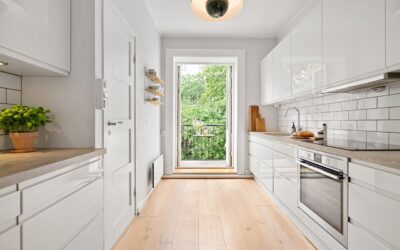
A corner pantry sits behind a 45-degree wall in the kitchen, eating up valuable cabinet runs but unlocking 12 to 20 cubic feet of storage that a row of upper cabinets simply cannot match. The catch is access. A standard swing door blocks the dishwasher when open. A pocket door eats into a wall that may not exist. Picking the right corner pantry door means matching swing geometry, framing constraints, and budget against what you actually store in there.
Part of our Kitchen Remodeling guide — explore the full guide →
- Standard Sizes That Fit Most Kitchens
- Swing Doors: Simple but Space-Hungry
- Bi-Fold Doors for Tight Spaces
- Sliding Barn Doors for Wide Openings
- Pocket Doors for the Cleanest Look
- Hardware Choices That Make or Break the Door
- Code and Clearance Requirements
- Frosted Glass and Decorative Options
- Quick Decision Matrix
Standard Sizes That Fit Most Kitchens
Builder-grade corner pantries use a 24-inch or 30-inch slab door on a 45-degree wall. The interior typically measures 36 to 48 inches deep on each leg, giving you 18 inches of usable shelf depth after you account for door swing and hardware clearance.
For new construction or major remodels, upsize the opening to 32 or 36 inches if your kitchen plan allows. Wider openings turn deep corner pantries from cramped to genuinely useful. Stock interior doors at Lowe’s or Home Depot range from $90 to $260 for a 6-panel hollow-core to a solid-core flat-panel.
Swing Doors: Simple but Space-Hungry
The most common and cheapest setup. A 30-inch slab on three 3.5-inch hinges, swinging out into the kitchen. Total install cost with prehung jamb and casing runs $250 to $500 depending on door style.
Plan the swing path before you commit. The door needs roughly 30 inches of unobstructed arc. If it blocks the dishwasher, fridge, or main walkway when open, you will hate it within a week. Reverse the swing direction during framing if necessary by spec’ing left-hand or right-hand hinging on the door order.
Bi-Fold Doors for Tight Spaces
Two-panel bi-folds cut swing depth roughly in half, projecting 15 inches into the kitchen instead of 30. They work especially well in galley kitchens where every inch of walkway matters. Johnson Hardware 100FD bi-fold tracks at $80, plus two 15-inch slab doors at $90 each, plus hinges and pivot pins at $35, total around $300 in materials.
Downsides: the visible track at the top, the slight wobble, and the limited width. Above 36 inches total opening, bi-folds start feeling flimsy. The seam down the middle also means slightly reduced clear opening width when entering.
Sliding Barn Doors for Wide Openings
Barn doors work brilliantly on corner pantries because they slide along the angled wall without needing any swing clearance. A 36-inch slab on a Real Sliding Hardware track at $280, plus the slab at $180 to $400 depending on style, totals $460 to $680.
The catch is the slab needs a parallel wall section equal to the door width plus 4 inches for the track stops. On a 45-degree corner pantry, that means the door slides over either the upper cabinets or a stretch of blank wall. Measure carefully before ordering. Vintage Industrial Home and Rustica both stock barn-door kits sized specifically for kitchen pantries.
Pocket Doors for the Cleanest Look
A pocket door disappears entirely into the wall when open, giving you a flush opening with zero swing intrusion. The Johnson 1500 series pocket frame at $180 fits a 30-inch door inside a standard 2×4 wall cavity. Add the door at $200 to $500 and finish trim at $80 for a total of $460 to $760.
Pocket doors only work if you have a sacrificial wall cavity at least 60 inches wide (door width plus equal pocket depth) with no plumbing, ductwork, or major electrical inside. They are easiest to install during framing, awkward and expensive as a retrofit ($1,200 to $1,800 with drywall repair).
Hardware Choices That Make or Break the Door
Hinges matter more than people realize. Standard residential hinges (Stanley 1502 at $4 each) work for hollow-core doors. For solid-core or glass-panel doors over 30 pounds, upgrade to ball-bearing hinges like Hager BB1191 at $11 each to prevent sag.
- Door knobs: $20 to $80 for passage sets, no locking mechanism needed
- Door pulls: $30 to $150 for barn-door and sliding installations
- Soft-close bumpers: $8 for a pair, prevents slamming and protects food storage
- Magnetic catches: $4 each, keeps the door from drifting open
- Door bottom sweep: $12, blocks pantry pests from entering at floor level
For families with kids, add a Safety 1st Adhesive Magnet Lock at $25 a pair to keep curious hands out of the snack shelves without drilling new hardware holes.
Code and Clearance Requirements
The 2024 IRC does not regulate pantry doors specifically, but kitchen egress requirements still apply. Section R311.2 requires a 36-inch clear path between fixed elements in the primary kitchen circulation route. If a swing door blocks this path when open, you have created a code violation that could bite you at resale.
Plan the door swing during the cabinet layout phase. A good kitchen designer can model the door arc against the appliance package using 2020 Design or Chief Architect software and catch interference issues before drywall goes up. Fixing it after is expensive.
Frosted Glass and Decorative Options
For homeowners who want light bouncing into the corner pantry without exposing the inside contents, frosted or reeded glass panels add visual interest. ETO Doors and TruStile both offer 5-panel doors with a single full-light frosted insert in the top panel for $380 to $620.
Reeded fluted glass has become especially popular for transitional and modern farmhouse kitchens. It hides the contents but still reads as luxurious. Pair with brushed brass hardware (Schoolhouse Electric or Rejuvenation knobs at $60 to $110) and the corner pantry becomes a feature, not a closet to hide.
Quick Decision Matrix
For tight galley kitchens, choose bi-fold or pocket. For open-concept kitchens with room to swing, choose a single hinged slab or a barn door. For new construction, plan a pocket from day one. For retrofits in finished kitchens, the cheapest improvement is upgrading the existing slab to a glass-panel solid-core door and adding a brass knob, total under $400 in a weekend.