
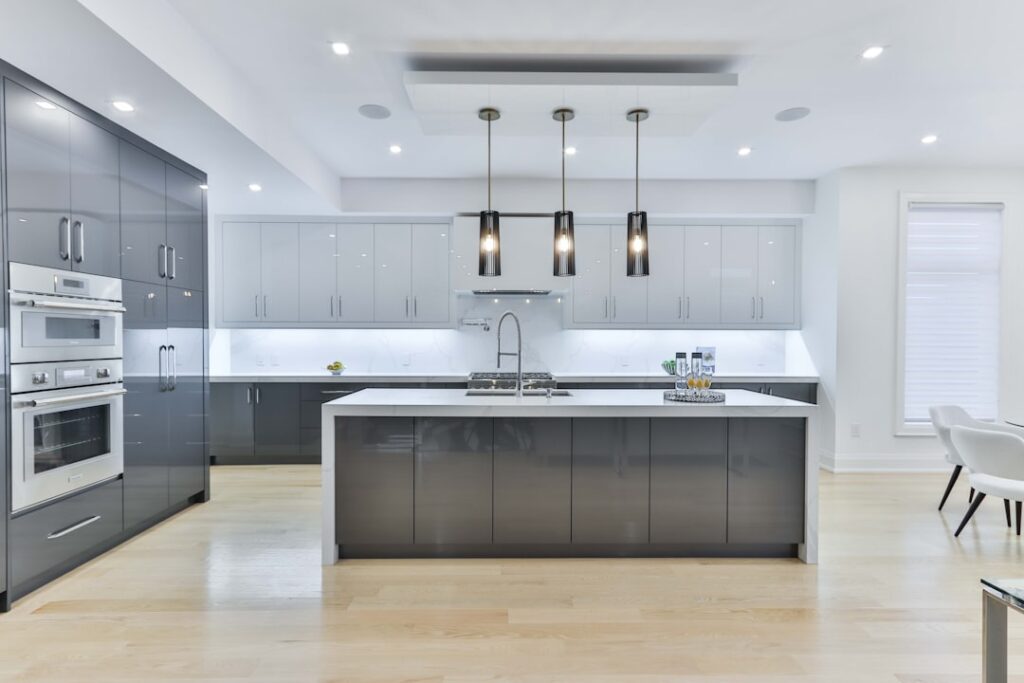
Few upgrades change a kitchen’s look as cheaply as new pantry cabinet doors. The box behind them is usually fine, so swapping just the fronts gives you a fresh face for a fraction of a full remodel. I have re-doored dozens of pantries, and the project succeeds or fails on two things: picking the right style and measuring correctly.
Part of our Kitchen Remodeling guide — explore the full guide →
Whether you are replacing a warped slab or dressing up a builder-grade closet, pantry cabinet doors come in more styles, materials, and sizes than most people expect. Here is how to sort through them and get doors that fit the first time.
Shaker Doors
The default choice for good reason. A shaker door is a flat recessed center panel framed by a squared-off rail and stile. It reads clean in a modern kitchen and traditional in a farmhouse, which is why it never goes out of style. On a pantry, shaker doors paint beautifully and hide fingerprints better than glossy slabs.
- Best for: Almost any kitchen; the safe, resale-friendly pick.
- Cost: $40 to $120 per door in MDF or paint-grade; $120 to $250 in solid wood.
Glass-Front Doors
Glass pantry doors put your dishes and jars on display, which is either a feature or a chore depending on how tidy you keep things. Clear glass shows everything; frosted, seeded, or reeded glass gives light and depth while hiding clutter. I steer busy families toward frosted so the pantry does not have to be Instagram-perfect.
- Best for: Showing off dishware, brightening a dark corner, breaking up a wall of solid fronts.
- Cost: $90 to $300 per door depending on glass type and frame material.
Louvered and Slatted Doors
Angled horizontal slats give a pantry airflow, which matters if you store potatoes, onions, or anything that needs to breathe. Louvered doors also bring a coastal or cottage vibe. The downside is dusting, because every slat catches it.
- Best for: Ventilated storage, cottage and coastal styles, hiding a water heater or utility closet.
- Cost: $50 to $180 per door; solid-wood louvers run higher.
Barn, Sliding, and Bi-Fold Doors
For a walk-in pantry rather than a cabinet, a sliding barn door saves the floor space a swinging door would eat. It becomes a design centerpiece too. Hardware quality matters here, because a cheap track rattles and jumps.
- Best for: Walk-in pantry openings 30 to 42 inches wide; tight kitchens where a swing door is in the way.
- Cost: $150 to $500 for the door, plus $60 to $200 for a solid track kit.
Bi-fold panels fold in half on a track, so they open a wide pantry closet without projecting far into the room. They are the classic reach-in-pantry solution. Modern versions with soft-close pivots feel far better than the flimsy hollow-core folds from the 1980s.
- Best for: Wide reach-in pantry closets, 36 to 48 inches, in tight kitchens.
- Cost: $70 to $250 per set depending on material and hardware.
Materials That Hold Up
Material drives both look and longevity. Here is how the common options stack up for a pantry:
- MDF: Dead-flat, never warps, takes paint perfectly. The best value for painted shaker doors.
- Solid wood: Warm, durable, stainable, but can shift with humidity and costs the most.
- Plywood with veneer: Stable and lighter than solid wood, good for stained looks.
- Thermofoil: A vinyl film over MDF, cheap and wipeable, but it can peel near heat and is hard to repair.
For a painted pantry, I reach for MDF nearly every time. It stays flat over a tall span where solid wood is most likely to cup.
How to Measure for Replacement Doors
This is where projects go sideways, so measure twice. Cabinets use either full-overlay, partial-overlay, or inset doors, and each measures differently. For the most common overlay pantry:
- Measure the height and width of the existing door, not the cabinet opening, to the nearest sixteenth of an inch.
- Check the hinge type: European cup hinges bore a 35mm hole; face-frame hinges mount differently. Match it.
- Note the overlay, meaning how far the door covers the frame, typically half an inch on each side.
- For a tall pantry over 40 inches, confirm you need one door or a pair, since very tall single doors can warp and bind.
Standard pantry door heights run from 30 inches up to 90-plus inches for a full-height utility pantry. Widths for a single door usually top out around 24 inches; anything wider is better as a pair of doors to keep them from sagging on the hinges.
If your pantry box is solid and level, replacing only the doors, called refacing when you also re-skin the frame, saves 50 to 70 percent versus new cabinetry. A full set of quality pantry cabinet doors and new hinges might run $200 to $800 installed, against several thousand for a new pantry cabinet. Swap the doors, add new latch hardware and soft-close hinges, and a tired pantry looks new for a weekend’s work. Just get those measurements right, and the rest is the easy part.
Finishes, Color, and Hinges
Once the style is settled, finish is the next decision, and it changes both the look and the upkeep. Painted doors in white, greige, or a deep navy read clean and modern, but they show scuffs and chips more than stained wood, and touch-ups have to match exactly. A factory-sprayed conversion-varnish finish holds up far better than a brush-painted door, so if you are buying paint-grade, pay for a sprayed finish if you can.
Stained wood hides wear and fingerprints better and brings warmth to a kitchen, but it locks you into that wood tone for years. Two-tone kitchens, where the pantry gets an accent color different from the base cabinets, have stayed popular because a tall pantry is the natural spot to make a statement without overwhelming the room. Whatever you pick, buy a sample door or a finished color chip and look at it in your actual kitchen light before ordering the full set.
New doors deserve new hinges. Reusing old, worn hinges on fresh fronts is a false economy, because a sagging hinge makes a beautiful new door hang crooked. Budget for these alongside the doors themselves:
- Soft-close concealed hinges: $3 to $8 per hinge; two per standard door, three on a tall pantry door.
- Knobs or pulls: $3 to $15 each depending on finish and brand.
- Bumpers and catches: a couple of dollars to keep doors from banging and drifting.
A tall pantry door over 40 inches should ride on at least three hinges to distribute the weight and stop it from twisting. Skimp here and the door binds against the frame within a season.
DIY vs Hiring a Pro
Swapping overlay pantry cabinet doors is one of the most DIY-friendly kitchen jobs there is. If you can measure to a sixteenth of an inch, run a drill, and use a self-centering bit for the hinge screws, you can do a whole pantry in an afternoon. The learning curve is real only on inset doors, where the reveal around all four edges has to be dead even, and on custom-bored European hinges that require a 35mm Forstner bit and a drill press or jig for clean results.
Hire a cabinet installer if the boxes are out of square, if you are moving to a different overlay or hinge system, or if the doors are large, heavy, or expensive enough that a bad bore ruins a costly piece. Expect a pro to charge $75 to $150 per door for a straightforward swap, more if there is filling, sanding, and refinishing involved. For a like-for-like overlay swap, though, save the labor and do it yourself.
One planning tip that saves headaches: order all your doors together from a single run so the color and grain match, then dry-fit every door before you drill a single hinge hole. Hang them, step back, and check the reveals across the whole pantry before committing. The measurements are the whole game, and if you nail those, new pantry cabinet doors are one of the highest-impact, lowest-cost upgrades in the entire kitchen.


