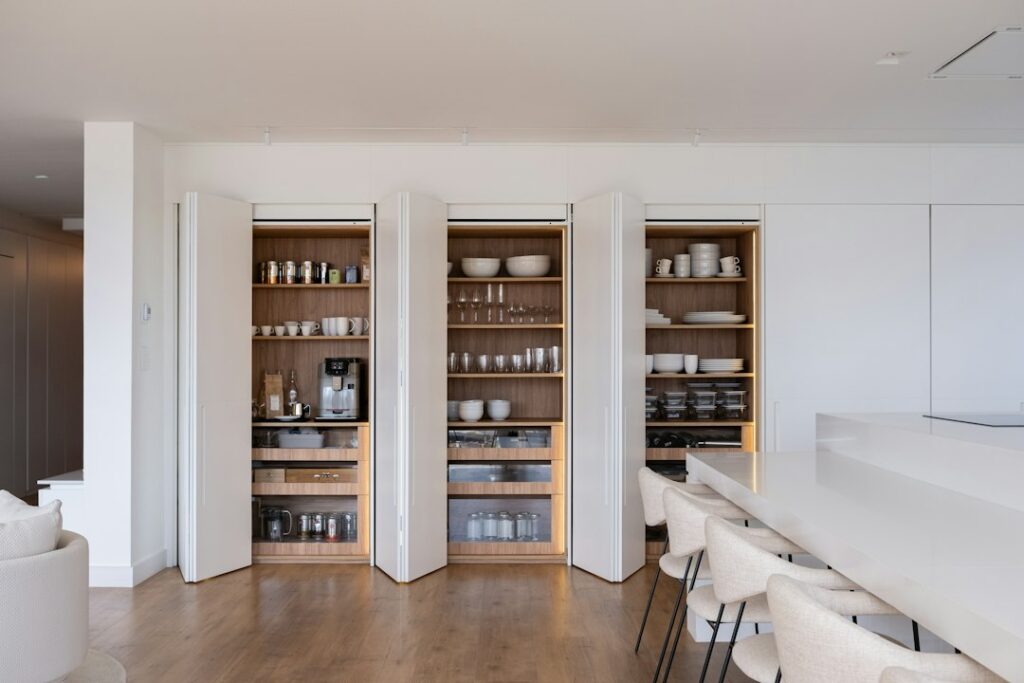
The difference between a pantry that swallows your groceries and one that hides them in a black hole comes down to how it’s fitted out inside. A custom kitchen pantry cabinet is built to your exact wall space and stocking habits, turning wasted corners and awkward gaps into organized, reach-everything storage. Unlike a stock unit, a custom kitchen pantry cabinet lets you dictate the shelf spacing, pull-out drawers, and door style so nothing gets lost in the back.
Part of our Kitchen Remodeling guide — explore the full guide →
Whether you’re filling a narrow filler space or building a floor-to-ceiling wall of provisions, the payoff is real usable capacity. This guide covers layouts, interior options, materials, sizing, and what it costs.
Why Go Custom Instead of Stock
Stock pantry cabinets come in fixed widths, usually 12, 15, 18, 24, and 30 inches, and standard interior configurations. That’s fine until your available space is 21 inches, or your ceiling is 9 feet and a stock 84-inch cabinet leaves a foot of dead space above it. Custom solves the fit problem and, more importantly, the function problem.
With custom, you decide how many shelves, how far apart, whether they pull out, and how deep. You can build in tall slots for baking sheets, a spice rack on the door back, and a bottom bank of deep drawers for bulk items. That tailored interior is where custom earns its premium, because it eliminates the wasted vertical air that plagues fixed-shelf cabinets.
Popular Pantry Layouts
The right configuration depends on your space and how you cook.
- Tall single cabinet: A floor-to-ceiling column, typically 84 to 96 inches high, packing maximum storage into a narrow footprint. Ideal for filling a gap beside a refrigerator.
- Pull-out pantry: Narrow full-height cabinet with slide-out shelving racks accessible from both sides, perfect for tight 8 to 18-inch slots.
- Wall of pantry cabinets: A run of tall cabinets covering an entire wall for large kitchens and serious cooks.
- Corner pantry: Uses an otherwise dead corner, sometimes with a diagonal door or a lazy Susan inside.
- Base pantry with drawers: A lower run of deep drawers where heavy items live at an easy-to-reach height.
For most kitchens, a tall cabinet with pull-out shelves delivers the best combination of capacity and access, because you bring the back of the shelf to you instead of digging.
Interior Options That Make the Difference
The inside is where a custom pantry justifies itself. Prioritize these features.
- Pull-out shelves or roll-out trays: Full-extension slides bring everything into view; the single best upgrade for usability.
- Adjustable shelving: Shelf pins on a 32mm system let you reconfigure spacing as your needs change.
- Deep drawers at the base: For canned goods, bags, and small appliances at a no-bend height.
- Door-mounted racks: Shallow spice and can racks on the door backs reclaim otherwise dead space.
- Vertical dividers: Slots for trays, cutting boards, and baking sheets standing on edge.
- Lighting: LED strips or motion-activated puck lights so you can actually see to the back.
Full-extension, soft-close slides from brands like Blum or Rev-A-Shelf are worth the upgrade; they carry heavy loads smoothly and last for decades of daily pulls.
Materials and Construction
A pantry holds serious weight, so the box construction matters. Choose plywood cabinet boxes over particleboard; plywood resists sagging under canned goods and holds screws far better, especially for full-extension slides that put leverage on the sides. Solid wood or plywood shelves at least 3/4 inch thick prevent the bowing that thin melamine shelves develop under load.
For the doors and face, match your kitchen. Shaker doors are the most versatile and popular, painted or in natural wood. If budget is tight, a semi-custom route using stock boxes with a custom interior fit-out captures much of the benefit for less than full custom cabinetry.
Sizing Your Pantry Cabinet
Get the dimensions right and the pantry disappears into the kitchen seamlessly.
- Measure the available width, height, and depth precisely, accounting for adjacent cabinets, appliances, and trim.
- Standard pantry depth is 24 inches to match base cabinets, but 12 to 16-inch shallow pantries keep items visible and are great for canned goods.
- Set shelf spacing to your tallest common items; cereal boxes want about 12 inches, small cans only 7 to 8, so vary the spacing.
- Plan the tallest cabinet to reach near the ceiling, adding a crown or filler to close the gap for a built-in look.
Shallower shelves near eye level and deeper drawers down low is the ergonomic sweet spot; you see the shallow stuff and don’t lose items behind a deep shelf.
What a Custom Pantry Costs
Pricing spans a wide range with the level of customization.
- Semi-custom (stock box, upgraded interior): $300 to $900 per tall cabinet.
- Full custom cabinetry: $1,000 to $3,500-plus per tall pantry depending on wood, finish, and hardware.
- Pull-out shelf and organizer add-ons: $50 to $250 each installed.
- Professional design and installation: adds labor, often $500 to $2,000 for a full wall.
A single tall custom pantry with good pull-outs typically lands around $1,200 to $2,500 installed, which many homeowners find worth it for the daily convenience and the resale appeal of organized storage.
Pull-Out Pantry Systems Explained
Among all the configurations, the pull-out pantry deserves a closer look because it solves the toughest storage problem: narrow gaps and deep, dark cabinets where items vanish. A pull-out pantry is a tall, narrow cabinet whose entire interior slides out on heavy-duty rails, giving you access to both sides of the shelving at once.
- Full-height slide-out: The whole rack rolls out, with wire or wood shelves accessible from both sides. Best for slots 8 to 18 inches wide beside a fridge or range.
- Base pull-out pantry: A shorter version in a base cabinet, ideal for oils, spices, and cans at counter height.
- Swing-out systems: Shelves that swing out and to the side, common in corner and blind-corner cabinets to reclaim dead space.
Because these units carry serious weight when loaded, the slide hardware has to be rated for it. Look for full-extension slides rated 100 pounds or more per pair, and confirm the cabinet box is plywood so the rails have something solid to anchor to. A well-built pull-out pantry can hold a startling amount in a footprint under a foot wide.
Planning for Ventilation and Access
A few practical details separate a pantry that works from one that frustrates. Ventilation matters if you store produce like potatoes and onions; a slotted or wire shelf, or a section with a vented bin, keeps air moving and food fresher. Solid shelving is fine for cans and boxes but can trap humidity around fresh items.
Access is the other consideration. Plan the door swing so it doesn’t collide with an adjacent appliance or block a walkway when open; in tight kitchens, a pull-out or a bifold pantry door avoids a wide swing. Set the most-used items between knee and shoulder height, the easiest reach zone, and reserve the very top and very bottom for lighter or rarely used goods. Adding interior lighting, even a simple battery-powered motion puck, transforms a deep pantry from a cave into a space where you can actually see what you have.
DIY vs. Hiring a Pro
Whether to build it yourself or hire out depends on your skills and the complexity. A handy DIYer can absolutely fit out a stock tall cabinet with aftermarket pull-out shelves, door racks, and organizers from brands like Rev-A-Shelf, capturing most of the custom benefit for a few hundred dollars in parts. Retrofitting slide-out trays into an existing pantry is a weekend project with a drill and basic tools.
Full custom cabinetry, with a made-to-measure box, matched doors, and integrated features, is generally a job for a cabinetmaker or a kitchen contractor, both for the fabrication and for a clean, built-in installation that ties into the surrounding cabinetry. If your goal is a seamless look that matches the rest of the kitchen exactly, hire a pro; if you mainly want better function inside an existing space, the DIY organizer route delivers most of the payoff for far less.
Making It Work Long Term
Design for how you actually shop. Group like items on dedicated shelves, keep heavy and bulk goods low in drawers, and reserve eye-level shallow shelves for the things you grab daily. Add a small step stool for the top reaches, and consider clear bins on the pull-outs so you can see contents at a glance.
Done right, a custom kitchen pantry cabinet turns cramped, cluttered food storage into a system where every item has a place and nothing expires forgotten in the back. Fit it to your exact space, invest in full-extension pull-outs and plywood construction, and you’ll have storage that works harder than any stock cabinet ever could.