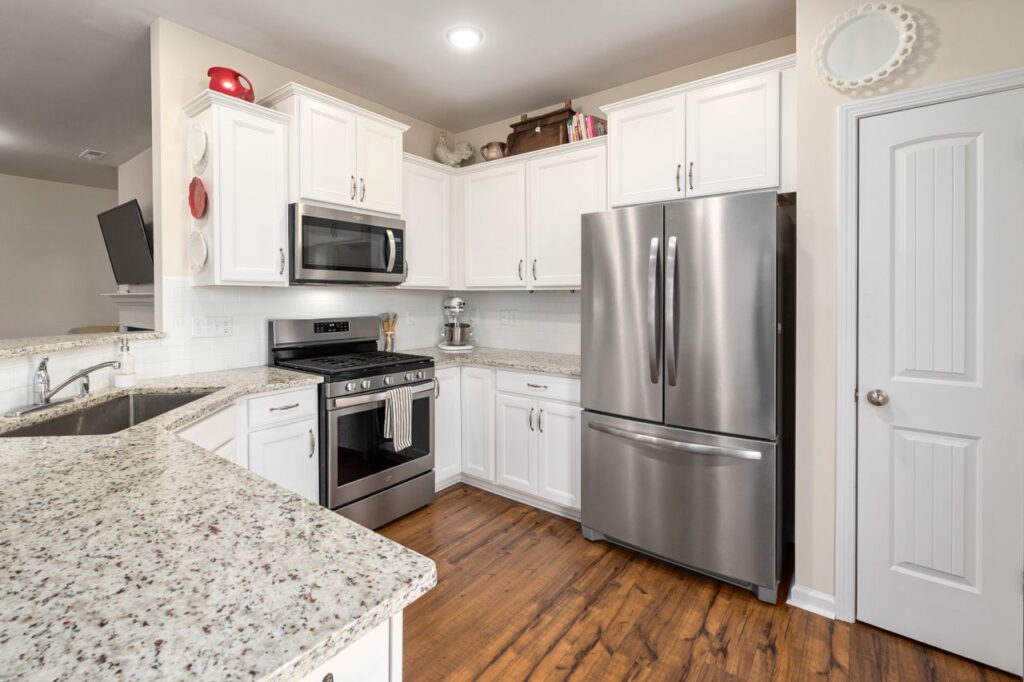
If you want that sleek, built-in look without paying for a true built-in unit, a counter-depth model is the answer — but only if you know the numbers before you buy. Countertop depth refrigerator dimensions are designed so the fridge body sits roughly flush with your cabinets and countertops instead of jutting a foot into the kitchen. The catch is that “counter depth” describes the cabinet box depth, not the total depth with doors and handles, and that distinction trips up a lot of homeowners at the appliance store. Here is everything you need to measure and choose correctly.
Part of our Countertops guide — explore the full guide →
What Counter Depth Actually Means
A standard countertop is about 25.5 inches deep — that includes the 24-inch base cabinet plus a small counter overhang. A counter-depth refrigerator is engineered so the main cabinet (the insulated body) is shallow enough to align with that surface, typically 23 to 25 inches deep. Compared with a standard-depth fridge that runs 30 to 36 inches deep and sticks out well past the cabinets, the counter-depth version reads as flush and intentional.
The trade-off is interior volume. Because counter-depth models are shallower front to back, they hold less and tend to be wider and taller to compensate. Expect 18 to 25 cubic feet of capacity versus 22 to 31 cubic feet in a comparable standard-depth unit.
The Real Numbers: Depth, Width, and Height
Here is the typical range for counter-depth refrigerators across the major brands:
- Body depth (without doors): 23 to 25 inches — this is the spec that makes it “counter depth.”
- Total depth (with doors closed): 27 to 30 inches once you add the doors and handles.
- Total depth (doors open 90 degrees): 44 to 49 inches, which matters for clearance.
- Width: 30 to 36 inches, with 36 inches being the most common for French-door models.
- Height: 67 to 71 inches, tall enough to align with the top of upper-cabinet runs in many kitchens.
Notice that the doors and handles always add a few inches beyond the cabinet line. A unit advertised as 24 inches deep will still protrude a couple of inches because the doors and handle sit proud of the counter. That slight overhang is normal and expected.
Counter Depth vs. Standard Depth
The decision comes down to looks versus storage. A standard-depth fridge gives you more room inside for the same width and usually costs less, but it bumps out 6 inches or more past your cabinets, which can feel bulky in a galley kitchen and partially block walkways. A counter-depth model costs more — often $300 to $1,000 more for an equivalent feature set — and stores a bit less, but it looks tailored and keeps traffic paths clear.
If your kitchen is tight or open to a living area where the fridge is on display, counter depth is usually worth the premium. If you have a deep pantry-style alcove and storage is your priority, standard depth makes more sense.
How to Measure Your Opening
Measure three dimensions of the cabinet or wall opening and write them all down. For width, measure between the cabinets at the narrowest point, not just at the front. For height, measure from the floor to the underside of any upper cabinet or soffit. For depth, measure from the back wall to the front edge of your countertop.
Then subtract for clearances. You need roughly 1 inch of air gap behind the fridge for the coils to vent, plus about 1/8 inch on each side and 1 inch on top so the unit slides in and the doors clear adjacent walls. A fridge crammed in with zero clearance runs hot and shortens compressor life.
Door Swing and Clearance
The dimension homeowners forget is how far the doors and drawers project when open. A French-door counter-depth fridge needs 44 to 49 inches of total depth with the doors open at 90 degrees, and the bottom freezer drawer pulls out 20 to 24 inches. If an island or opposing cabinet sits closer than that, the drawer or crisper bins will jam against it.
Check the door swing against adjacent walls too. When a refrigerator is installed right next to a perpendicular wall, the door may not open past 90 degrees, which prevents the interior shelves and bins from pulling out fully. Manufacturers sell flush-mount hinge kits or you can add a 1- to 2-inch filler panel to gain the needed swing room.
Choosing the Right Configuration
Counter-depth comes in several layouts, and each fits a different kitchen. French-door models (two doors over a freezer drawer) are the most popular at 33 to 36 inches wide. Side-by-side units split the width into a tall fridge and freezer, which works in narrow spaces but gives you skinnier shelves. Four-door and door-in-door models add flexibility but raise the price.
For a kitchen with a 36-inch opening, a 35.75-inch-wide French-door counter-depth fridge gives you the cleanest built-in look. Always confirm the exact spec sheet for the specific model — dimensions vary by a half inch or more between brands, and that half inch decides whether the fridge slides in flush or sticks out.
Built-In vs. Counter Depth
It helps to know where counter-depth sits between standard and true built-in units. A genuine built-in refrigerator is even shallower — around 24 inches total including doors — and stands taller at 80 to 84 inches so it aligns with full-height cabinetry. Built-ins are designed to be flush-mounted with custom cabinet panels and trim kits, and they cost $7,000 to $15,000 or more.
Counter-depth is the budget-friendly middle ground. It delivers most of the flush look for a fraction of the price, usually $1,800 to $4,000 for a quality model, while still installing as a standard freestanding unit. For the vast majority of kitchens, counter-depth gives the built-in aesthetic without the built-in invoice.
Going shallow costs you interior room, so plan around it. Where a 36-inch standard-depth French-door fridge might offer 27 cubic feet, the counter-depth equivalent in the same width usually lands around 21 to 23 cubic feet. That difference shows up most in the freezer drawer and the rear of the shelves, where deep platters and large stockpots no longer fit as easily.
To compensate, look for smart interior layouts — adjustable spill-proof shelves, full-width deli drawers, and door bins deep enough for gallon jugs. A well-organized 22-cubic-foot counter-depth box often feels roomier in daily use than a poorly laid-out standard-depth unit, so weigh the usable space, not just the headline capacity number.
Final Planning Tips
Order the spec sheet from the manufacturer’s website before you buy and compare its width, height, total depth, and door-open depth against your measured opening. Confirm the water and ice line, the electrical outlet, and the venting gap are accounted for behind the unit. Get those countertop depth refrigerator dimensions right on paper, and your new fridge will sit flush with the cabinets, clear every door swing, and look like it was built into the kitchen from day one.