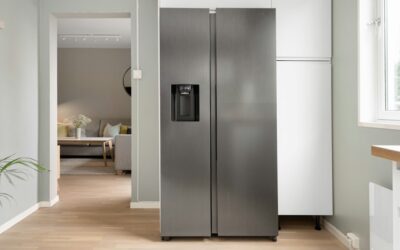
Most people shopping for a new fridge measure the width of the opening and stop there, then discover on delivery day that the doors hit an island or the case sticks out past the counters by six inches. Getting side by side refrigerator dimensions right means checking width, height, depth and door swing together. A typical full-size model is 33 to 36 inches wide, 66 to 71 inches tall and 29 to 36 inches deep with the doors attached, holding roughly 21 to 28 cubic feet.
Those ranges cover the vast majority of units sold in the US. Counter-depth versions trim the depth to about 24 to 25 inches of case (around 28 to 31 inches including doors and handles), which looks built-in but gives up a few cubic feet of storage. Because the freezer and fresh food compartments sit next to each other with two narrow doors, this style needs less swing room in front than a French door or top-freezer model of the same width, which is why it remains popular in galley kitchens.
- Standard Side by Side Refrigerator Dimensions by Width
- Door Swing and Galley Kitchen Fit
- Clearances Around the Case
- How to Measure for a Side by Side Fridge
- Floor Protection and Leveling
- Electrical and Water Line Requirements
- Troubleshooting Common Fit Problems
- General Cost Ranges
- When to Call a Pro
- Side by Side Large Refrigerator Options and Double Fridge Dimensions
- Frequently Asked Questions
Width gets most of the attention, but height under the upper cabinets and depth past the counter edge cause just as many returns. Treat side by side refrigerator dimensions as a set of three numbers plus door swing, and check each one against your kitchen before you order.
Standard Side by Side Refrigerator Dimensions by Width
Manufacturers build this style in a handful of nominal widths. The actual case is usually a fraction of an inch narrower than the label, so a “36-inch” model often measures 35.75 to 35.9 inches. Always confirm the spec sheet, but these general figures hold across most brands:
| Nominal width | Typical height | Depth with doors | Capacity |
|---|---|---|---|
| 33 inches | 66 to 70 inches | 29 to 33 inches | 20 to 23 cu ft |
| 36 inches (standard depth) | 69 to 71 inches | 33 to 36 inches | 25 to 28 cu ft |
| 36 inches (counter depth) | 69 to 71 inches | 28 to 31 inches | 20 to 23 cu ft |
| 42 to 48 inches (built-in) | 83 to 84 inches | 24 to 26 inches | 25 to 30 cu ft |
The 36-inch standard-depth unit is the most common size, and it is what most people mean when they search for standard side by side refrigerator dimensions. Built-in models at 42 and 48 inches are a separate category: they are taller, designed to sit flush with cabinetry, and usually require a custom opening and professional installation.
Height Considerations
Height matters most when you have upper cabinets over the fridge. Standard wall cabinets mounted at 54 inches off the floor with a 15-inch cabinet over the fridge often leave an opening of 69 to 70 inches. A tall 71-inch model with hinge caps may not slide in. Measure to the lowest point of the cabinet face frame, not the cabinet box.
Depth and Handles
Spec sheets list depth several ways: case only, with doors, and with handles. Side by side fridge measurements for depth “with handles” are what matter for walkways, because handles can add 2 to 3 inches. If you want the front of the doors roughly flush with a standard 25-inch-deep countertop, a counter-depth unit is the only realistic choice.
Door Swing and Galley Kitchen Fit
The biggest practical advantage of this layout is the narrow door. On a 36-inch model each door is only about 15 to 20 inches wide, so it needs much less clearance when open than the single 33- to 36-inch door on a top-freezer fridge. In a galley kitchen with 42 inches between counters, that difference decides whether you can open the fridge while someone is standing at the sink behind you.
Keep these numbers in mind:
- Front clearance: plan for at least 30 to 36 inches in front of the fridge so the doors open fully and you can stand in front of them.
- Doors fully open: many models need the doors to open past 90 degrees for crisper drawers and shelves to slide out. Check the “doors open” width on the spec sheet.
- Side wall: if a wall sits right beside the hinge side, leave 2 to 4 inches or more so the door can swing wide enough to clear the bins. Some models list a “zero clearance” hinge, but most do not.
The trade-off is that the freezer and refrigerator sections are both narrow and tall. A frozen pizza box or a large sheet tray may not fit flat in the freezer side of a 33-inch model. If you regularly store wide platters, measure your largest item against the interior width listed on the spec sheet, which is often only 10 to 12 inches on the freezer side.
Clearances Around the Case
A refrigerator needs room to breathe. The compressor and condenser shed heat, and a fridge jammed tight into an opening runs longer, uses more power and can wear out sooner. General guidance, which you should confirm against your model’s installation guide:
- Top: about 1 inch between the top of the case (or hinge caps) and the cabinet above.
- Sides: 1/8 to 1/2 inch on each side for most freestanding models.
- Back: about 1 to 2 inches, plus space for the water line loop and the power cord plug.
Add these clearances to the published side by side refrigerator dimensions to get the minimum opening. For a 35.75 by 70 by 29.5-inch case (without doors), you would want an opening of roughly 36.25 inches wide and 71 inches tall, with the wall at least 31 inches behind the front edge of the doors. Side by side fridge size charts from retailers sometimes show the required cutout directly, which saves the math.
How to Measure for a Side by Side Fridge
A tape measure works, but a laser distance measure makes it easy to get consistent height readings in a tight cabinet opening, especially when you are working alone. Gather a tape, a notepad, a level and a flashlight, then follow these steps:
- Measure width at three heights. Take the width at the floor, the middle and just under the upper cabinet. Walls and cabinet sides are rarely perfectly plumb; use the smallest number.
- Measure height at both sides and the center. Floors slope, especially in older homes. Use the lowest reading.
- Measure depth. Go from the back wall to the front edge of the countertop, then note any baseboard, outlet box or water valve that sticks out from the wall.
- Check the floor. Place a level on the floor of the opening. A slope of more than about 1/4 inch side to side may exceed the leveling legs’ range.
- Measure the delivery path. Front door, interior doors, hallway turns and stairs all need to clear the fridge’s depth without doors. Removing the doors often reduces depth by 4 to 6 inches.
- Compare to the spec sheet. Subtract required clearances from your opening. If the margin is under 1/4 inch on any dimension, choose a smaller model.
Floor Protection and Leveling
A loaded side-by-side refrigerator can weigh 300 to 400 pounds, and most of that weight rides on small front rollers or leveling legs. Rolling one across a new floor is a common way to scratch hardwood, dent luxury vinyl plank or crack a tile with a hollow spot underneath.
Before delivery, lay down a strip of 1/4-inch hardboard or a sheet of plywood from the doorway to the opening. Once the fridge is in place, consider a thin appliance mat or furniture cups under the front legs if you have soft flooring. On floating floors such as laminate or click vinyl, avoid pinning the floor under the cabinet run and fridge so tightly that it cannot expand; leave the expansion gap the flooring maker specifies at the walls behind the fridge.
Level the unit with the front slightly higher (about 1/4 inch) than the back so the doors swing closed on their own. Many models also need the two doors aligned at the top, which is done with an adjustment screw or shim on the lower hinge.
Electrical and Water Line Requirements
Most side-by-side models include an ice maker and through-door water dispenser, which means a water supply line and a standard 115-volt, 15- or 20-amp grounded outlet behind the unit. A few practical safety points apply here:
- Plug directly into the wall. Never run a refrigerator on an extension cord or power strip. The compressor’s startup draw can overheat lightweight cords.
- Dedicated circuit: many manufacturers recommend a dedicated circuit. If your kitchen does not have one, or you need to move or add an outlet, hire a licensed electrician. New circuits and outlets are not a DIY job.
- Before touching the outlet or cord: turn off the breaker and confirm power is off with a non-contact voltage tester. Never test a live circuit with probes.
- GFCI: local code may require GFCI protection for kitchen receptacles. Your electrician can tell you what applies where you live.
- Water line: shut off the supply valve before connecting. Use a braided stainless supply line rather than thin plastic tubing, and leave a loose loop behind the fridge so it can be pulled forward for cleaning without kinking. If you need a new valve or line run, a licensed plumber is the safe call.
Troubleshooting Common Fit Problems
The fridge sits proud of the counters. Standard-depth models almost always stick out 6 to 10 inches past the counter. If that bothers you, the fix is a counter-depth model, or recessing the wall behind the fridge, which is a framing job.
Doors will not open far enough. A wall or tall pantry cabinet beside the hinge side blocks the swing. Look for models with a narrow-swing hinge, or reverse which side the opening sits on during a remodel. Unlike single-door fridges, side-by-side doors are not reversible.
The fridge runs constantly or feels hot on the sides. It likely lacks ventilation. Pull it forward an inch or two and check the top gap. Clean the condenser coils with the power off.
The case does not fit under the upper cabinet. Sometimes the only fix is to raise or remove the cabinet above the fridge. A carpenter can cut down the cabinet box or rehang it a few inches higher.
General Cost Ranges
Freestanding side-by-side models run from roughly the high hundreds for basic 33-inch units to a few thousand dollars for 36-inch counter-depth models with premium finishes. Built-in 42- and 48-inch units cost considerably more, often several times the price of a freestanding fridge, plus custom cabinetry. Delivery and haul-away usually add a modest fee; adding a water line or dedicated circuit adds a plumber or electrician service call, which varies widely by region.
When to Call a Pro
Most homeowners can measure, choose and slide in a freestanding unit. Bring in help when the opening needs to be enlarged, upper cabinets must be modified, a new water line or shutoff valve is needed, or there is no suitable outlet. Electrical work, including adding a circuit or moving a receptacle, should go to a licensed electrician, and plumbing changes to a licensed plumber. Built-in models almost always need professional installation to secure anti-tip brackets and align panels.
Side by Side Large Refrigerator Options and Double Fridge Dimensions
The largest freestanding side by side refrigerator is a 36-inch standard-depth model at about 25 to 28 cubic feet, while built-in 42- and 48-inch units reach about 25 to 30 cubic feet in a flush, taller case. If you need more space than that, a double fridge setup, two separate refrigerator and freezer columns installed next to each other, is the next step up.
What Counts as a Full Size Side by Side Fridge Freezer
Full size generally means a 36-inch-wide unit with the freezer running the full height on one side. In metric terms that is roughly 91 cm wide and 175 to 180 cm tall, and around 85 to 91 cm deep with doors for a standard-depth model. Smaller 33-inch versions exist but give up several cubic feet, mostly on the freezer side.
| Setup | Total width | Typical height | Approx. capacity |
|---|---|---|---|
| 36-inch freestanding side by side | About 36 inches | 69 to 71 inches | 25 to 28 cu ft |
| 42-inch built-in side by side | About 42 inches | 83 to 84 inches | About 25 cu ft |
| 48-inch built-in side by side | About 48 inches | 83 to 84 inches | About 30 cu ft |
| Double fridge column pair | About 48 to 72 inches | Often 84 inches | Varies with column widths |
Planning a Double Fridge Column Pair
Column units come in single-purpose widths, commonly 18, 24, 30 or 36 inches, so a large fridge freezer side by side can be built as, for example, a 30-inch fridge next to a 30-inch freezer. Double fridge size depends entirely on the pair you choose, which lets you give more room to fresh food or to frozen storage instead of the fixed split of a single unit.
- Columns are built-in appliances, so they usually need a custom cabinet opening, panels and professional installation.
- Each column has its own compressor, and many makers call for a separate outlet for each unit. Have a licensed electrician add circuits or receptacles.
- Some pairs need a trim kit or a small gap between columns to prevent condensation; check the installation guide.
Choosing Between Them
A 36-inch freestanding model is the practical choice for most kitchens since it slides into a standard opening. Go built-in or columns only when the cabinetry is being redone, and measure the delivery path carefully, because tall built-in units are heavy and awkward to move.
Frequently Asked Questions
What is the most common side by side fridge size?
The most common size is about 36 inches wide, 69 to 71 inches tall and 33 to 36 inches deep with doors, with roughly 25 to 28 cubic feet of capacity.
How much space do I need around a side by side refrigerator?
Plan on about 1 inch at the top, 1/8 to 1/2 inch on each side and 1 to 2 inches at the back, plus 30 to 36 inches of open floor in front for the doors.
Are side by side refrigerators good for small kitchens?
They work well in narrow galley kitchens because each door is only 15 to 20 inches wide, so they need less swing room than a full-width single door.
Will a side by side fridge fit through a standard door?
Usually, yes. Most interior doors are 30 to 32 inches wide, and removing the fridge doors and handles typically brings depth under 30 inches, but measure first.
Can a side by side fridge be plugged into an extension cord?
No. Plug it directly into a grounded wall outlet. If there is no suitable outlet, have a licensed electrician install one.