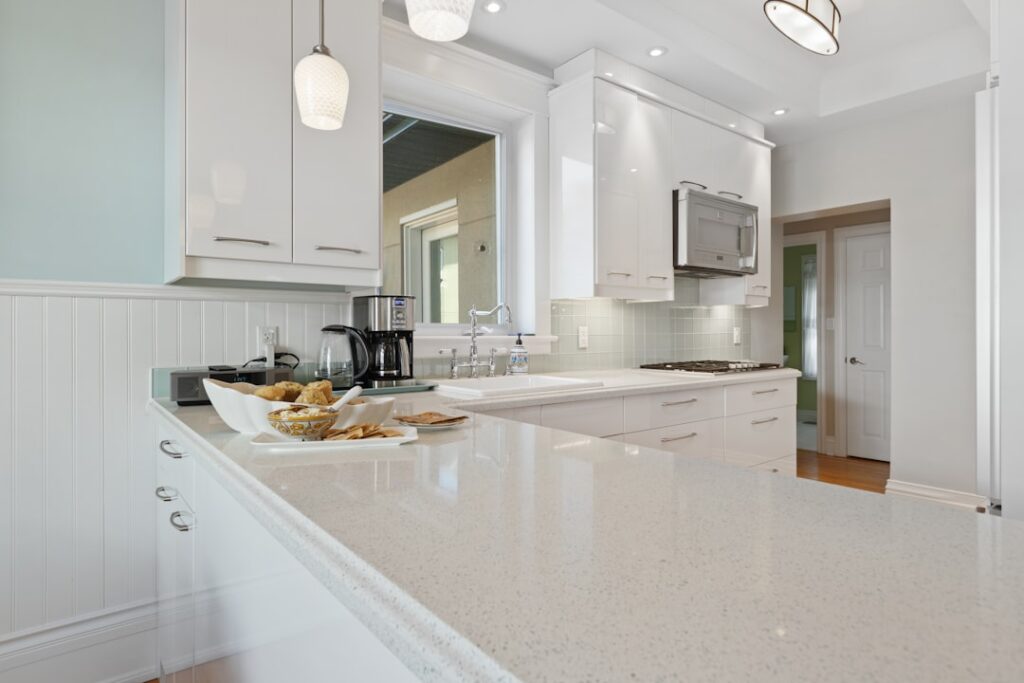
A countertop overlay is a thin slab of stone, quartz, or concrete that installs directly over your existing countertops. It gives you the look and feel of brand-new countertops at a fraction of the cost and disruption of full replacement. After decades of helping homeowners upgrade their kitchens, we have seen countertop overlays become one of the fastest-growing renovation options. This guide explains exactly what a countertop overlay is, what it costs, and whether it is the right choice for your kitchen.
Part of our Countertops guide — explore the full guide →
What Is a Countertop Overlay
A countertop overlay is a thin layer of material (typically 1cm to 1.5cm thick, compared to the standard 3cm for full slabs) that bonds directly to your existing countertop surface. The overlay covers the entire countertop including the edges, creating the appearance of a completely new countertop without the demolition, disposal, and extended timeline of full replacement.
Think of it like a veneer for your countertops. The existing countertop serves as the substrate, providing structural support. The overlay provides the new surface material, color, and finish. The result is a countertop that looks, feels, and performs like a full-thickness slab installation.
Countertop overlays work on most existing surfaces including laminate, solid surface, tile, and even older natural stone. The key requirement is that the existing countertop must be structurally sound, level, and firmly attached to the cabinets. Warped, water-damaged, or sagging countertops need replacement rather than overlay.
Countertop Overlay Materials
Several materials are available in thin-slab formats suitable for countertop overlay applications:
Granite overlay: Natural granite sliced to 1cm-1.5cm thickness. You get genuine granite beauty, veining, and color at reduced cost and weight. Granite overlays require sealing just like full-thickness granite countertops. Available in most granite colors and patterns.
Quartz overlay: Engineered quartz in thin-slab format. This is the most popular overlay option because quartz offers consistent color, zero maintenance, and excellent stain resistance. Major quartz brands including Caesarstone and Silestone offer thin-slab options specifically designed for overlay applications.
Concrete overlay: A cementitious coating applied in layers directly over the existing countertop. Concrete overlay is not a prefabricated slab but rather a poured or troweled mixture that cures in place. This option offers the most design flexibility with custom colors, textures, and embedded decorative elements. Thickness ranges from 1/8 inch to 1/2 inch.
Porcelain slab overlay: Large-format porcelain panels (such as Dekton or Neolith) in ultra-thin profiles. These materials are extremely hard, UV resistant, and stain resistant. They work well for overlays because they are lighter than stone while being just as durable. Cost is higher than granite or quartz overlay.
Epoxy overlay: A poured epoxy resin coating that creates a glossy, seamless surface over existing countertops. While not technically an overlay in the traditional sense, epoxy achieves a similar goal at the lowest cost. Results mimic the appearance of polished stone when applied with decorative techniques. See our dedicated guide on epoxy countertops for detailed instructions.
Overlay vs Full Replacement
Understanding the differences between a countertop overlay and full replacement helps you make the right choice for your situation:
Cost: Overlays cost 30-50% less than full replacement. A granite overlay runs $25-$60 per square foot installed versus $40-$100 for full-thickness granite. The savings come from thinner material, no demolition, no disposal, and faster installation.
Timeline: Overlay installation takes 1-2 days. Full replacement takes 3-6 weeks from templating to completed installation. If minimizing kitchen downtime is important, overlay is the clear winner.
Disruption: Overlays require no demolition, no plumbing disconnection (in most cases), and no cabinet work. Full replacement involves tearing out old countertops, potential wall and backsplash damage, plumbing disconnect and reconnect, and more mess.
Durability: Full-thickness stone countertops are more durable than thin overlays, particularly regarding impact resistance. A 3cm granite slab absorbs impacts better than a 1cm overlay. However, for everyday kitchen use, a properly installed overlay performs comparably to a full slab.
Resale perception: Full-thickness stone is perceived as a premium upgrade by homebuyers. Overlay may be perceived as a budget alternative if the thinness is noticeable, particularly at the edges. That said, many buyers cannot tell the difference between a well-installed overlay and a full slab.
Material options: Full replacement gives you access to every countertop material in every thickness. Overlay is limited to materials available in thin-slab format and certain color selections.
Countertop Overlay Cost Guide
Here is a detailed cost breakdown for countertop overlay options based on a typical 40-square-foot kitchen:
Granite overlay:
- Materials: $15-$35 per square foot
- Installation: $10-$25 per square foot
- Total: $1,000-$2,400 for 40 sq ft
Quartz overlay:
- Materials: $20-$45 per square foot
- Installation: $10-$25 per square foot
- Total: $1,200-$2,800 for 40 sq ft
Concrete overlay:
- Materials: $5-$15 per square foot
- Installation: $15-$30 per square foot (labor-intensive process)
- Total: $800-$1,800 for 40 sq ft
Porcelain slab overlay:
- Materials: $25-$50 per square foot
- Installation: $15-$30 per square foot
- Total: $1,600-$3,200 for 40 sq ft
Comparison to full replacement costs:
- Full granite replacement: $1,600-$4,000 for 40 sq ft
- Full quartz replacement: $2,000-$4,800 for 40 sq ft
The overlay option saves $600 to $2,000 or more compared to full replacement of the same material. Savings are greatest with premium materials where the thin slab uses significantly less raw material.
Pros and Cons
Pros of countertop overlay:
- Lower cost: 30-50% less than full replacement for comparable materials.
- Faster installation: Most overlays install in one day. No weeks of waiting for fabrication.
- Minimal disruption: No demolition, less dust, less mess. The kitchen is usable the same day or the next day in most cases.
- Eco-friendly: Reusing the existing countertop as a substrate keeps material out of landfills and reduces resource consumption.
- No plumbing changes: In most installations, the sink and faucet stay in place. The overlay is cut to fit around existing fixtures.
- Genuine materials: You get real granite, quartz, or porcelain, not a faux finish or paint treatment.
Cons of countertop overlay:
- Thinner profile: The countertop appears thinner than a standard 3cm slab, which some people notice at the edges. Edge treatments can mitigate this.
- Existing surface must be sound: Water damage, warping, or loose laminate disqualifies a countertop from overlay. You cannot overlay a damaged substrate.
- Added height: The overlay adds 1-1.5cm to the total countertop height. This rarely causes problems but may affect the fit of under-counter appliances like dishwashers.
- Limited availability: Not all fabricators offer overlay services. You may have fewer local options compared to standard countertop installation.
- Cannot change layout: Overlay works with your existing countertop footprint. If you want to change the layout, add an island, or extend the counter, you need full replacement.
Installation Process
Understanding the countertop overlay installation process helps you prepare and set realistic expectations:
Step 1: Assessment and measurement. A technician inspects your existing countertops to verify they are suitable for overlay. The surface must be structurally sound, level, and firmly attached. Measurements are taken for material fabrication. This visit takes about one hour.
Step 2: Material selection. Choose your overlay material, color, and edge profile. Some overlay companies bring samples to your home while others have showrooms. For granite and quartzite, you may visit a stone yard to select your specific slab.
Step 3: Fabrication. The overlay slabs are cut to your measurements at the fabricator’s shop. Sink cutouts, edge profiles, and seam preparation happen during fabrication. This typically takes 3-7 business days.
Step 4: Surface preparation. On installation day, the crew prepares the existing countertop surface. This involves cleaning, light sanding for adhesion, and in some cases applying a bonding agent. For tile countertops, the crew may skim-coat the surface to fill grout lines and create a flat substrate.
Step 5: Adhesive application. A thin layer of construction adhesive or epoxy is applied to the existing countertop. The adhesive creates a permanent bond between the old surface and the new overlay.
Step 6: Overlay installation. The fabricated overlay pieces are set into the adhesive and positioned precisely. Seams are aligned and joined with color-matched epoxy. Edge pieces are attached and secured.
Step 7: Finishing. The crew caulks the joint where the countertop meets the backsplash and wall. They clean the surface and inspect for any imperfections. The entire installation typically takes 3-6 hours.
Step 8: Cure time. The adhesive needs 24 hours to reach full strength. Avoid placing heavy objects on the countertop or leaning on the edges during this period.
Best Candidates for Overlay
A countertop overlay is the ideal solution in these situations:
Cosmetic updates only: When your countertops are structurally fine but aesthetically outdated, overlay transforms the appearance without the cost and disruption of full replacement.
Budget-conscious renovations: If your renovation budget does not stretch to full stone countertop replacement, overlay lets you get genuine stone or quartz at 30-50% less cost.
Quick turnaround needed: Selling your home soon? Overlay delivers a dramatic kitchen upgrade in days rather than weeks.
Rental properties: Overlay upgrades the look of a rental kitchen at lower cost, increasing rental value and tenant satisfaction.
Existing laminate in good condition: Laminate countertops that are firmly bonded, level, and undamaged are perfect overlay candidates. The laminate provides an excellent substrate.
Poor candidates for overlay: Countertops with water damage, peeling laminate, warped substrates, or significant unevenness. If the existing surface moves, bounces, or shows signs of moisture damage, full replacement is the better investment. Also avoid overlay if you want to change your countertop layout, move the sink, or add new features.
Durability and Maintenance
Properly installed countertop overlays perform similarly to their full-thickness counterparts in everyday use:
Granite overlay durability: Same scratch and heat resistance as full granite. Requires sealing once a year. The thinner profile is slightly more vulnerable to impact damage along edges, so avoid dropping heavy objects on the countertop edge.
Quartz overlay durability: Same stain and scratch resistance as full quartz. Zero maintenance. Same heat sensitivity (use trivets for hot pans). Edge chipping is the primary concern with thinner quartz.
Concrete overlay durability: Requires sealing every 6-12 months, same as full concrete countertops. The thinner concrete layer is more susceptible to cracking if the substrate shifts. Use a penetrating sealer for best results.
Expected lifespan: A properly installed stone or quartz overlay lasts 15-25 years. Concrete overlays last 10-20 years with proper maintenance. These lifespans are shorter than full-thickness countertops (25-50 years) primarily because the thinner material is more vulnerable to edge damage and impacts.
Maintenance requirements: Follow the same maintenance routine as full-thickness versions of the same material. Clean quartz with soap and water. Seal granite and concrete on schedule. Use cutting boards and trivets regardless of material.
Frequently Asked Questions
What is a countertop overlay?
A countertop overlay is a thin slab of natural stone, engineered quartz, concrete, or porcelain (typically 1-1.5cm thick) that is bonded directly over your existing countertop. It transforms the appearance and surface material without requiring demolition or full countertop replacement.
How much does a countertop overlay cost?
Countertop overlay costs $25-$70 per square foot installed, depending on the material. For a typical 40-square-foot kitchen, expect to pay $1,000-$2,800. This is 30-50% less than full countertop replacement with the same material.
Is a countertop overlay as durable as a full countertop?
In daily use, an overlay performs similarly to a full-thickness countertop for scratch, stain, and heat resistance. The thinner profile is slightly more vulnerable to edge chipping and impact damage. With normal care, a stone or quartz overlay lasts 15-25 years.
Can you put a countertop overlay over laminate?
Yes, laminate is one of the best substrates for countertop overlay. The laminate must be firmly bonded, level, and free of water damage or warping. The overlay adheres to the laminate surface with construction adhesive, creating a permanent bond.
How long does countertop overlay installation take?
Installation day takes 3-6 hours for a standard kitchen. The total process from measurement to completed installation takes 1-2 weeks, including fabrication time. This is significantly faster than the 3-6 week timeline for full countertop replacement.