
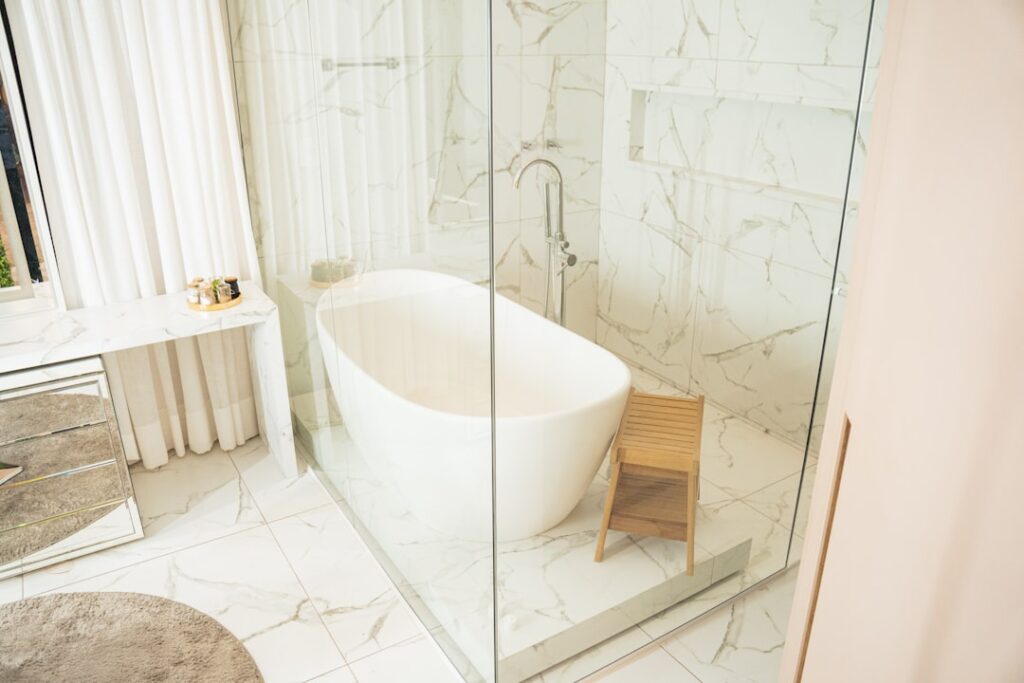
Walk into a 1990s bathroom and there is a good chance the tub walls are cultured marble — those seamless panels with swirled veining and a glossy gel-coat finish. It fell out of fashion for a while, but a cultured marble tub surround has quietly come back into the conversation as tile labor prices have climbed. I have installed and torn out plenty of these panels, and they occupy a genuine sweet spot: cheaper and faster than tile, more durable than a flimsy acrylic kit, and grout-free by design. Whether that trade-off works for you depends on how you weigh looks against practicality.
What Cultured Marble Actually Is
Despite the name, there is no quarried stone in the panel. Cultured marble is an engineered composite — roughly 75 percent crushed natural marble dust or limestone blended with a polyester resin, poured into a mold and cured, then sprayed with a clear gel-coat surface. That gel coat is what you see and touch: a hard, glossy, nonporous shell over a solid core. Because the panels are cast to size in a shop, a surround arrives as two or three large pieces rather than dozens of small tiles.
The result is a solid-surface material that behaves more like a countertop than a tile wall. There are no grout lines to scrub, no individual tiles to pop loose, and the veining runs through a printed or hand-swirled pattern in the gel coat. Quality varies a lot between fabricators, and that variation is the single biggest predictor of how the finished product looks and lasts.
The Real Pros
The advantages are practical and add up quickly for a mid-range remodel.
- No grout to maintain: the seamless surface eliminates the mold and mildew lines that plague tile showers. This alone sells a lot of homeowners.
- Nonporous surface: the gel coat does not absorb water, so it resists staining and does not need periodic sealing the way natural stone does.
- Fast installation: a standard three-wall surround goes up in a day, versus three to five days for a tiled equivalent once you factor in waterproofing, setting, and grouting.
- Lower cost than tile: the material-plus-labor number typically undercuts a comparable tile job by a wide margin.
- Custom sizing: because panels are cast to order, odd tub dimensions and integrated soap shelves or corner caddies are easy to include.
- Warm, smooth feel: the surface is comfortable to lean against and easy to wipe down.
The Honest Cons
No material is perfect, and cultured marble has a specific set of weaknesses worth knowing before you commit.
The gel coat is durable but not indestructible. Drop a heavy shampoo bottle on a corner and you can chip it; drag an abrasive cleaner across it for years and the gloss dulls to a hazy matte. Unlike tile, a damaged section is hard to spot-repair invisibly, though a fabricator can often buff out light scratches. Heat is another enemy — a curling iron or a lit candle set directly on a ledge can scorch the surface, and that damage is permanent.
Style is the other consideration. Cheaper panels read as dated because the veining looks painted on rather than natural. Higher-end fabricators do far better work, with subtle, dimensional veining that passes for real stone at arm’s length, but you pay for it. If your heart is set on a large-format porcelain or a natural marble look, cultured marble will always be a compromise rather than a match.
What a Cultured Marble Tub Surround Costs
Pricing swings with panel quality, wall size, and your local labor market, but here are realistic 2026 ballpark figures for a standard three-wall alcove tub.
- Basic builder-grade panels, material only: $500 to $900 for a three-wall kit
- Mid-range custom fabricated panels, material only: $900 to $1,800
- High-end custom with premium veining and integrated features: $1,800 to $3,000
- Professional installation labor: $400 to $900 depending on complexity and demolition
- Typical all-in installed project: $1,200 to $3,500
For comparison, a tiled tub surround of similar size commonly runs $2,500 to $5,000 installed once you include waterproofing membrane, tile, setting materials, and the extra labor days. That gap is exactly why the material keeps finding buyers. A cultured marble tub surround delivers a finished, grout-free wall for roughly half the cost of a quality tile job, and it does it in a fraction of the time.
Installation Basics
The panels bond to a properly prepared wall, and prep is where installs go wrong. The substrate should be a water-resistant board — cement board or a foam waterproof panel — that is flat and plumb. Cultured marble is rigid and unforgiving, so a bowed wall telegraphs gaps behind the panel that eventually crack the silicone seal.
- Verify the walls are plumb and flat; shim or float out any dips before the panels arrive.
- Dry-fit each panel and mark cutouts for the valve, spout, and any shelves using a carbide-tipped hole saw.
- Apply construction adhesive rated for solid surface, plus a bead of 100% silicone at all seams and the tub-to-panel joint.
- Set the back wall first, then the two end walls, pressing firmly and bracing until the adhesive grabs.
- Tool every seam and the tub flange joint with mildew-resistant silicone — this joint is the entire waterproofing strategy, so do not rush it.
Give the silicone a full 24 hours to cure before the first shower. The most common callback I see is a failed tub-to-wall seam because someone showered too soon or skimped on the bead.
Care and Cleaning
Maintenance is genuinely easy, which is half the appeal, but the rules are strict about what you cannot use. Wipe the panels down with a soft cloth and a mild, non-abrasive cleaner — dish soap and water, or a dedicated cultured marble cleaner. Never reach for scouring powders, magic erasers, or anything with grit; they micro-scratch the gel coat and kill the shine that makes the surface waterproof.
For soap scum, a 50/50 white vinegar and water spray works without harming the finish. If the gloss dulls over years of use, a fabricator or a careful DIYer can restore it with automotive-grade polishing compound and a buffer, followed by a coat of gel-coat wax. That refresh can take a tired surround back to nearly new for the cost of supplies. Keep heat sources off the ledges and rinse away any hair dye or harsh chemicals promptly, since prolonged contact can stain even a nonporous surface.
Cultured Marble vs. the Alternatives
Against acrylic tub-wall kits, cultured marble is heavier, more rigid, and feels more substantial, though acrylic is lighter to handle and cheaper at the very bottom of the market. Against solid surface materials like Corian, cultured marble costs less but is more prone to gloss wear. Against tile, it wins on speed, cost, and grout-free maintenance while losing on high-end aesthetics and spot-repairability.
Where it fits best is the mid-range remodel, the rental property, or the busy family bath where a low-maintenance, budget-conscious, good-looking surround beats a showpiece that demands constant grout scrubbing.
How Long It Lasts and When to Replace
A well-made cultured marble tub surround, cared for properly, commonly lasts 15 to 20 years before the gel coat wear becomes noticeable enough to bother most owners. The failure mode is rarely the panel cracking — it is the gloss dulling and the silicone seams needing renewal. Plan to re-caulk the tub-to-wall joint every three to five years with a fresh bead of mildew-resistant silicone; that single habit prevents the water intrusion that shortens the life of any surround. A yellowed or scratched surface can often be professionally refinished for a few hundred dollars rather than replaced, which stretches the material’s usable life considerably.
Signs it is genuinely time to replace rather than refinish include soft spots behind the panel indicating water has gotten past the seams, cracks radiating from a stress point, or a substrate that has begun to fail. If you catch a seam leak early, you save the whole assembly. Ignore a musty smell or a spongy wall and you end up replacing not just the surround but the wall behind it, which turns a modest refresh into a full demolition.
The Verdict
Choose a cultured marble tub surround if you want to eliminate grout, install fast, and keep the budget in check while still getting a solid, seamless wall. Skip it if you are chasing a true natural-stone look, you tend to be rough on surfaces, or you plan to stay in the home for decades and want a finish that ages without dulling. For most homeowners refreshing a dated tub area, it remains one of the best value moves in the bathroom — practical, quick, and easy to live with, provided you buy from a reputable fabricator and respect the no-abrasives rule from day one.


