More than half the dark blue bathroom projects I consult on end up looking like a submarine because the homeowner nailed the paint color but ignored every other variable. A successful dark blue bathroom needs the right undertone, matching tile, well-placed lighting, and enough reflective surface to keep it from swallowing the room. Get those four elements right and you’ll end up with a space that looks like a high-end boutique hotel. Miss one, and you’ll be repainting within 18 months.
Part of our Bathroom Remodeling & Flooring guide — explore the full guide →
The Undertone Makes or Breaks the Room
Dark blues split into three undertone families, and mixing them within a single bathroom creates visual dissonance that reads as “off” even if you can’t name why. Cool blues lean toward gray or green (Benjamin Moore Hale Navy, Farrow & Ball Hague Blue). Warm blues carry red or violet (Sherwin-Williams Naval, BM Gentleman’s Gray). True blues stay neutral (BM Old Navy, F&B Stiffkey Blue).
Pick a lane and commit. Warm brass fixtures pair with warm blues. Chrome and polished nickel match cool blues. True blues accept either but look best with matte black or unlacquered brass.
Paint Colors That Actually Work
These five colors have delivered consistent results across dozens of projects in varying light conditions.
- Benjamin Moore Hale Navy (HC-154): The safest choice. Balanced undertone, reads navy even in north-facing rooms.
- Farrow & Ball Hague Blue (No. 30): More green-leaning, sophisticated, pairs beautifully with Carrara marble.
- Sherwin-Williams Naval (SW 6244): Warm navy, stunning against brass. Popular in powder rooms.
- Benjamin Moore Gentleman’s Gray (2062-20): Teal-leaning dark blue. Dramatic but not claustrophobic.
- Farrow & Ball Stiffkey Blue (No. 281): Almost black in low light, vibrant navy in sunlight. Moody in the best way.
Order $5 sample pots and paint 2×2 foot squares on two different walls before committing. Bathroom lighting changes color perception dramatically between morning and evening.
Wall Coverage Strategy
Painting all four walls dark blue in a small bathroom (under 50 sq ft) works only if you have a window and light-colored flooring. In a windowless powder room, limit dark blue to one accent wall or the lower two-thirds with white wainscoting below.
A ceiling in the same dark blue can actually make a small space feel more intentional, not smaller. The trick is to carry the color up without a trim break, which tells the eye “this is a cocoon,” instead of “this room ran out of paint.”
Tile Pairings That Elevate the Look
Dark blue walls need contrast to avoid reading as heavy. These combinations have worked repeatedly in real bathrooms.
- White subway tile with dark grout: Classic, budget-friendly at $2-4 per sq ft. Anchors the blue without competing.
- Carrara or Calacatta marble: Veining in gray and white picks up cool blue undertones. $12-25 per sq ft.
- Zellige tile in cream or terracotta: Adds warmth and handmade texture. $18-35 per sq ft.
- Brass penny-round mosaic floor: Unexpected luxury touch. Runs $22-40 per sq ft installed.
Avoid matching blue tile unless it’s a different shade entirely. A blue floor with blue walls creates a void effect that even good lighting can’t rescue.
Lighting a Dark Room Without Losing the Mood
Dark blue absorbs roughly 40% more light than off-white, so you need to compensate without flooding the room. Layer three sources: overhead, vanity, and accent.
Overhead should be 2700-3000K LED at 800-1100 lumens for a standard 50-75 sq ft bath. Add 500-700 lumen sconces on either side of the mirror (never above alone, which casts shadows). Under-cabinet LED strip lights at the vanity toe-kick create a floating effect and bounce light onto dark walls.
Dimmers are non-negotiable. You want full brightness for morning routines and 20% for evening soaks.
Fixtures and Hardware Choices
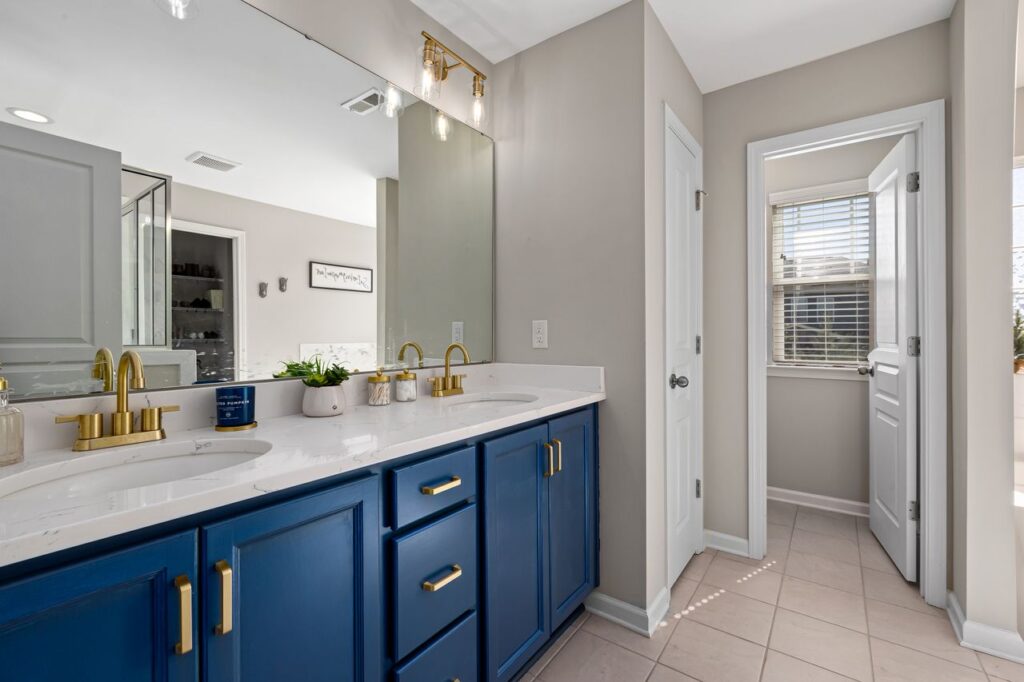
Polished brass and brushed brass are having a moment and pair exceptionally well with most dark blue paint colors. Matte black reads architectural and modern but can feel flat against blue in low light. Chrome is the safest cool-undertone choice.
Mix metals only if you commit to two finishes maximum. A brass faucet with matte black cabinet pulls works. Add a chrome towel bar and you’ve created chaos.
Common Mistakes to Avoid
The biggest failure mode is choosing dark blue without testing under actual bathroom lighting. A color that looks perfect in the showroom can turn purple under warm LEDs or gray under cool fluorescents.
The second mistake is skimping on trim. A dark blue bathroom with yellowed builder-grade trim looks unfinished. Budget for crisp white semi-gloss on all moldings and plan to refresh the ceiling paint while you’re at it. Total paint cost for a small bath comes out to $75-150 in materials plus $300-600 if you hire out labor.
Accessorizing Without Overwhelming
Once the hard surfaces are set, keep textiles simple. White or natural linen towels, a jute bath mat, and a single piece of warm-toned artwork are enough. Plants with lighter green leaves (pothos, Chinese evergreen) thrive in humid bathroom conditions and break up the dark palette naturally.
Skip the navy-and-white nautical theme. That’s a beach house trope that dates the room instantly.