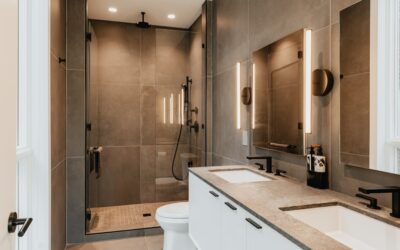
There is a reason designers keep reaching for dark gray tile in kitchens, bathrooms, and entryways: it hides dirt, grounds a room, and reads as modern without going fully black. Charcoal, slate, and graphite shades have become the default neutral for anyone who finds beige boring and stark white impractical. But dark tile is also less forgiving than lighter shades in ways most homeowners do not discover until the floor is down. Dust, lint, hard-water spots, and dried footprints all show more readily on a deep matte surface, and the wrong grout color can make an expensive floor look cheap. This guide walks through material choices, finishes, grout pairings, real pricing, and the rooms where charcoal tile genuinely earns its place.
Part of our Tile & Grout guide — explore the full guide →
Why Homeowners Choose Dark Gray Over Other Neutrals
Dark gray sits in a sweet spot between the coldness of true black and the fussiness of light gray. It anchors a space visually, which is why it works so well on floors, and it flatters warm and cool palettes alike. Pair it with white cabinets and brass hardware for a crisp transitional kitchen, or with walnut and matte black fixtures for something moodier and more contemporary. Because gray absorbs light rather than bouncing it around, a dark floor makes ceilings feel taller by contrast and gives furniture and rugs a stage to stand on.
The practical appeal matters just as much as the look. In a mudroom or entryway that takes constant abuse from boots, road salt, and pet traffic, a dark charcoal floor disguises the day-to-day grime that would show glaringly on travertine or light oak-look tile. That forgiveness is real, but it cuts both ways, which is worth understanding before you commit an entire floor.
Porcelain vs. Ceramic: Which Dark Tile to Buy
For most floor applications, porcelain is the better buy. Porcelain is fired at higher temperatures and pressed denser than standard ceramic, giving it a water absorption rate below 0.5 percent and a PEI abrasion rating of 4 or 5 that stands up to heavy foot traffic. Full-body or through-body porcelain carries the color all the way through the tile, so a chip on a dark gray floor does not reveal a pale clay bisque underneath. That single feature is worth paying extra for on a dark tile, because chips are far more visible against a deep color.
Glazed ceramic still has a place on walls, backsplashes, and low-traffic bathrooms where its lower cost and easier cutting are advantages. But on a dark gray floor that will see daily wear, a chipped glaze exposing white clay is exactly the kind of eyesore you are trying to avoid. If your budget only stretches to ceramic, keep it on the walls and spend on porcelain underfoot.
Matte, Polished, or Textured Finish
Finish changes everything about how a dark gray tile performs and reads. A matte or honed surface looks soft and organic, hides water spots reasonably well, and offers better slip resistance underfoot, but it holds onto dust and shows lint more than you would expect. A polished finish looks luxurious and dramatic, reflecting light like stone, yet it magnifies every footprint, streak, and speck of dust, and it turns slick when wet. For bathrooms and any floor that gets damp, look for a coefficient of friction rating (often listed as DCOF) of 0.42 or higher.
Textured and structured finishes, including many wood-look and slate-look planks, split the difference. The subtle relief breaks up reflections, hides debris between cleanings, and grips wet feet, which is why textured charcoal tile is so popular in showers and pool surrounds. The tradeoff is that texture traps grime in its low points and takes a stiff brush rather than a quick mop to clean thoroughly.
Choosing Grout Color for Dark Gray Tile
Grout is the decision that makes or breaks a dark tile installation, and it is the one homeowners regret most. A matched charcoal grout gives a seamless, monolithic look that reads high-end and lets the tile pattern disappear into a single field of color. A contrasting light gray or white grout, by comparison, turns every seam into a visible grid, which can look intentional and graphic with square tiles but frequently looks busy and dated with wood-look planks.
Whatever shade you choose, buy a quality epoxy or urethane grout, or at minimum a stain-resistant cementitious grout with a sealer. Light grout between dark tiles shows dirt fast and is a constant cleaning battle in kitchens and entries. When in doubt, sample the grout dry against your actual tile before the installer mixes a batch, because wet grout looks two shades darker than it dries.
What Dark Gray Tile Costs
Pricing spans a wide range depending on quality and origin. Budget glazed ceramic dark gray tile starts around $1.50 to $3 per square foot. Mid-grade porcelain in the popular 12×24 and wood-look plank formats typically runs $3 to $7 per square foot, which is where most homeowners land. Premium through-body porcelain, large-format slabs, and imported designer lines climb to $8 to $15 per square foot and beyond.
- Budget ceramic: $1.50 to $3 per sq ft, best for walls and light-use areas
- Mid-grade porcelain: $3 to $7 per sq ft, the practical choice for floors
- Premium and large-format: $8 to $15+ per sq ft
- Professional installation: $7 to $14 per sq ft on top of materials
Budget another 10 to 15 percent in overage for cuts, breakage, and future repairs, and keep a sealed box of leftover tile in the garage. Dark gray dye lots shift between production runs, so a matching replacement tile bought two years later rarely blends in.
Best Rooms and Design Pairings
Dark gray tile shines in entryways, mudrooms, laundry rooms, and bathrooms where its dirt-hiding talents and moisture resistance both come into play. In a large open kitchen with generous natural light, a charcoal floor grounds white or wood cabinetry beautifully. Be cautious in small, low-light rooms, where too much dark tile can feel like a cave; there, use it as a shower floor, a backsplash accent, or a niche rather than covering every surface.
To keep a dark floor from feeling heavy, layer in lighter walls, warm wood tones, and a textured area rug. Underfloor heating pairs especially well with dark porcelain, since the tile’s density stores and radiates warmth efficiently, taking the chill off a surface that would otherwise feel cold underfoot in winter. Handled with these details in mind, dark gray tile delivers the rare combination of drama, durability, and everyday practicality that keeps it at the top of the trend list year after year.
Prefer to explore on your own?
See how new flooring looks in your actual room in seconds — free, no signup.
Try the free Floor Studio →