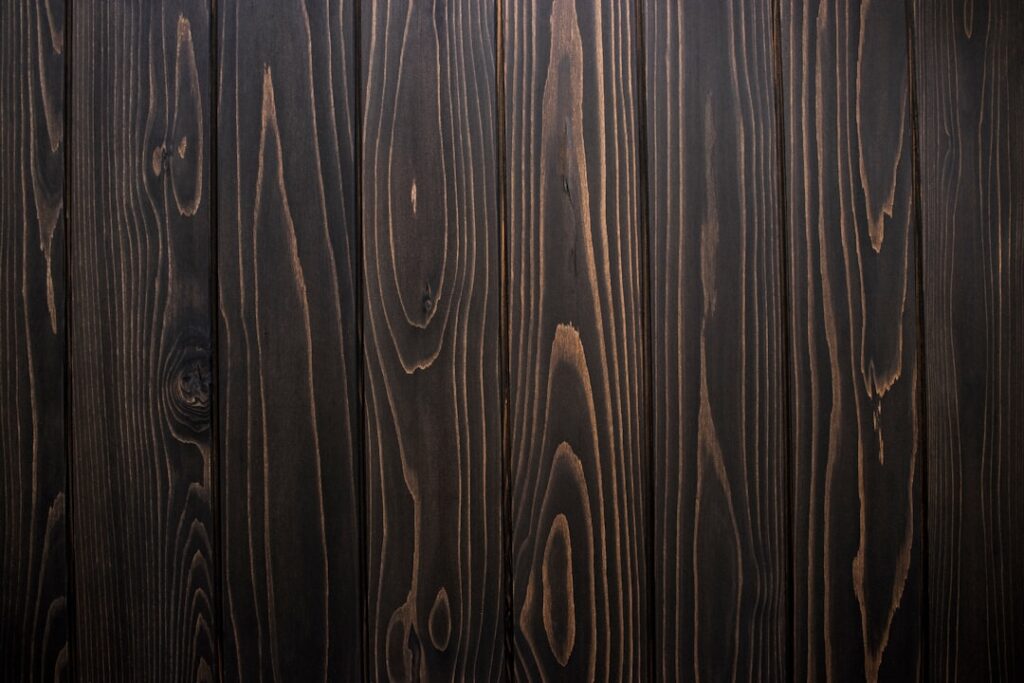
Dark finishes are the most dramatic thing you can do to wood — and the least forgiving. A dark wood stain like jacobean, ebony, or dark walnut hides repairs, unifies mismatched boards, and gives furniture instant weight and formality, but it also magnifies every prep shortcut: blotches on pine, streaks on maple, lap marks on tabletops, and swirl scratches you never knew your sander left. The good news is that even, gallery-dark color is a technique problem with known solutions. This guide compares the major dark shades and walks through the application system that gets them on evenly.
- The Dark Shade Lineup
- Why Dark Stain Blotches — and the Species That Fight You
- The Blotch-Control System
- Applying Dark Stain Evenly on Big Surfaces
- Topcoats for Dark Finishes
- Living With Dark Wood: What to Expect
- Dark Stain vs Alternatives
- Matching Dark Stain Across Boards and Batches
- Budget and Materials Checklist
- FAQ
The Dark Shade Lineup
| Shade | Undertone | Depth | Character |
|---|---|---|---|
| Dark Walnut | Cool brown | Dark | Classic dark brown; grain clearly visible |
| Espresso | Neutral | Very dark | Coffee-bean brown, minimal red |
| Jacobean | Faint red-black | Very dark | The statement-table espresso; slight warmth |
| Ebony | Cool black | Near black | Black with grain ghosting through |
| True Black | Flat black | Black | Full black; grain texture only |
| Red Mahogany | Deep red | Dark | Formal, traditional, unapologetically red |
The practical differences: Dark Walnut is the safest choice when you want “dark but still obviously wood.” Jacobean and Espresso are nearly interchangeable at arm’s length — Jacobean pulls a whisper of burgundy on red oak, Espresso stays neutral. Ebony reads black in most light but lets oak’s grain figure show through as texture. If you’re deciding between these and mid-tones, the full wood stain color chart shows all of them next to their lighter siblings with brand equivalents.
Why Dark Stain Blotches — and the Species That Fight You
Blotching happens because wood density varies within a single board. Softwoods like pine have alternating earlywood (spongy, absorbs heavily) and latewood (dense, absorbs little), plus random resin pockets. Dark pigment amplifies the difference: where light stain shows a subtle mottle, jacobean shows leopard spots. Maple and birch have the opposite problem — grain so tight the pigment can’t get in, so it sits on the surface in streaks wherever your rag pressure varied.
- Easy species for dark stain: red oak, white oak, ash, hickory, walnut. Open, even grain drinks dark pigment uniformly.
- Hard species: pine, fir, maple, birch, cherry, poplar. All need blotch control.
The Blotch-Control System
For pine, fir, and other blotch-prone softwoods:
- Sand to 150, no finer. Over-sanding burnishes softwood and worsens uneven absorption.
- Apply pre-stain wood conditioner (about $6-8/pint), a thin resin wash that partially seals the thirsty earlywood. Wait 15 minutes, then stain within 2 hours while the conditioner is still receptive. Expect the final color one shade lighter than the chip — plan a second coat.
- Alternative: a washcoat of dewaxed shellac cut 1:3 with denatured alcohol. Seals more aggressively than conditioner; ideal before ebony or true black on pine.
For maple and birch, skip liquid penetrating stain entirely and use gel stain. Gel is a thick pigment paste that sits on the surface in a controllable film — General Finishes Java Gel (a Jacobean-class dark) is famous precisely because it puts even espresso color on woods that reject regular stain. Apply with a rag, wipe with even pressure, and build depth over two or three thin coats.
Applying Dark Stain Evenly on Big Surfaces
- Remove every sanding scratch first. Dark pigment lodges in swirl marks and highlights them. After your final grit, hand-sand with the grain and inspect under a raking light before any stain opens.
- Work wet-to-wet in full-width sections. On a tabletop, stain the entire width one end to the other; never stop mid-panel. A dried lap line under dark stain cannot be blended out — only sanded out.
- Flood, dwell, wipe hard. Apply generously, let it sit 10-15 minutes for maximum depth (oil-based), then wipe off all excess with the grain using clean rags, refolding constantly. Residual smears left to dry are the number-one cause of streaky dark finishes.
- Second coat after full dry (8+ hours for oil) adds roughly 25% more depth. Two coats plus dwell time is the ceiling — after that, pigment just stockpiles on the surface and peels under the topcoat.
- Watch your rags. Oil-stain rags generate heat as they cure and can self-ignite. Lay them flat outdoors to dry stiff, or submerge in water, before disposal.
Topcoats for Dark Finishes
Dark surfaces show dust nibs, brush marks, and sheen inconsistency far more than light ones. Satin or matte polyurethane hides application flaws and fingerprints better than gloss — gloss over jacobean turns every speck of dust into a white spot. Water-based poly keeps ebony and true black dead-neutral; oil-based poly warms dark browns pleasantly but shifts blacks slightly bronze. Whichever you use, strain it, work in a dust-controlled space, and sand lightly with 320 between coats. Three thin coats outperform two heavy ones on tables that will see glasses and spills.
Living With Dark Wood: What to Expect
Dark stain hides wood defects but shows life: dust is visible within a day or two, fine scratches expose lighter wood beneath, and water rings read clearly. On high-traffic pieces — dining tables, stair treads — that means either embracing patina or committing to a tougher topcoat (a catalyzed or professional-grade finish). Sunlight matters too: strong UV slowly bleaches dark pigment, so a table half-covered by a runner will two-tone over years in a sunny room. None of this argues against going dark; it argues for satin sheens, good topcoats, and window film or curtains in harsh sun.
Dark Stain vs Alternatives
- Dye stain: For dark color with maximum grain clarity (think ebonized-but-luminous), water-soluble dyes penetrate deeper without muddying figure. Less UV-stable than pigment; best indoors away from windows.
- India-ink or paint-wash ebonizing: True flat black options when grain contrast doesn’t matter.
- Stain-and-poly combos: One-pass products exist in dark shades but are hardest to apply evenly precisely when the color is dark — see our wood stain and sealer guide for when combos make sense.
- Going gray-dark instead: Charcoal layering (gray over a black wash) gives moody depth without brown warmth — recipes in the gray wood stain guide.
Matching Dark Stain Across Boards and Batches
Dark projects often span multiple boards or build sessions, and mismatches show at this depth more than any other. Buy all your stain for a project at once and from the same batch when possible — pigment loads drift slightly between production runs, and a quart bought in March next to one bought in June can read a half-shade apart at jacobean depth. If you’re gluing up a panel from several boards, dry-fit and stain a test stripe across all of them before assembly; boards from different trees take dark pigment at visibly different rates, and rearranging or swapping the outlier before glue-up is free, while living with a light stripe down a finished tabletop is forever. For projects finished weeks apart — a bookcase now, a matching desk later — keep a stained and topcoated reference block from the first piece and match the second piece to the block, not to your memory or to the can’s label.
Budget and Materials Checklist
A complete dark-stain furniture finish costs less than people expect: stain $7-15, pre-stain conditioner $7 (softwoods), or gel stain $15-17 per quart (maple/birch), 320-grit sandpaper and tack cloths $10, quality satin polyurethane $15-25 per quart, brushes and rags $10-15. Call it $50-75 for a dresser-sized piece done properly — with the conditioner and the extra poly coat included, which are exactly the line items people skip and regret. Coverage math: a quart of stain handles roughly 150 sq ft, and dark colors don’t consume more product than light ones; they just consume more care.
FAQ
How do I fix blotchy dark stain? Once dry, the honest fix is sanding back to bare wood and restarting with conditioner or gel. A partial rescue: apply a coat of gel stain in the same color over the blotchy surface to even it out.
Can I get dark color in one coat? On oak, yes — full-strength jacobean with a 15-minute dwell gets close. On conditioned pine or maple, plan two coats from the start.
Jacobean vs Dark Walnut? Jacobean is a full shade darker and slightly redder. Dark Walnut keeps more visible wood character; Jacobean reads almost-espresso.
Do dark stains cost more? No — same $6-9 per half-pint, $11-15 per quart as lighter shades in the same line. Budget extra only for conditioner ($7) or gel stain ($15/qt) on difficult woods.
Prep like the stain will expose everything — because it will — and dark shades become the easiest way to make ordinary lumber look expensive.