If you are exploring ultra-durable surfaces for a kitchen, bathroom, or outdoor space, you have probably run into a material that seems almost indestructible. Understanding the range of Dekton countertop colors helps you decide whether this advanced surface is right for your project. Made by Cosentino, Dekton is a sintered stone, a distinct category from quartz and granite, engineered for extreme resistance to heat, scratches, stains, and UV fading. This guide explains what Dekton is, the color families available, its pros and cons, cost, and how to care for it.
Part of our Countertops guide — explore the full guide →
- What Is Dekton
- The Range of Dekton Countertop Colors
- Finishes Beyond Color
- Why Homeowners Choose Dekton
- Honest Drawbacks to Consider
- Where Dekton Works Best
- What Dekton Costs
- Caring for Dekton
- How Dekton Compares to Quartz and Granite
- Choosing a Color for Your Space
- Final Thoughts on Dekton Countertop Colors
What Is Dekton
Dekton is a sintered stone surface produced by Cosentino. Rather than being a natural stone or a resin-bound quartz, it is made by combining raw minerals and subjecting them to intense heat and pressure in a process that mimics, at high speed, the natural formation of stone over millennia. The result is an ultra-compact surface with no resins, which gives it a very different set of properties from engineered quartz. It is worth being clear on this point: Dekton is not quartz and not granite; it is its own category of ultra-compact sintered surface.
That distinction matters because it explains Dekton’s standout strengths. With no resin binder, it resists heat and UV in ways quartz cannot, making it uniquely suited to both busy kitchens and outdoor installations.
The Range of Dekton Countertop Colors
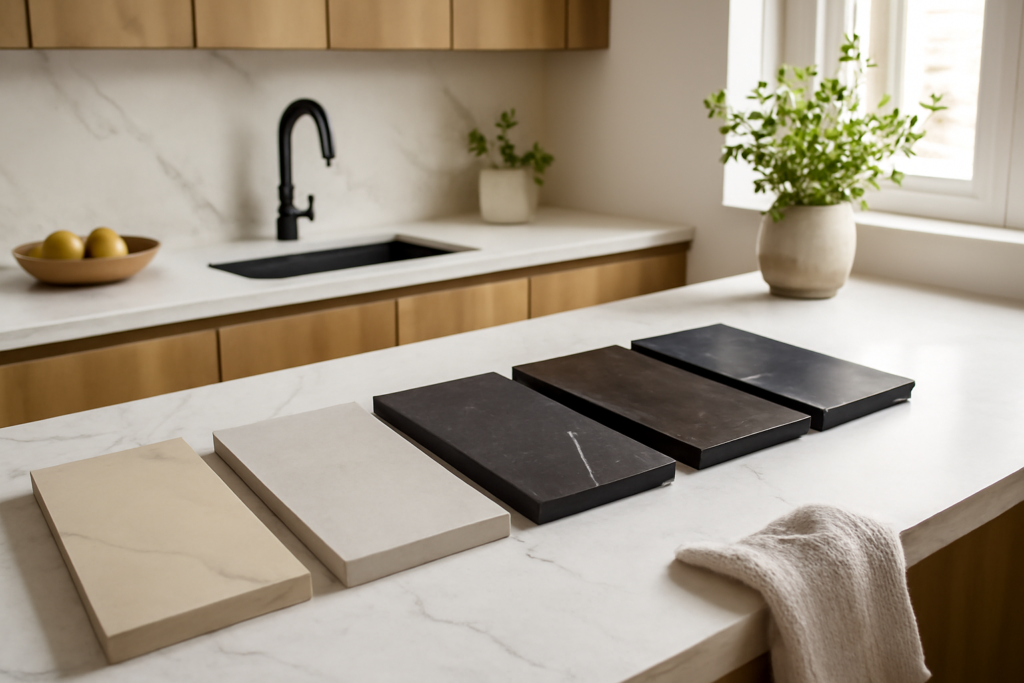
Dekton is organized into collections, and the palette spans a wide spectrum from bright whites to deep blacks, warm concretes, and richly veined marble looks. While exact names and availability change over time, the color families generally fall into these groups.
- Whites and light neutrals. Clean, bright surfaces, some with subtle veining, ideal for airy modern kitchens.
- Marble-look veined designs. Dramatic veining on light backgrounds for a luxurious, high-end aesthetic.
- Greys and concrete looks. Soft to deep greys with a matte, industrial feel popular in contemporary spaces.
- Warm tones and taupes. Earthy, inviting colors that pair beautifully with wood.
- Blacks and dark charcoals. Bold, graphic surfaces for a striking, modern statement.
- Metallic and textured effects. Distinctive finishes that add depth and character.
Because names and collections evolve, always confirm current availability with a Cosentino dealer and view a full-size sample, since color and veining read very differently at scale.
Finishes Beyond Color
Color is only half the story with Dekton, because the finish dramatically changes the look and feel. The same color can appear in a polished, matte, or textured finish, each suiting a different style. Polished finishes feel sleek and reflective, matte finishes read soft and contemporary, and textured finishes add tactile depth. When you choose a color, consider the finish alongside it, because it affects both appearance and how the surface hides fingerprints and water spots.
Why Homeowners Choose Dekton
- Exceptional heat resistance. With no resin, Dekton resists high heat far better than quartz, tolerating hot pans without scorching.
- UV stable. It resists fading in sunlight, which makes it one of the few surfaces truly suited to outdoor kitchens.
- Highly scratch and scuff resistant. The dense surface stands up to knives and daily abuse.
- Stain resistant and non-porous. It shrugs off spills and never needs sealing.
- Large formats. Big slabs allow fewer seams on large runs and islands.
Honest Drawbacks to Consider
No surface is perfect, and Dekton has a few characteristics to weigh.
- Cost. Dekton is a premium product and typically costs more than many quartz and granite options.
- Hardness cuts both ways. Its extreme density can make fabrication more demanding, so use an experienced fabricator.
- Brittleness at edges. Very hard, thin material can chip on a sharp impact at an exposed edge, though thicker profiles help.
- Fewer local fabricators. Not every shop is set up to cut sintered stone, so availability of skilled installers varies.
Where Dekton Works Best
Dekton’s heat and UV resistance make it exceptionally versatile. It excels as an indoor kitchen countertop where hot pans and busy cooking are the norm, and it is one of the few surfaces genuinely recommended for outdoor kitchens because it will not fade in the sun. It also works well as flooring, cladding, and even facades, so it can tie an indoor kitchen to an outdoor entertaining area with a consistent look. For a bathroom vanity or a fireplace surround, its durability and color range make it a strong contender too.
What Dekton Costs
As a premium sintered surface, Dekton generally sits at the higher end of the countertop market. Installed prices vary by color, thickness, finish, region, and fabrication complexity, but many homeowners see figures in the range of roughly 60 to 130 dollars per square foot installed, with dramatic veined colors and thicker profiles pushing higher. Always request an itemized quote covering templating, fabrication, edge work, cutouts, and installation, and choose a fabricator experienced with sintered stone to ensure clean results and warranty coverage.
Caring for Dekton
One of Dekton’s great advantages is how little maintenance it needs. Because it is non-porous, it never requires sealing, and everyday cleaning is simply warm water with a mild soap and a soft cloth. It resists stains, heat, and scratches remarkably well, so you can be relaxed about daily use. For stubborn marks, a non-abrasive cleaner usually does the job. There is little you can do to harm it in normal use, which is a large part of its appeal for busy households and outdoor spaces.
How Dekton Compares to Quartz and Granite
Because Dekton is often cross-shopped against quartz and granite, it helps to see where it stands. Against engineered quartz, Dekton’s big advantages are heat and UV resistance; quartz can scorch under a hot pan and is not recommended for sunny outdoor use, whereas Dekton handles both with ease. Against natural granite, Dekton offers greater consistency, a non-porous surface that never needs sealing, and often better stain and scratch resistance, though it lacks the genuine one-of-a-kind character of quarried stone. The trade-offs are cost and fabrication: Dekton is a premium product and its extreme hardness demands an experienced fabricator, and its very thin, hard profiles can chip at an exposed edge on a hard impact. If your priorities are maximum durability, heat tolerance, and indoor-outdoor versatility, Dekton is compelling; if you want authentic natural stone or the lowest price, granite or quartz may fit better.
Choosing a Color for Your Space
With so many Dekton colors available, narrowing the field is easier if you start from the room rather than the swatch. For a bright, open modern kitchen, a white or light neutral with subtle veining keeps things airy and timeless. For a dramatic, contemporary statement, a deep charcoal or black in a matte finish reads as sophisticated and hides fingerprints well. For a warm, inviting feel, an earthy taupe or a soft concrete look pairs beautifully with wood cabinetry. For an outdoor kitchen, lean on Dekton’s UV stability and pick a color you love knowing it will not fade in the sun. Whatever direction you take, always view a large sample in your own lighting, since color and veining read very differently at full scale than on a small chip, and consider how the finish, whether polished, matte, or textured, will affect both the look and the day-to-day upkeep.
Final Thoughts on Dekton Countertop Colors
The breadth of Dekton countertop colors means there is a shade and finish for nearly every style, from bright veined whites to moody charcoals and warm concretes. What truly sets Dekton apart, though, is what lies beneath the color: a sintered stone surface, distinct from quartz and granite, engineered to resist heat, UV, scratches, and stains with almost no maintenance. It is a premium choice, but for homeowners who want a surface that performs indoors and out and looks contemporary for years to come, Dekton is one of the most capable options on the market today.