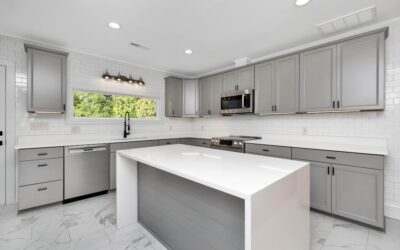
Quartz and granite get most of the attention, but there is a surface quietly winning over designers and budget-conscious homeowners alike. A porcelain tile countertop delivers near-indestructible durability, true heat resistance, and a huge range of looks, from marble veining to concrete and wood, often at a lower price than natural stone. Whether you install classic tile with grout lines or a large-format porcelain slab that mimics a solid stone top, porcelain is one of the most practical countertop materials available today.
Part of our Countertops guide — explore the full guide →
Why Consider Porcelain for a Countertop
Porcelain’s strengths come from how it is made. Fired at temperatures above 2,200 degrees Fahrenheit, it becomes extremely dense, hard, and nonporous, which translates into real advantages on a kitchen counter. It is heat-resistant enough that you can set a hot pan directly on it without scorching, something that can damage quartz. It resists scratches from knives and cookware, does not stain because liquids cannot penetrate the surface, and shrugs off the UV fading that affects some other materials, making it viable for outdoor kitchens too.
The design range is the other big selling point. Modern printing technology lets porcelain convincingly imitate Carrara marble, soapstone, concrete, and even weathered wood, complete with texture. You get the look of premium materials with the toughness of fired ceramic, and because the color and pattern are baked into a glazed surface, they do not wear off with use.
Tile Versus Slab Porcelain
There are two very different ways to build a porcelain countertop, and they suit different budgets and skill levels. Understanding the distinction is key to choosing the right approach.
Traditional tile countertops use individual porcelain tiles, often 12×12 or larger, set on a substrate with grout lines between them. This is the affordable, DIY-friendly route, but the grout lines require sealing and can trap crumbs. Large-format porcelain slabs, by contrast, come in sheets up to roughly 5 by 10 feet and just a quarter-inch to half-inch thick, fabricated much like a stone slab to create a seamless, grout-free surface that looks like solid stone. Slabs cost more and require professional fabrication, but they eliminate the maintenance and dated look of grout joints.
Pros and Cons at a Glance
Like any material, porcelain has trade-offs worth weighing before you commit. Here is the honest balance sheet.
- Pros: exceptional heat and scratch resistance, nonporous and stain-proof, no sealing needed for the tile itself, UV-stable, and a wide range of realistic looks.
- Cons: can chip or crack on impact at edges, tile versions have grout lines to maintain, slab fabrication requires specialized tools and skilled installers, and edge profile options are more limited than stone.
The chipping risk is the main practical caution. Porcelain is hard but somewhat brittle, so a heavy pot dropped on an unsupported edge can chip it. Good installation with proper edge support minimizes this, and the risk is comparable to what you accept with natural stone.
What a Porcelain Countertop Costs
Porcelain spans a broad price range depending on format. A DIY porcelain tile countertop can be remarkably cheap, with tile at $3 to $10 per square foot, so materials for an average kitchen might total just a few hundred dollars if you install it yourself. This is the budget champion of the countertop world.
Large-format porcelain slabs cost considerably more once you factor in fabrication and installation, typically $55 to $120 per square foot installed, which is competitive with quartz and mid-range granite. For a 30-square-foot kitchen, a professionally fabricated porcelain slab counter runs roughly $1,600 to $3,600. You are paying for the seamless look and the specialized cutting equipment porcelain slabs demand, but you gain a surface that outperforms most stone on heat and stain resistance.
How Porcelain Compares to Quartz and Granite
Homeowners cross-shopping surfaces will find porcelain competitive on the metrics that matter. Against quartz, porcelain wins on heat resistance and UV stability, since quartz can scorch and fade, while quartz offers a slightly more forgiving, less brittle surface and easier edge profiles. Against granite, porcelain matches or beats it on stain resistance and requires no annual sealing, whereas granite offers the authenticity and depth of real stone that some buyers prefer.
The deciding factors usually come down to look, budget, and installation. If you want a heat-proof, low-maintenance surface and love the idea of a marble look without marble’s fragility, a porcelain tile countertop or slab is hard to beat. If you prioritize a solid stone feel or want maximum edge-profile flexibility, quartz or granite may edge it out.
Best Uses and Design Applications
Porcelain earns its keep in specific spots around the home. It is a standout choice for outdoor kitchens and grilling stations because it resists UV fading, freeze-thaw cycles, and the heat of a nearby grill, where quartz would fade and discolor. Indoors, it works beautifully on a busy family kitchen island that takes hot pans, spills, and knife contact, and its stain-proof surface makes it a smart pick for bakers who work with staining ingredients like turmeric, wine, and berries. Because the material comes in large-format slabs, it can also wrap a waterfall island edge or clad a full backsplash in a continuous, matching sheet for a seamless designer look.
The realistic printed finishes open up design options that would be costly or impractical in natural materials. You can get the look of book-matched marble without the fragility and etching risk, the warmth of aged wood on a surface that never needs oiling, or the industrial gray of poured concrete without the cracking and sealing headaches. That combination of authentic looks and genuine performance is why porcelain keeps gaining ground in kitchens that want style without babying a delicate surface.
Installation and Care Tips
Tile installation is within DIY reach with a wet saw, quality thin-set, and patience, though cutting porcelain cleanly takes a diamond blade and a steady hand. Slab installation should always go to a professional fabricator, as the thin, large sheets crack easily without the right suction tools and support. Whichever route you take, a solid, level substrate is essential to prevent flexing that could crack the surface.
Daily care could not be simpler. Wipe the counter with mild soap and water or a pH-neutral cleaner; because porcelain is nonporous, you never need to seal the tile face, and it resists stains from wine, oil, and citrus. If you have grout lines, seal and clean them periodically, but the tile itself asks for almost nothing. That low-maintenance toughness, combined with genuine heat resistance and a designer look, is why porcelain deserves a serious spot on your countertop shortlist.