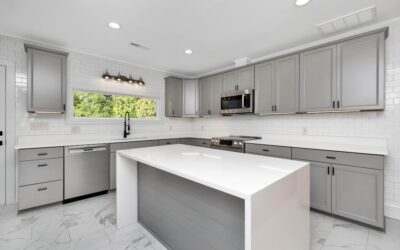
Sintered porcelain has quietly become one of the most requested surfaces in modern kitchens, and for good reason. Large porcelain tile kitchen countertops deliver the seamless, stone-like look of a full slab while resisting heat, scratches, and stains better than almost anything else on the market. If you have been weighing quartz against granite and feeling underwhelmed, a large-format porcelain slab is the option most homeowners have never fully considered.
Part of our Countertops guide — explore the full guide →
This guide walks through what these countertops actually are, how thick the material comes, where the seams land, what installation involves, and how the real-world cost stacks up against quartz. By the end you will know whether a porcelain slab belongs in your kitchen or whether a different surface makes more sense for how you cook and live.
- What "Large Porcelain Tile" Actually Means for Countertops
- Slab Thickness Options and Why They Matter
- Seams: Where They Go and How Visible They Are
- Heat, Scratch, and Stain Performance in a Working Kitchen
- Cost Compared to Quartz and Granite
- The Installation Process and What Can Go Wrong
- Design, Edges, and Finish Choices
- Is a Porcelain Slab Right for Your Kitchen?
What “Large Porcelain Tile” Actually Means for Countertops
Traditional porcelain tile arrives in pieces measuring 12 by 12 inches or 24 by 24 inches, which is fine for floors but leaves a countertop riddled with grout joints. Countertop-grade porcelain is different. Manufacturers press and fire enormous slabs, most commonly 126 by 63 inches, roughly the footprint of a full sheet of plywood. A single slab of that size can cover an entire island or a long run of base cabinets with no interruptions at all.
The material is technically a sintered stone or ultra-compact surface. Fine clays, feldspar, and mineral pigments are compressed under thousands of tons of pressure and fired above 2,200°F, which fuses the particles into a dense, non-porous body. That firing is what gives porcelain its near-zero water absorption, typically under 0.5 percent, and its resistance to the acids and dyes that etch or stain natural stone.
Slab Thickness Options and Why They Matter
Porcelain countertop slabs are sold in three main thicknesses, and the choice affects both looks and price. The thinnest, 6mm, is roughly a quarter inch and is usually reserved for wall cladding or for bonding directly over an existing countertop. At 12mm, just under half an inch, you get a genuine standalone countertop thickness that most fabricators consider the practical minimum for a freestanding kitchen surface.
The 20mm slab, about three-quarters of an inch, is the premium choice and behaves most like a traditional stone counter. It is strong enough to span a dishwasher opening without cracking and takes a mitered edge cleanly. Many homeowners want the look of a chunky 40mm or 80mm edge, and fabricators achieve that by mitering two pieces of 12mm or 20mm together at a 45-degree angle, creating a hollow but visually thick profile without the weight of solid stone.
Seams: Where They Go and How Visible They Are
Because a single slab covers so much area, most kitchens need only one or two seams total, and skilled fabricators place them where they draw the least attention. A common location is at a sink or cooktop cutout, where the break in the surface reads as intentional. On a large island, the seam often runs down the centerline so the two halves mirror each other.
Seams in porcelain are filled with a color-matched epoxy rather than grout, producing a joint that can be as tight as a credit-card width. Because the pattern is printed on the surface layer, a good installer will book-match adjacent slabs so the veining flows across the seam. Done well, the joint disappears at arm’s length. That said, porcelain seams are not invisible up close the way a poured surface would be, so set expectations if you are a detail-oriented homeowner.
Heat, Scratch, and Stain Performance in a Working Kitchen
This is where porcelain earns its reputation. You can set a pot straight off a 400°F burner onto the surface without a trivet and leave no mark. Quartz, by contrast, uses a resin binder that scorches and yellows around 300°F, which is why every quartz warranty warns against direct heat. For anyone who cooks seriously, that single difference often decides the purchase.
Scratch resistance is equally strong. Porcelain rates around 7 on the Mohs hardness scale, harder than a steel knife blade, so you can technically cut directly on it, though doing so will dull your knives fast and is not recommended for the sake of your blades. Because the body is non-porous, red wine, coffee, lemon juice, and oil wipe away with no staining and no need for annual sealing, unlike granite or marble.
Cost Compared to Quartz and Granite
Installed pricing for large porcelain tile kitchen countertops typically runs from $60 to $120 per square foot, with most projects landing between $75 and $100. That puts it in the same neighborhood as mid-range quartz, which averages $60 to $110 installed, and slightly above builder-grade granite at $50 to $90. Premium designer porcelain patterns, especially those mimicking rare marbles like Calacatta, can push past $120.
The material itself is a smaller share of the bill than you might expect; fabrication and installation drive the cost. Porcelain is harder and more brittle to cut than quartz, so fabricators need specialized wet saws with continuous-rim diamond blades and they charge for that expertise. A typical 40-square-foot kitchen with an island might total $3,500 to $5,500 installed, and the price difference versus quartz is often a wash once you factor in porcelain’s heat tolerance.
The Installation Process and What Can Go Wrong
Installing a porcelain slab is not a weekend DIY project. The slabs are large, heavy at roughly 5 to 9 pounds per square foot depending on thickness, and unforgiving if flexed. Transport and handling account for a surprising number of breakages; a 126-inch slab must be carried vertically on an A-frame and never laid flat unsupported, or it can snap under its own weight.
Fabricators template the kitchen with a laser or digital measuring tool, cut the slab on a CNC bridge saw, and polish the exposed edges before delivery. On site, the cabinets must be dead level within an eighth of an inch because porcelain will not conform to a wavy base and any high spot becomes a stress point. Cutouts for undermount sinks and cooktops get reinforced with rodding or additional support to prevent cracking. Expect the whole process from template to installed counter to take one to two weeks.
Design, Edges, and Finish Choices
One of porcelain’s strengths is the breadth of looks available. Digital printing under the glaze reproduces marble veining, concrete, soapstone, and even weathered wood with startling accuracy, and full-body or through-body slabs carry the color into the core so the edges match the top. Finishes range from high-polish gloss to matte and lightly textured surfaces that hide fingerprints and water spots on a busy family counter.
Edge profiles are more limited than with thick natural stone because the material is thin, but the mitered edge solves that by letting you specify any apparent thickness. A clean, contemporary square edge suits most modern kitchens, while a bullnose or eased edge softens the look. If you want a waterfall island, where the countertop pattern flows vertically down the sides to the floor, porcelain handles it beautifully thanks to those matched book-matched slabs.
Is a Porcelain Slab Right for Your Kitchen?
Porcelain makes the most sense for homeowners who cook hard, want a low-maintenance surface with no sealing, and love the look of dramatic marble without the fragility. It is the strongest thermal performer of any countertop material and it will not stain or etch, which is a genuine advantage in a household with kids, wine, and citrus. Outdoor kitchens also favor porcelain because it is UV-stable and shrugs off freeze-thaw cycles.
The main cautions are cost of repair and finding the right installer. A porcelain slab is difficult to chip, but if you drop a cast-iron pan on an unsupported corner it can crack, and unlike quartz a cracked slab usually means replacement rather than a seam repair. Choose a fabricator with documented porcelain experience, ask to see completed local kitchens, and the surface should serve you for decades with little more than daily wiping.