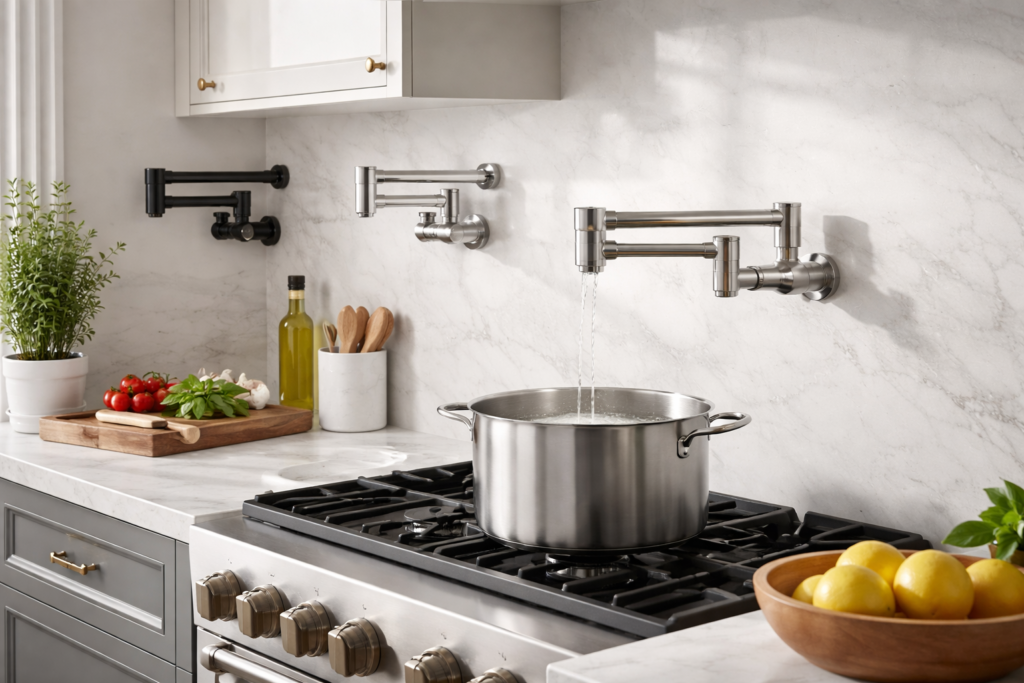
Most pot filler regrets come from the rough-in, not the faucet. A delta pot filler is a wall-mounted, cold-water faucet that folds flat against the backsplash behind your range, and every model in the current lineup shares the same basic plumbing: a single 1/2 inch IPS supply in the wall, a 4.0 gallon per minute flow rate at 60 psi, and dual shut-off valves (one at the wall, one at the spout). What separates the models is styling, finish choice and how the arm looks when it is folded away.
The short answer: Delta’s wall-mount pot filler family on its own site comes down to three designs. The Contemporary model (1165LF) has clean, squared-off lines. The Traditional model (1177LF) uses classic cross-style handles and curves. The Broderick model (1190LFL) belongs to the Broderick kitchen collection and suits transitional kitchens. All three are listed as ADA compliant and all three are offered in Champagne Bronze, the warm gold tone many people search for by name.
- Delta Pot Filler Models at a Glance
- How the Three Designs Differ in a Real Kitchen
- Choosing a Finish, Including Champagne Bronze
- Rough-In Specs and Planning
- Safety and Plumbing Basics
- Troubleshooting Common Problems
- Cost Ranges to Expect
- When to Call a Licensed Professional
- Frequently Asked Questions
Pick the style first, match the finish to your kitchen faucet and hardware, and then plan the supply line height before the drywall goes up. That order saves a lot of patching.
Delta Pot Filler Models at a Glance
The specs in this comparison come from the product pages on the manufacturer’s site. Delta does not list a single “reach” number on every page, so the arm length is shown as the swing-joint length it does publish. Check the current spec sheet for your exact model number and finish suffix before you order, since finishes go in and out of stock.
| Spec | Contemporary (1165LF) | Traditional (1177LF) | Broderick (1190LFL) |
|---|---|---|---|
| Style | Modern, squared profile | Classic curves, traditional handles | Transitional, matches Broderick kitchen faucets |
| Mounting | Single-hole wall mount | Single-hole wall mount | Single-hole wall mount |
| Supply connection | 1/2 inch IPS | 1/2 inch IPS | 1/2 inch IPS stub-out |
| Flow rate | 4.0 gpm at 60 psi | 4.0 gpm at 60 psi | 4.0 gpm at 60 psi |
| Arm and valves | 24 inch dual swing joints, dual shut-off | Dual swing joints, dual shut-off | 24 inch dual swing joints, dual shut-off |
| Height of fixture | About 8-1/8 inches | About 8-17/32 inches | About 8-1/2 inches |
| Finishes listed | Arctic Stainless, Black Stainless, Champagne Bronze, Chrome, Matte Black, Polished Nickel, Stainless | Arctic Stainless, Champagne Bronze, Chrome, Polished Nickel, Stainless, Venetian Bronze | Arctic Stainless, Black Stainless, Champagne Bronze, Chrome, Matte Black, Polished Nickel, Venetian Bronze |
| ADA | Listed as ADA compliant | Listed as ADA compliant | Listed as meeting ADA standards |
Two quick notes on the numbers. The “height” figure is the height of the fixture body itself, not how high you mount it. Also, Delta showed Black Stainless as out of stock on some model pages at the time of checking, so treat that finish as limited until the product page says otherwise.
How the Three Designs Differ in a Real Kitchen
Contemporary (1165LF)
Flat, geometric shapes and straight arm sections make this the cleanest-looking option. It pairs well with slab-door cabinets, quartz backsplashes and pro-style ranges with a squared hood. If you search for a delta contemporary pot filler, this is the model you are looking for. It has the widest finish list of the three, including Matte Black and the Champagne Bronze version (model 1165LF-CZ), which is the most common “gold” request in modern kitchens.
Traditional (1177LF)
Softer curves and classic handles make the Traditional model the natural partner for shaker or raised-panel cabinets, subway tile and farmhouse sinks. It skips Matte Black but adds Venetian Bronze, a dark oil-rubbed look that suits older homes and warm wood tones. The Champagne Bronze version is 1177LF-CZ.
Broderick (1190LFL)
This one sits in the middle. It belongs to Delta’s Broderick kitchen collection, so it is the easiest way to get a matched faucet and pot filler without guessing at profiles. It is offered in both Matte Black and Venetian Bronze, plus Champagne Bronze, which gives it the broadest dark-finish range. Delta’s page also states this model is cold water only, which is true of pot fillers in general.
Choosing a Finish, Including Champagne Bronze
The finish matters more than people expect because a pot filler sits at eye level in the middle of the cooking wall. A delta champagne bronze pot filler reads as a soft, warm gold rather than a bright brass. It works with white, cream, sage and navy cabinets, and it looks best when at least one other element in the room (cabinet pulls, a light fixture or the main faucet) carries the same tone.
- Chrome: the most forgiving finish for budgets and the easiest to match with older fixtures.
- Stainless and Arctic Stainless: blend with stainless appliances and range hoods. Arctic Stainless is a brighter, more polished stainless look.
- Matte Black: high contrast against white tile, available on Contemporary and Broderick.
- Polished Nickel: a warmer, slightly yellow silver that suits traditional kitchens.
- Venetian Bronze: dark and warm, available on Traditional and Broderick.
- Champagne Bronze: warm gold, available on all three designs.
Order a finish sample or view the actual product in person if you can. Screen colors shift gold tones a lot, and two “bronze” finishes from different makers rarely match exactly.
Rough-In Specs and Planning
Every delta pot filler model uses the same idea: a 1/2 inch IPS supply pipe comes straight out of the wall, and the fixture threads onto it. On the manufacturer’s Q&A for the Contemporary model, the company indicates no separate valve body is needed because the shut-off is built into the fixture. That makes the rough-in simpler than a wall-mount kitchen faucet, but it also means the stub-out position has to be right the first time.
Tools and materials for the rough-in
- 1/2 inch cold-water supply line (copper, PEX with a threaded drop-ear fitting, or similar per local code)
- Drop-ear elbow or wing fitting with 1/2 inch female or male IPS threads, depending on what the fixture requires
- Solid blocking between studs (2x lumber) to anchor the fitting
- Thread sealant tape or pipe dope rated for potable water
- Level, tape measure and a marker
- Test cap or plug to pressure-test before closing the wall
Step-by-step planning
- Center it on the cooktop. Most people center the pot filler on the range or on the most-used rear burner. Measure the center line of the cooktop and transfer it to the wall.
- Pick the height. Delta states it does not specify an install height, so it is up to you. Measure your tallest stockpot on the burner and add a few inches of clearance for the spout. Many installers end up roughly 18 to 24 inches above the cooktop surface, but your pots and hood decide it.
- Check the hood and backsplash. Confirm the folded arm will clear the hood liner and any tile niche or shelf. With 24 inch swing joints, the arm needs space to swing in both directions.
- Add blocking. Install horizontal blocking so the drop-ear fitting is rigid. A loose fitting will let the fixture droop over time.
- Set the stub-out depth. Plan for the finished wall thickness, including tile and thinset, so the threads land where the escutcheon can sit flat.
- Pressure-test. Cap the line and test for leaks before drywall and tile go up.
- Finish and install. After tile, thread the fixture on with sealant, square it to the wall, and check both shut-offs.
Safety and Plumbing Basics
Before you cut into any supply line, shut off the water at the main or the branch valve, open a faucet to relieve pressure, and drain the line. Plumbing work in a wall usually falls under local plumbing code, and many areas require a permit for new supply runs. If your kitchen is being remodeled, include the pot filler in the plumbing plan so the inspector sees it before the wall is closed.
Never tie a pot filler into the hot water supply. Hot water pulls more contaminants from pipes and water heaters, and Delta lists these fixtures as cold water only. If the wall behind your range has any wiring for a hood or outlet, turn off the breaker and confirm power is off with a non-contact voltage tester before you open the wall.
Troubleshooting Common Problems
- Drips from the spout: usually one of the two shut-offs is not fully closed, or debris is sitting on a ceramic valve. Close the wall valve first, then the spout valve, and see if it stops.
- Arm sags when folded: the supply fitting is not solidly anchored. This is a blocking problem and often needs the wall opened.
- Low flow: check the aerator for debris and confirm the line is a full 1/2 inch run, not reduced somewhere upstream.
- Escutcheon will not sit flat: the stub-out sticks out too far or not far enough. A plumber can adjust with the correct nipple length.
- Leak at the wall: shut the water off immediately. A leak inside the wall behind a range can damage the cabinets and subfloor quickly.
Cost Ranges to Expect
Pot fillers in these lines generally run from a few hundred dollars to over a thousand, depending on finish and model. Specialty finishes like Champagne Bronze and Polished Nickel tend to cost more than Chrome. Installation varies more than the fixture. If the wall is already open during a remodel, adding a supply line is usually a modest plumbing charge. Retrofitting into a finished, tiled wall can cost several times more once you add tile removal, patching and new backsplash work.
If you are still comparing brands, a general pot filler faucet guide helps you weigh wall-mount against deck-mount designs. Delta’s current pot filler lineup on its own site is all wall-mount, so if you need a deck-mount unit you will be shopping other styles.
When to Call a Licensed Professional
Call a licensed plumber when you need a new supply line run through an exterior wall, a wall without easy access, or any wall shared with gas lines for the range. Gas work is licensed-pro only. If you ever smell gas, leave the house and call your gas utility. A licensed plumber also knows whether your area needs a permit and inspection for new supply lines, and can pressure-test the run before tile goes up.
Bring in a licensed electrician if the work involves moving an outlet, a hood circuit or any wiring in the same wall cavity. If the wall is load-bearing or you need to notch studs to fit the supply, have a contractor confirm the framing before cutting.
Frequently Asked Questions
Does a Delta pot filler need hot water?
No. Delta lists its pot fillers as cold water only. You fill the pot with cold water and heat it on the burner, which is also the safer choice for drinking and cooking water.
What size supply line does a Delta pot filler use?
The current wall-mount models connect to a 1/2 inch IPS supply. Plan a solid 1/2 inch stub-out anchored to blocking in the wall.
Which Delta pot filler comes in Champagne Bronze?
The Contemporary, Traditional and Broderick wall-mount models are all listed in Champagne Bronze on the manufacturer’s site, though stock can vary by finish.
How high should a pot filler be mounted?
Delta does not give a required height. Measure your tallest pot on the burner and add clearance for the spout. Many kitchens land roughly 18 to 24 inches above the cooktop.
Can I install a pot filler without opening the wall?
Rarely. The supply has to come straight out of the wall behind the range, so most retrofits mean opening drywall or removing backsplash tile.
What is the flow rate of a Delta pot filler?
The current models list 4.0 gallons per minute at 60 psi, which fills a large stockpot much faster than a standard kitchen faucet.