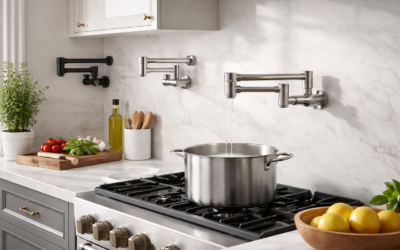
A wall-mounted faucet looks simple once it is installed, but the hard part happens inside the wall weeks earlier. Every Delta wall mount faucet is sold as a visible trim kit plus a separate rough-in valve, and if the valve is set at the wrong depth or the wrong height, the trim will not fit. Choosing the trim first, then buying the exact rough-in it calls for, is the single most important step.
In short, Delta’s wall-mount lineup falls into three groups: single-handle wall-mount bathroom faucets that use the R3510-WL rough-in, two-handle wall-mount bathroom faucets and wall-mount tub fillers that share the R3500-WL rough-in, and tub setups with a hand shower, which require a different valve arrangement because the two-handle wall rough has no extra outlet for a hose. Spout reach on the wall-mount tub fillers runs about 11-1/2 inches, while the single-handle bathroom trim sits much closer to the wall.
- Delta Wall Mount Faucet Options and Rough-In Valves
- Single-Handle Wall-Mount Bathroom Faucets
- Two-Handle Wall-Mount Faucets and the R3500-WL
- Delta Wall-Mount Tub Fillers
- Planning the Rough-In Step by Step
- Troubleshooting Wall-Mount Faucet Problems
- Cost Ranges
- When to Call a Licensed Professional
- Frequently Asked Questions
- Which rough-in valve does a Delta wall mount faucet need?
- Does Delta make a wall mount tub filler with hand shower?
- How far does a Delta wall-mount tub filler reach?
- Is the Trinsic wall mount tub filler still available?
- Can I install a wall-mount faucet without opening the wall?
- What depth does the R3500-WL need?
Specifications here come from Delta’s product pages and spec sheets. Models change and get discontinued, so confirm the current spec sheet for the exact trim number before you frame or tile.
Delta Wall Mount Faucet Options and Rough-In Valves
The table summarizes the common configurations and what each one needs inside the wall.
| Configuration | Example trim | Rough-in valve | Key dimensions |
|---|---|---|---|
| Single-handle wall-mount bathroom faucet | Trinsic T3559LF-WL | R3510-WL (sold separately) | 2-hole, handle 4 to 8 in from spout; rough depth 2-1/4 to 3-1/4 in; 1.2 gpm |
| Two-handle wall-mount bathroom faucet | Various two-handle WL trims | R3500-WL | 3-hole, 8 in centers; rough depth 2-3/4 in, plus or minus 1/2 in |
| Two-handle wall-mount tub filler | T5759-WL | R3500-WL | 3-hole, 8 in; rigid spout about 11-2/5 in long |
| Two-handle wall-mount tub filler (discontinued) | Pivotal T5799-WL | R3500-WL | 3-hole, 8 in; spout extends about 11-1/2 in from wall |
| Tub with hand shower | Deck-mount Roman tub trims, or shower valve with diverter spout | Not R3500-WL (no hand shower outlet) | Deck mount uses a separate roman tub rough-in with hand shower connection |
Single-Handle Wall-Mount Bathroom Faucets
The Trinsic single-handle wall-mount bathroom faucet (trim T3559LF-WL) is the clean, minimal option most people picture for a vessel sink. Delta lists it as a two-hole design where the handle can sit on either side of the spout, spaced 4 to 8 inches apart. The spout does not swivel, which is normal for wall-mount lavatory spouts, and flow is rated at 1.2 gallons per minute at 60 psi.
It requires the R3510-WL rough-in, not the two-handle R3500-WL. Delta’s spec sheet gives a rough-in depth range of 2-1/4 to 3-1/4 inches, which is the distance from the valve mounting surface to the finished wall face. That range has to cover your drywall or cement board, thinset and tile combined, so measure the finished wall thickness before you anchor the valve.
Spout reach and sink placement
Delta’s product page does not list a formal spout reach for this trim; a published answer on the product page puts it around 7-1/2 inches, so measure a display unit or ask the supplier if the exact figure matters. Because the spout cannot be moved after installation, center the vessel or wall-hung sink on the spout’s flow point, not on the wall. Mount the spout high enough to clear the sink rim by a few inches, but not so high that water splashes out of a shallow bowl.
Two-Handle Wall-Mount Faucets and the R3500-WL
The R3500-WL is Delta’s two-handle wall-mount rough. Its spec sheet describes a lead-free brass body with 1/2-inch NPT connections, 8-inch centers between the hot and cold valves, and an overall body width of about 10-1/4 inches. Depth from the mounting surface to the finished wall is 2-3/4 inches with a tolerance of about 1/2 inch either way. It ships with the valves and plaster guards, and the trim is ordered separately.
Delta describes this rough as being for two-handle wall-mount lavatory faucets and wall-mount tub fillers. That shared valve is convenient: a plumber who has installed one knows the layout for the other. The catch is that it only has hot, cold and spout outlets, so there is no port for a hand shower.
Delta Wall-Mount Tub Fillers
For freestanding tubs placed against a wall, or for drop-in tubs where you want a clean deck, a wall-mount tub filler moves the water source into the wall. Delta’s T5759-WL is a two-handle wall-mount tub filler trim with a rigid spout about 11-2/5 inches long, a 3-hole 8-inch installation, and the R3500-WL required to complete it. Some retailers list it under the Trinsic name; Delta files it in a contemporary bathroom collection. The Pivotal T5799-WL, with a spout that extends about 11-1/2 inches from the wall, is marked discontinued on Delta’s site, though stock may remain at some suppliers.
Spout reach determines where the tub sits. With a reach around 11-1/2 inches, the spout outlet should land a few inches inside the tub rim. Many freestanding tubs have a wide, rolled rim that eats up 3 to 5 inches, so set the tub position on paper before the valve goes in.
What about a Delta wall mount tub filler with a hand shower?
This is the most common surprise. The R3500-WL rough does not provide a separate connection for a hand shower, and Delta’s wall-mount tub filler trims do not include one. If you want a hand shower at the tub, the usual options are a deck-mounted Roman tub faucet with hand shower (which uses a deck rough-in with a hand shower connection, such as the R4707), or a standard shower valve feeding a diverter tub spout and a wall-mounted hand shower on a slide bar. A plumber can lay out either before the walls close.
Planning the Rough-In Step by Step
- Pick the exact trim number. Download its spec sheet and note the required rough-in and depth range.
- Set fixture positions. Mark the sink or tub location, then work back to the spout height and centerline.
- Add blocking. Install horizontal 2x blocking between studs so the valve body can be anchored solidly. A loose valve leads to wobbly handles and leaks.
- Calculate finished wall thickness. Add backer board, waterproofing membrane, thinset and tile. Set the valve so the finished face lands inside the allowed depth range.
- Use plaster guards. Keep the guards on through drywall and tile to protect the valve and mark the cutouts.
- Pressure test before closing the wall. Leaks found after tile are expensive.
- Install trim after finishes. Trim goes on last, after grout and caulk cure.
Troubleshooting Wall-Mount Faucet Problems
- Trim sits proud of the wall or will not reach the valve. The valve was set outside the depth range. Ask the manufacturer whether an extension kit exists for your valve; otherwise the wall must be opened and the valve reset.
- Water splashes out of the sink. The spout is too high or the reach is too short for the bowl. A lower-flow aerator can help.
- Handles feel loose. Usually inadequate blocking behind the valve.
- Slow tub filling. Water pressure, supply line size and the trim’s design all affect fill rate; reviewers on some wall-mount fillers report slower flow than expected, so check flow ratings and supply sizing before buying.
- Hot and cold reversed. On two-handle roughs, check the supply connections before closing the wall.
Cost Ranges
Wall-mount trims generally cost more than comparable deck-mount faucets, and the rough-in valve is an added purchase. Expect the trim and rough combined to run from a few hundred dollars for a basic bathroom faucet into the higher hundreds or more for a tub filler in a specialty finish. Labor adds the bigger share: a plumber running new supply lines in an open wall typically charges a few hundred dollars, while opening a finished tile wall, rerouting supplies and retiling can reach well into four figures.
When to Call a Licensed Professional
Wall-mount faucets involve concealed supply lines that must be soldered, crimped or threaded correctly and pressure tested before walls close. Shut off the water and relieve pressure before any work on existing lines. Most jurisdictions require a permit for new supply runs, and a licensed plumber should handle relocating lines, setting the valve depth and inspections. If the project also moves walls, adds a tub that changes floor loading, or involves electrical work for lighting or a heated floor, bring in the relevant licensed trades. Freestanding tubs filled with water and a person can be very heavy, so have a contractor confirm the floor framing can carry the load.
Frequently Asked Questions
Which rough-in valve does a Delta wall mount faucet need?
Single-handle wall-mount bathroom trims such as T3559LF-WL use the R3510-WL. Two-handle wall-mount bathroom faucets and wall-mount tub fillers use the R3500-WL. Always confirm on the trim’s spec sheet.
Does Delta make a wall mount tub filler with hand shower?
Delta’s wall-mount tub filler trims do not include a hand shower, and the R3500-WL rough has no outlet for one. A deck-mount Roman tub faucet with hand shower or a shower valve with a diverter spout are the usual alternatives.
How far does a Delta wall-mount tub filler reach?
Current and recent models extend roughly 11-1/2 inches from the wall. Check the specific trim’s spec sheet and allow for the width of the tub rim.
Is the Trinsic wall mount tub filler still available?
Availability changes. Delta lists the T5759-WL as a current wall-mount filler, and some retailers sell it under the Trinsic name, while the Pivotal T5799-WL is marked discontinued.
Can I install a wall-mount faucet without opening the wall?
No. The rough-in valve mounts inside the wall cavity and needs blocking and new supply connections, so the wall must be open on at least one side.
What depth does the R3500-WL need?
Delta’s spec sheet shows 2-3/4 inches from the mounting surface to the finished wall, with about 1/2 inch of tolerance either way.