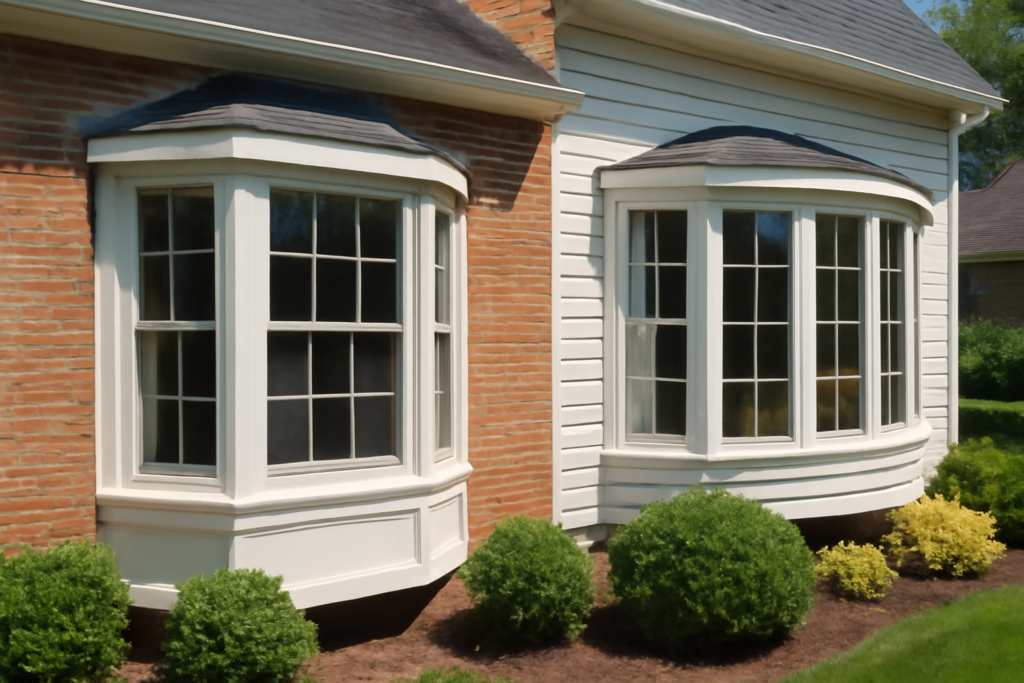
Walk down any older street and you will see both, often on houses built the same year, yet most homeowners cannot tell them apart until they are shopping for one. The difference between bay and bow window comes down to a single controlling idea: a bay window is built from a few flat panels set at sharp angles, while a bow window is built from several equal panels set on a gentle curve. Everything else, from cost to the light they let in, flows from that one distinction.
Part of our Windows & Doors guide — explore the full guide →
Understanding the difference between bay and bow window before you call a contractor saves you from ordering the wrong shape for your room. Both project outward from the wall and create a shelf or seat inside, but they do it with different geometry, different panel counts, and noticeably different price tags. Here is how to tell which one belongs on your house.
The Core Distinction: Angles Versus a Curve
A bay window is typically made of three sections. A large fixed picture window sits in the center, flanked by two smaller windows angled back toward the wall at 30, 45, or sometimes 90 degrees. Those hard angles give a bay its bold, faceted look and a deep central projection. It reads as an architectural statement, almost like a small alcove pushed out from the room.
A bow window uses four, five, or six windows of equal size, joined at shallow angles so the whole assembly sweeps out in a smooth arc. Because each joint bends only slightly, the result is a rounded, gentle curve rather than sharp corners. Where a bay juts out assertively, a bow flows. Stand back from each and the difference is obvious: one has clear facets, the other has a graceful bend.
Panel Count and Window Types
The number of glass units is the fastest way to identify each style. Bay windows almost always use three units. Bow windows use four or more, and five is the most common configuration. That difference in count is what lets a bow trace a curve while a bay stays angular.
The window types differ too. In a bay, the center is usually a large fixed pane for maximum view, with the flanking windows often operable as casements or double-hungs for ventilation. In a bow, the equal-sized units are frequently all the same type, and many are fixed, though you can order some as operable casements. If cross-ventilation matters to you, ask specifically which units open before you sign off on a design.
Projection, Interior Space, and the Window Seat
Both styles bump outward, but they create different interior real estate. A bay projects farther from the wall at its center because of its steep flanking angles, so it produces a deeper shelf. That deep, angular ledge is why bays are the classic choice for a reading nook, a kitchen herb shelf, or a cushioned window seat.
A bow projects less deeply but spreads its bump across a wider section of wall. Instead of one deep pocket, you get a broad, curved shelf that follows the arc. This makes a bow feel more like a panoramic extension of the room and less like a distinct alcove. If you want a cozy seat to tuck into, lean bay. If you want a sweeping wall of glass and a wider, shallower ledge, lean bow.
Light and Views
Here the bow often wins on sheer glass area. With four to six panels wrapping around a curve, a bow window pulls in light from a wide range of angles and gives you an almost 180-degree panorama on a generous install. Rooms facing a garden or a long view benefit from that wraparound glass.
A bay still floods a room with light thanks to its large central pane, and its angled sides catch morning and afternoon sun from different directions. The practical takeaway is simple. For the widest, most immersive view and the most daylight across a broad wall, a bow generally edges ahead. For a strong central view with a dramatic sense of depth, a bay delivers.
Cost Comparison
Money is where many homeowners make their decision, and the gap is meaningful. Because a bow uses more window units and requires more precise assembly to form its curve, it almost always costs more than a comparable bay. As a rough guide, an installed bay window commonly runs somewhere in the range of 1,000 to 3,500 dollars, while a bow window often lands between 2,000 and 6,000 dollars or more, depending on size, glass package, and materials.
Several factors move those numbers. More panels mean more frames, more glass, and more labor. Custom curves, energy-efficient low-emissivity coatings, and premium frame materials all add cost. Structural work also matters: both styles project beyond the wall and may need proper support below and flashing above, which adds to installation on either type.
Installation and Structural Support
Neither window is a simple swap-in-place job. Because both hang off the wall, they need real support. Smaller units may rely on cable-supported systems anchored into the framing above, while larger and heavier assemblies often use knee braces or a supporting roof structure beneath. A bow, spreading its weight across a wider curved opening, can demand careful framing to carry the load evenly.
Weatherproofing is critical on both. The roof cap over the projection, the flashing where it meets the wall, and the insulation of the seat board all determine whether the window stays dry and energy efficient for decades. This is not a place to cut corners, and it is a strong argument for hiring an experienced installer rather than attempting a first-time DIY on such a large opening.
Which One Is Right for Your Home
Match the window to your goal and your budget. Choose a bay when you want a defined nook or window seat, a strong central view, a more assertive exterior look, and a lower price. Choose a bow when you want maximum glass, a soft curved silhouette that suits Victorian and traditional homes, a wide panoramic view, and you have room in the budget for the extra panels.
Architectural style plays a role too. Bows often complement ornate, historic facades, while bays suit a huge range of homes from cottages to contemporary builds. When you weigh the difference between bay and bow window, start with the angles-versus-curve idea, then layer on your priorities for space, light, and cost. Get those straight and the right choice usually becomes obvious before the salesperson even opens the brochure.
Energy Efficiency and Maintenance
Any window that projects from the wall has more surface area exposed to the weather than a flat window, so the glass package and the seal quality matter more, not less. Look for double-pane or triple-pane insulated glass with a low-emissivity coating and an argon gas fill, which cut heat loss in winter and heat gain in summer. The seat board and the roof cap over the projection should be well insulated, because those are the spots where a poorly built bay or bow leaks conditioned air and lets in drafts.
Maintenance runs similar for both, though the bow’s extra panels mean more frames to clean and more seals to eventually service. The little roof over the projection needs its flashing checked periodically so water does not work its way behind the unit. Operable side windows on either style have moving parts, weatherstripping, and locks that wear over time. Neither type is high-maintenance in normal use, but the larger the assembly, the more surfaces there are to keep an eye on.
Quick Side-by-Side Comparison
When you strip it down, a few points decide most purchases:
- Shape: bay is angular with three panels; bow is curved with four to six panels.
- Projection: bay juts out deeper at the center; bow projects less but spans wider.
- Interior use: bay favors a deep window seat or nook; bow gives a broad, shallow ledge.
- Light and view: bow offers wider panoramic glass; bay centers on a big picture pane.
- Cost: bay is generally the more affordable of the two.
- Style fit: bows lean traditional and Victorian; bays suit nearly any home.
Run your room and your budget through those six lines and the decision tends to settle itself. If you want a defined seat and a lower price, the bay wins. If you want the sweeping wall of glass and the softer profile, and the budget allows, the bow earns its premium. One more practical note: a bow often needs a wider stretch of unbroken wall to look right, so measure the run before you fall in love with the curve. A bay can slot into a narrower opening and still make its statement, which is part of why it shows up on such a wide range of homes.