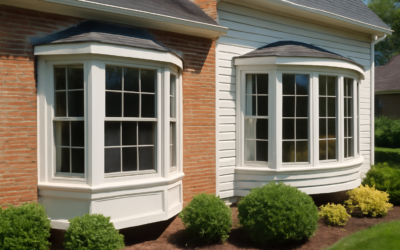
Homeowners use the two names interchangeably, and window salespeople rarely correct them — right up until the quote arrives and one option costs 30 percent more than the other. Bay and bow windows are both projection windows that angle outward from the house, add interior space, and flood a room with light, but they are built differently, priced differently, and suit different walls. A bay is three windows joined at sharp angles; a bow is four to six windows forming a gentle curve. That single structural difference drives everything else: cost, light, ventilation, and even which architectural styles each one flatters.
Part of our Windows & Doors guide — explore the full guide →
- The Structural Difference in Plain Terms
- Cost Comparison
- Light, View, and How Each Feels Inside
- Ventilation and Practical Performance
- Which Suits Your House and Wall
- Installation Realities for Either Choice
- Garden Windows and Box Bays: The Small-Space Cousins
- Dressing the Interior: Seats, Treatments, and Trim
- The Bottom Line
The Structural Difference in Plain Terms
A bay window is a three-unit assembly: a large fixed picture window in the center, flanked by two smaller windows set at an angle — most commonly 30 or 45 degrees, occasionally 60 or a boxy 90. The flankers are usually operable double-hung or casement units. Because there are only two joints, the projection is angular and pushes relatively far into the yard: a 45-degree bay projects 18 to 24 inches from the wall on a typical 6- to 8-foot opening.
A bow window uses four, five, or six equal-sized window units (lites) joined at shallow 10- to 15-degree angles so the assembly reads as a curve. The gentle arc means a bow projects less — usually 12 to 18 inches — but spans wider along the wall, commonly 8 to 12 feet. More units mean more mullions, more seals, and more labor, which is the root of the price gap.
Cost Comparison
Expect these installed ranges for a quality vinyl or clad-wood unit with insulated Low-E glass:
- Bay window: $2,000 to $5,500 installed; premium wood-clad or oversized units to $7,000
- Bow window: $3,000 to $8,500 installed; six-lite and radius-roof versions can pass $10,000
Figure a bow at roughly 25 to 40 percent more than a comparable-width bay because of the extra units and fabrication. Both carry costs a flat replacement window never sees: a support system (steel cables to the header or knee braces below, $200 to $600), an insulated seat board, and a small hip or “bird box” roof over the projection if the main roof overhang does not cover it — that roof alone adds $500 to $1,500. If the existing opening must be widened, add $1,000 to $3,000 for the header work, and always a permit, since you are altering structure.
Light, View, and How Each Feels Inside
Bows win on raw light. Four to six panes wrapping a curve catch sun across a wider arc of the sky, and on a corner installation a bow can wrap the corner itself — a dramatic option bays cannot match. The curve casts soft, even light with slim sightline interruptions.
Bays win on view and usable depth. The big uninterrupted center pane frames a yard like a picture, with no mullions in the middle of the scene, and the deeper projection creates a genuinely usable seat or shelf — an 18- to 24-inch-deep bay seat holds cushions, a reading nook, or a plant collection. A bow’s 12-to-15-inch shelf is more of a display ledge. If your goal is a window seat you will actually sit in, that is a bay conversation.
Ventilation and Practical Performance
Ventilation depends on how many lites open. A standard bay gives you two operable flankers, which create excellent cross-breeze at an angle to the wall. Bow units are often sold all-fixed for cost reasons, but ordering casements at the two ends (or alternating operable lites) matches or beats a bay’s airflow — specify this at ordering, because it cannot be changed later. Energy performance is similar per square foot of glass with equal glazing packages, but note that both styles add glass area to the wall, and the projection’s roof, seat board, and skirt must be insulated properly (closed-cell foam in the seat and head, R-15 or better) or the nook becomes the coldest spot in the house every January. On cleaning and maintenance: more mullions on a bow mean more seals to inspect and more glass edges to squeegee, while the bay’s big fixed pane is the easier daily-life window.
Which Suits Your House and Wall
Architecture gives a strong hint. Bays, with their crisp angles, suit Victorians, Craftsman homes, colonials, and most traditional American styles — they read as classic. Bows, with their soft curve, flatter brick traditional, Tudor, and larger formal facades, and they are the only choice for a curved turret look or a wraparound corner. Wall width is the practical filter: a bow needs 8-plus feet of clear wall to look proportional, while a bay works handsomely in a 6-foot opening. Projection clearance matters too — check your property’s setback rules and anything below the window outside, because a 24-inch bay projection over a walkway can clip head height, and both styles need clearance from porch roofs and utility runs inside the wall.
Installation Realities for Either Choice
Neither is a DIY swap. A projection window assembly for an 8-foot opening weighs 300 to 600 pounds, must be supported independently of its nailing fin (cable rods from the header above or braces beneath), flashed on three planes, and roofed. Good crews install one in a long day on an existing same-size opening; opening up a wall stretches it to two or three days. Two specification tips that pay off: order the seat board in a finished hardwood or a solid-surface material rather than the builder-grade veneer (you will look at and touch it every day), and insist on factory-mulled units rather than site-joined singles — factory joints are engineered, warrantied, and far less likely to leak at the seams.
Garden Windows and Box Bays: The Small-Space Cousins
Two smaller relatives are worth knowing before you commit. A garden window is essentially a mini greenhouse bay for kitchens — a boxed projection about 3 to 4 feet wide with a glass roof and side vents, sized to replace a standard window over the sink for $1,000 to $2,500 installed. It adds herb-shelf space and light without structural drama, since most garden windows hang from the existing opening with brackets rather than requiring header work. A box bay uses 90-degree returns instead of angled flankers, creating a squared-off projection that suits contemporary homes and maximizes the flat seat area within a modest 12-to-16-inch projection. Both options make sense when the wall, the budget, or the setback rules cannot absorb a full bay or bow — and both still deliver the psychological payoff of these windows, which is glass wrapping you on three sides instead of one.
Dressing the Interior: Seats, Treatments, and Trim
Plan the inside before ordering, because the projection creates finish questions a flat window never asks. The seat board is prime real estate — on a bay, deep enough for a cushioned bench with storage drawers below if you frame a knee wall; on a bow, better treated as a display shelf with a hardwood or stone cap. Window treatments need the geometry considered up front: a bay takes three separate shades or inside-mount blinds easily, while a bow’s four to six narrow lites usually look best with individual cellular shades or a curved track rod ($80 to $250) sweeping drapery across the whole arc. Ask the installer to run electrical while the wall is open if you want outlets in the seat area — code requires receptacles along usable wall space, and a bay seat with an outlet becomes a favorite laptop perch. Finally, budget for interior trim beyond the standard picture-frame casing; the angled head and seat joints on a projection window are genuine finish carpentry, and skimping there undercuts everything you paid for outside.
The Bottom Line
Choose a bay when you want maximum projection and a real window seat, a clean center view, strong angles that suit a traditional facade, or the lower price — it delivers about 80 percent of the drama for 70 percent of the money. Choose a bow when the wall is wide, the goal is a soft, light-drenched curve, or you want to wrap a corner. Either one transforms a flat room in a way no ordinary replacement window can, typically returning a healthy share of its cost in resale appeal — appraisers and buyers consistently treat projection windows as an upgrade, not a repair. Decide based on the wall you have and the seat you want, and you will not regret either answer.