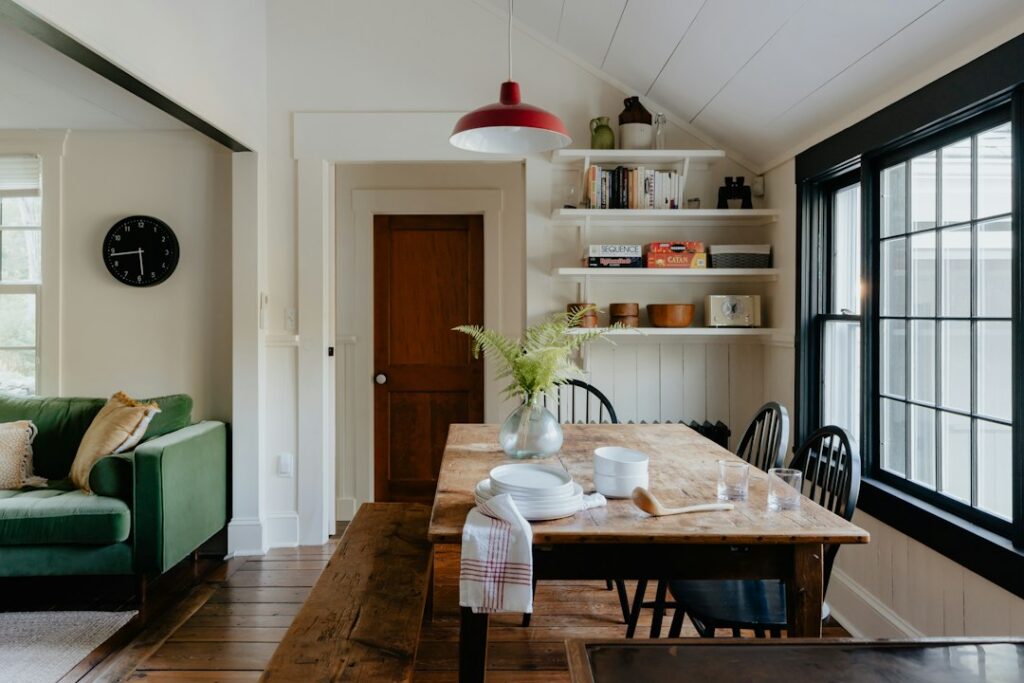
In a lot of homes the formal dining room sees use maybe six times a year, while someone in the house works from a laptop on the kitchen counter every single day. A dining room office combo fixes that mismatch by giving the room a daily job without giving up the ability to host a holiday meal. The approach that works is simple: keep the table, add a dedicated work zone along one wall, and store everything work-related behind doors so the room can switch modes in five minutes.
Most dining rooms are 10 by 12 to 12 by 14 feet, which leaves enough wall space for a desk run or a bank of cabinets once you account for chair clearance around the table. The layouts that fail are the ones that try to use the dining table itself as the desk. Papers, monitors and chargers creep across it, and clearing it for guests turns into a chore nobody wants to do.
- Planning a Dining Room Office Combo Layout
- Closed Storage for Quick Mode Switching
- Desk Options That Blend With Dining Furniture
- Lighting for Work and Dinner
- Outlets, Cables and Internet
- Step-by-Step Conversion Plan
- Troubleshooting Common Problems
- Cost Ranges
- When to Call a Pro
- Frequently Asked Questions
Behind every successful conversion are four decisions: where the desk goes, how the work gear hides, how the room is lit for both tasks, and where power comes from. Plan each one and the room serves as an office on weekdays and a dining room on the weekend.
Planning a Dining Room Office Combo Layout
Start by measuring the table with chairs pulled out. You need about 36 inches from the table edge to a wall or furniture for someone to sit down and stand up comfortably, and 42 to 48 inches where people will walk behind seated diners. Whatever wall space remains outside those zones is where the office lives.
Three layouts cover most rooms:
- Wall desk run: a 20 to 24 inch deep desk surface along the longest free wall, often built from base cabinets and a countertop. Best for rooms with one long uninterrupted wall.
- Window desk: a desk under a window for daylight, flanked by tall closed cabinets. Great for focus, though screen glare needs managing with blinds or sheers.
- Library wall with a pull-out desk: floor-to-ceiling bookcases with closed lower doors and a fold-down or slide-out work surface. Ideal when the room is small and you want the office to disappear completely.
If the room is on the smaller side, consider a round or oval table. A 48 inch round seats four and takes less floor area than a rectangle, which frees a wall for the work zone. Extension leaves then let you seat six or eight when company comes.
Closed Storage for Quick Mode Switching
Open shelving looks great in photos, but in a shared room it becomes a display of cables, paper stacks and printer ink. Closed storage is what lets a dining room office combo read as a dining room at dinner time. A closed storage bookcase with glass or open shelves on top for books and serving pieces, and solid doors on the bottom for files and electronics, handles both roles well.
Plan storage for these specific items:
- A printer or scanner on a pull-out shelf with a ventilation gap behind it
- File boxes or a two-drawer lateral file
- A drawer or bin for chargers, headsets and a spare keyboard
- Serving platters, table linens and candles, so the dining side has storage too
Buffets and sideboards can double as office storage. A 60 to 72 inch sideboard holds a printer in one cabinet and table linens in another, and its top works as a serving surface during parties and a document staging area during the week.
Desk Options That Blend With Dining Furniture
Match the desk to the dining furniture in wood tone or paint color so the room looks planned rather than cluttered. A built-in desk made from stock base cabinets with a matching countertop costs less than custom millwork and gives you drawers at the right height. Standard desk height is 28 to 30 inches, while base cabinets with a countertop land around 36 inches, so if you build from kitchen cabinets, use shorter vanity or desk-height boxes or plan on a counter-height chair.
Other options that work well:
- Secretary desk: a traditional piece with a fold-down writing surface that closes up to hide a laptop.
- Console-style writing desk: slim at 16 to 20 inches deep, it sits behind a sofa or along a wall and passes for a hall table.
- Armoire office: a tall cabinet with doors that open to reveal a desk surface, shelves and cord holes.
Choose a desk chair that looks at home next to dining chairs. Upholstered task chairs in linen or leather with a simple frame blend better than mesh gaming chairs. Some people simply use an upholstered dining armchair with a seat cushion, which works for shorter sessions.
Lighting for Work and Dinner
A dining room usually has one central fixture over the table and little else. That is fine for a meal but poor for eight hours of screen work. Layer the lighting so each activity gets its own source:
- Task light at the desk: a desk lamp or wall-mounted swing-arm light, 3000K to 4000K, aimed to the side of your screen to avoid glare.
- Ambient light: the existing chandelier on a dimmer, turned down for dinner and up for general tidying.
- Accent light: lamps on a sideboard or lighting inside glass-front cabinets, which make the room feel finished in the evening.
Position the desk so a window is beside you, not behind the monitor or behind your head. A window behind the screen causes eye strain, and one behind you puts glare on the screen and leaves your face in shadow on video calls.
Outlets, Cables and Internet
Power is where a dining room office combo most often comes up short. Dining rooms were often wired with just a few outlets, spaced for a lamp and a buffet. A workstation with a monitor, laptop, printer, lamp and router needs more than that, and running extension cords across the floor creates trip hazards.
Practical steps:
- Map the existing outlets before choosing the desk location, and place the desk where one already exists if possible.
- Use a single surge protector plugged directly into the wall outlet. Do not daisy-chain power strips together or run them from extension cords.
- Route cords with a cable tray under the desk and adhesive raceways along the wall to keep them out of sight.
- Drill a grommet hole through the back of cabinets so the printer and charging drawer can reach power cleanly.
- Consider a mesh network node or a wired connection if the dining room sits far from the router.
If you replace an existing outlet with one that has built-in USB ports, turn off the breaker first and confirm power is off with a non-contact voltage tester before removing the cover plate. Never work on a receptacle with the circuit live. Adding new outlets, moving outlets or putting in a floor outlet under the table is a job for a licensed electrician, and it often requires a permit.
Step-by-Step Conversion Plan
- Clear and measure. Remove clutter, measure the room, and mark table clearance zones on the floor with painter’s tape.
- Choose the work wall. Pick the wall with an outlet and good daylight that sits outside the table clearance zone.
- Protect the floor. Place a chair mat or low-pile rug under the desk chair so casters do not scratch hardwood or dent vinyl plank.
- Install storage. Anchor tall bookcases and cabinets to wall studs with anti-tip hardware, especially in homes with kids.
- Set up the desk and power. Run cables before moving heavy furniture into place.
- Add lighting. Place the task lamp and check for screen glare at the times you usually work.
- Create a reset routine. Assign a bin or drawer for the laptop and papers so clearing the room for dinner takes minutes.
Troubleshooting Common Problems
The room still feels like an office at dinner. Add doors or a fabric panel to open shelving, and close laptop lids and cabinet doors before guests arrive. A table runner and centerpiece shift the mood quickly.
Noise and echo on video calls. Dining rooms with hard floors and bare walls bounce sound. A large area rug under the table, lined curtains and a full bookcase all absorb noise.
Not enough outlets. Rearrange so the desk sits near existing power, and use one wall-plugged surge protector rather than stacking strips. If that is still not enough, have an electrician add a receptacle.
Cost Ranges
A simple dining room office combo using furniture you already own plus a desk, lamp and surge protector can come in at a few hundred dollars. Adding a closed storage bookcase wall or sideboard pushes the budget into the low thousands. Semi-custom built-ins with a desk run and upper cabinets typically cost several thousand dollars depending on size and finish, and electrical work for new outlets is priced by the electrician based on access and distance to the panel.
When to Call a Pro
Call a licensed electrician for new outlets, circuits or any change to existing wiring beyond a direct device swap. Hire a finish carpenter or cabinet installer when you want built-ins that match existing trim or need to scribe cabinets to out-of-plumb walls. For heavy bookcases on plaster walls, a carpenter can locate framing and install proper anchoring.
Frequently Asked Questions
Can a dining room be used as a home office?
Yes. Keep the table for meals, add a desk along a free wall, and store work equipment in closed cabinets so the room can switch back for hosting.
How much space do I need around a dining table if I add a desk?
Leave about 36 inches from the table edge to the desk or wall for seating, and 42 to 48 inches where people walk behind chairs.
How do I hide office clutter in a dining room?
Use closed storage such as bookcases with lower doors, a sideboard or an armoire office, plus a single bin for your laptop and papers.
Is it safe to use power strips for a dining room workstation?
Plug one surge protector directly into a wall outlet and avoid chaining strips or extension cords. If you need more outlets, have an electrician add them.
What lighting works best for a combined dining room and office?
Use a task lamp at the desk, keep the chandelier on a dimmer for dinner, and add accent lamps on a sideboard for evening ambience.