The short answer to does insulation have asbestos is: some types from before 1990 absolutely do, and the only way to know for sure is a $40 lab test. Vermiculite attic insulation, pipe-wrap insulation, and certain industrial board insulations were manufactured with asbestos fibers through the 1970s and into the early 1980s. If your house was built or renovated before 1990, this guide walks through identification, testing, and the realistic cost of safe handling.
- Which Insulation Types May Contain Asbestos
- Identifying Vermiculite by Sight
- Pipe Wrap and Duct Insulation
- Testing: The Only Real Answer
- What to Do If a Sample Tests Positive
- Cost Breakdown for Professional Abatement
- DIY Insulation Work in Older Homes
- Selling or Buying a Home With Asbestos Insulation
- Health Risks From Exposure
- When Encapsulation Beats Removal
Which Insulation Types May Contain Asbestos
Not every old insulation is dangerous. The four products with the strongest connection to asbestos contamination are:
- Vermiculite attic insulation (especially Zonolite brand mined in Libby, Montana 1923-1990)
- Pipe wrap insulation on steam and hot-water pipes in basements
- Boiler and HVAC duct wrap (white or gray fibrous tape)
- Asbestos millboard and corrugated panel insulation in older furnace surrounds
Modern fiberglass batts (pink, yellow, or white), blown cellulose (gray-brown shredded paper), mineral wool (dense brown or pink), and spray foam never contained asbestos. If you can identify the product by sight and the home was built after 1990, asbestos is functionally not a concern.
Identifying Vermiculite by Sight
Vermiculite looks like silver-gray, gold, or brown pebbles roughly the size of pencil erasers. The pieces are accordion-shaped, lightweight, and pour like coarse sand. Run a flashlight across an attic that has not been touched in 40 years — if you see those pebble-like granules, do not disturb them.
The EPA estimates that 70% to 80% of vermiculite sold for home insulation between 1940 and 1990 came from the Libby mine and was contaminated with tremolite asbestos. The Zonolite Attic Insulation Trust still accepts claims from affected homeowners for partial reimbursement of removal costs.
Pipe Wrap and Duct Insulation
Pipe wrap insulation in older basements often contains 35% to 80% chrysotile asbestos. Look for chalky white or gray fibrous material wrapped around steam pipes, often covered by a canvas or paper outer layer. Air cell pipe insulation looks like corrugated cardboard wrapped around the pipe.
Duct insulation made before 1980 sometimes used asbestos felt or millboard inside the metal housings on coal-converted furnaces and old oil boilers. Indicators include a powdery white residue, fraying canvas, or visible repair tape with a woven pattern. Do not poke, prod, or remove any of this material yourself.
Testing: The Only Real Answer
Visual identification points you toward suspect material but cannot confirm asbestos content. Send samples to an accredited lab certified under the National Voluntary Laboratory Accreditation Program (NVLAP). Mail-in testing through EMSL Analytical, Asbestos Testing Lab, or Schneider Laboratories runs $30 to $60 per sample with 3- to 5-day turnaround.
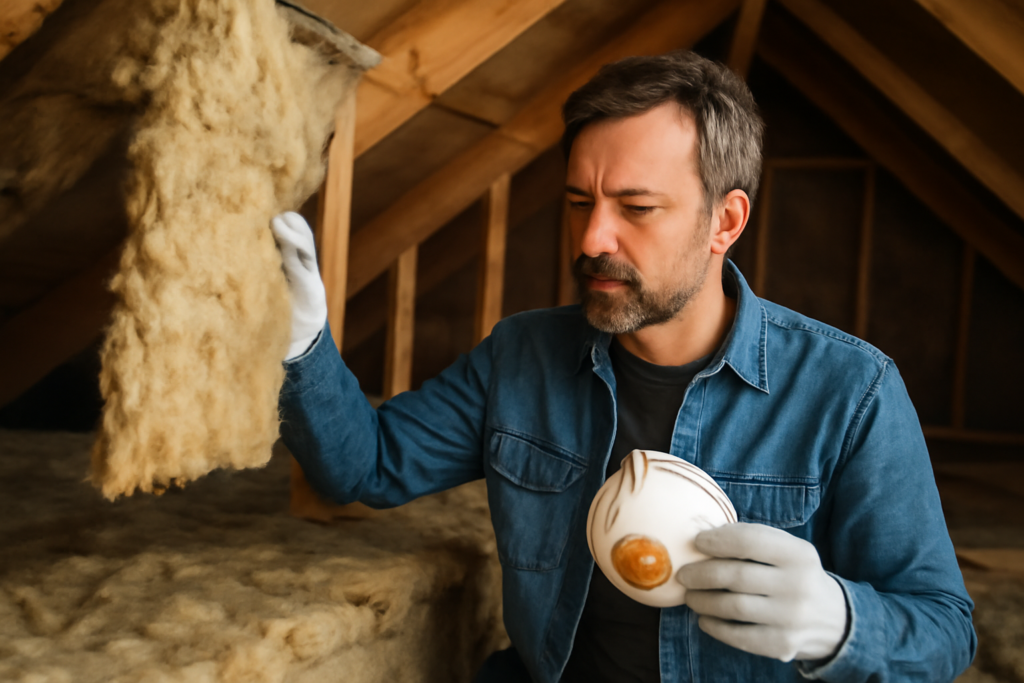
Take samples wearing a P100 respirator, disposable coveralls, and nitrile gloves. Mist the material with water before collection to suppress fiber release. Place the sample in two zip-top bags. Most labs require a 1-teaspoon sample, which is more than enough for polarized light microscopy.
What to Do If a Sample Tests Positive
A positive result does not require immediate panic. Asbestos is dangerous only when fibers become airborne. Encapsulation — sealing the material in place with paint, polyurethane, or specialty mastic — is often the safest and cheapest response. Vermiculite that sits undisturbed in a sealed attic poses near-zero risk.
Disturbance is the danger. If you plan to add insulation, run electrical wiring, install recessed lights, or convert the attic to living space, the contaminated material must be removed by a licensed abatement contractor. State-licensed firms charge $5 to $20 per sq ft for vermiculite removal — $2,500 to $10,000 for a typical 500 sq ft attic.
Cost Breakdown for Professional Abatement
Abatement costs vary by region and material location. Pipe-wrap insulation removal runs $8 to $15 per linear foot, with most basements totaling $1,000 to $3,500. Boiler and duct insulation removal usually costs $2,000 to $6,000 depending on the system complexity.
Whole-attic vermiculite removal jobs in the Northeast and Midwest commonly run $8,000 to $20,000, with HEPA-vacuum extraction, double-bagged disposal at certified landfills, and air clearance testing all included. Get three written bids and verify the contractor’s state asbestos license number before signing anything.
DIY Insulation Work in Older Homes
Even if you have not confirmed asbestos, treat all pre-1990 insulation in older homes as suspect until tested. Do not sweep, vacuum, or disturb questionable material with shop vacs — standard filters pass asbestos fibers right through. If you need to access an attic for one-time work like running cable, wear full PPE and minimize movement.
For larger projects in old homes, schedule testing as the first step. Spending $200 on five lab samples up front beats discovering contamination mid-project, when work must stop for weeks and abatement crews command premium pricing.
Selling or Buying a Home With Asbestos Insulation
Asbestos disclosure laws vary by state. Most states require disclosure of known asbestos-containing materials but do not require testing as part of the sale. As a buyer, request an asbestos assessment as part of the home inspection — a Phase I environmental walkthrough costs $400 to $800 and identifies high-probability locations.
Mortgage lenders generally do not require asbestos remediation before closing, but FHA and VA appraisers will flag visible deteriorating pipe wrap or damaged duct insulation. Negotiate either a price reduction or a remediation credit in escrow — typical credits range from $5,000 to $15,000 depending on extent.
Health Risks From Exposure
Asbestos fibers cause three serious diseases — asbestosis, lung cancer, and mesothelioma — but only after sustained inhalation exposure over years or decades. Brief contact with intact asbestos-containing material poses minimal risk. The danger is friable asbestos: material that crumbles, breaks, or releases fibers when disturbed.
The latency period for asbestos-related disease ranges from 15 to 50 years between exposure and diagnosis. This is why occupational asbestos workers from the 1960s and 1970s are still being diagnosed today. Homeowners with brief incidental exposure face statistically tiny risk compared to professional installers who worked with raw fiber daily.
When Encapsulation Beats Removal
For vermiculite that sits undisturbed in a closed attic, encapsulation is often the best response. Spray-on encapsulants like Fiberlock ABC bond asbestos fibers in place and prevent airborne release. Cost runs $2 to $4 per sq ft — half the price of removal. The catch is that future work in the attic still requires abatement protocols.
Pipe-wrap insulation in intact condition can also be encapsulated rather than removed. Specialized canvas or aluminum jackets enclose the original asbestos wrap. Encapsulation is the right answer when the material is stable, the location is rarely accessed, and you do not plan major renovations that would disturb the surrounding area.