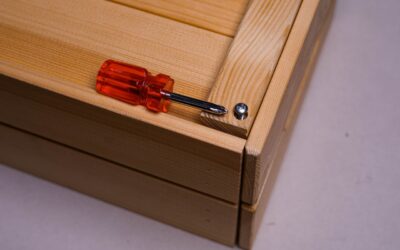
The screws holding your hinges matter more than the hinges themselves. The standard door hinge screw size for residential wood doors is a #9 flat-head wood screw, usually 3/4 inch to 1 inch long for the door leaf and the jamb. Heavier 4-1/2 inch hinges often use #10 or #12 screws. For exterior doors, at least one screw per hinge on the jamb side should be 2-1/2 to 3 inches long so it passes through the jamb and shims into the wall stud.
Part of our Windows & Doors guide — explore the full guide →
That long screw is the cheapest security and sag fix in the house. A jamb only about 3/4 inch thick gives a short screw little to grip, so a hard kick or years of door weight can rip it loose. A long screw anchored in framing does not move.
Metal doors and steel frames follow a different system: they use machine screws, commonly 12-24 thread, that thread into tapped holes. The chart and steps cover both wood and metal situations.
Door Hinge Screw Size Chart
Use these sizes as a starting point, then match the head to the countersink in your hinge. Many hinge packs include screws, but the included screws are often the shortest that will work.
| Location | Gauge | Length | Notes |
|---|---|---|---|
| Interior door leaf (3-1/2 in hinge) | #9 | 3/4 to 1 in | Flat head, wood thread |
| Interior jamb leaf | #9 | 1 in, one 2-1/2 in at top hinge | Long screw helps sag |
| Exterior door leaf (4 to 4-1/2 in hinge) | #10 or #12 | 1 to 1-1/4 in | Do not go through the door face |
| Exterior jamb leaf | #9 or #10 | 3 in, at least one hole | Reaches the wall stud |
| Hollow-core door leaf | #9 | 3/4 in | Hits the solid edge rail only |
| Steel door or steel frame | 12-24 machine screw | About 1/2 in | Threads into tapped holes |
| Fiberglass entry door leaf | Per door maker | Per door maker | Wood block inside edge varies |
Gauge numbers describe shank diameter: larger numbers are thicker. A #9 screw is roughly 0.177 inch across the shank, a #10 is about 0.190 inch, and a #12 is about 0.216 inch. Length is measured from the top of a flat head to the tip.
Why Hinge Screw Size Matters
Hinge screw size controls three things: holding power, how the head seats, and whether the screw finds solid wood. Too thin and the screw snaps or strips. Too thick and the head sits proud of the countersink, which keeps the hinge leaves from closing flat and causes hinge bind. Too long on the door side and the tip can poke through the door face or split the stile.
Door Leaf vs Jamb Leaf
The door leaf screws go into the door edge, which is solid wood on most doors (even hollow-core doors have a solid stile around the perimeter). These screws only need to grip the stile, so 3/4 to 1-1/4 inches is plenty. The jamb leaf is different. Behind the jamb there is a gap filled with shims and then the wall stud, so short jamb screws only grab the thin jamb. One long screw in each jamb leaf, or at least the top one, ties the door to the framing.
Head Shape
Hinge holes are countersunk for a flat-head screw. Long security screws sold for hinges usually have a slim flat head sized to match hinge countersinks. Avoid deck screws or drywall screws with bugle heads, which do not seat properly and are often too brittle for this load.
Tools and Materials
- Correct hinge screws in matching finish (#9 or #10, plus 3 inch hinge screws for the jamb)
- Drill/driver with a clutch to avoid overdriving
- Self-centering hinge drill bit for straight pilot holes
- Standard twist bits for deeper pilot holes
- Screwdriver for the final snug turn
- Wood glue and hardwood toothpicks or dowel for stripped holes
- Thin shim or wedge to support the door
Packs of 3 inch hinge screws in common finishes are inexpensive and are one of the most useful upgrades for any exterior door. Match the finish to your hinges so the long screws do not stand out.
How to Install Long Hinge Screws Step by Step
- Support the door. Close the door or wedge the bottom so it cannot drop while you work on one screw at a time.
- Pick the hole. On the jamb leaf, choose the hole closest to the door stop. That hole is most likely to line up with the stud behind the jamb.
- Remove one short screw. Work one screw at a time so the hinge never shifts.
- Drill a pilot hole. Run a bit slightly smaller than the screw’s root diameter through the jamb and shim and into the stud. For a #9 screw, a 3/32 inch bit in softwood or a 7/64 inch bit in harder framing is typical.
- Drive the long screw. Stop as soon as the head seats. Overdriving can pull the jamb toward the stud and change the gap at the latch side.
- Check the reveal. Close the door and look at the gap along the latch side and head. A long screw at the top hinge can be used intentionally to pull the top of a sagging door back toward the hinge side.
- Repeat on each hinge. At minimum, do the top hinge on interior doors and every hinge on exterior doors.
Troubleshooting Hinge Screws
Screw spins and will not tighten. The hole is stripped. Pack it with glue-coated toothpicks or a glued dowel, let it cure, trim flush and redrill. A longer screw of the same gauge also works if it reaches fresh wood.
Head sits above the hinge. The gauge is too large for the countersink, or the pilot was not drilled straight. Use a #9 instead of a #10, and drill pilots with a self-centering bit.
Latch side gap closes after installing long screws. The screw pulled the jamb inward. Back it out a turn, or add a shim behind the jamb at that spot before redriving.
Screw hits metal. Some exterior frames have steel reinforcement or the screw may be landing on a framing nail. Shift to another hole in the leaf, or drill a slightly larger pilot through the obstruction if it is just a nail.
Door still sags. If long screws are tight and the door still drops, the hinges may be undersized or worn. Check the hinge size against the door weight and consider heavier, ball-bearing hinges.
Choosing Door Hinge Screw Size for Special Cases
Not every door fits the standard pattern. Use these adjustments when the door or frame is unusual.
- Old doors with worn holes: step up one gauge, from #9 to #10, if the countersink allows it, or keep the gauge and go longer so the threads reach fresh wood.
- Doors with a spring or self-closing hinge: spring tension adds load to the screws, so use full-length screws in every hole and add a long screw at the top jamb leaf.
- Doors with a closer: the hinge side carries extra force each cycle; heavy-weight hinges with #10 or #12 screws hold up better.
- Thin or composite jambs: some prehung units use finger-jointed or MDF jambs that strip easily. Long screws into the framing matter even more here.
When in doubt about door hinge screw size, bring one original screw to the store and match the gauge with a screw gauge card, then decide on length based on whether the screw goes into the door edge or the jamb.
Cost
Hinge screws are among the cheapest hardware you can buy. A pack of 3 inch hinge screws for one door generally costs a few dollars, and a self-centering bit costs about the same as a small pack of screws. Paying a handyman to upgrade screws is usually folded into a minimum service call, so pairing it with other door adjustments makes the visit worthwhile.
When to Call a Pro
Bring in a carpenter or locksmith when the jamb is split, the frame is out of square, or the door is steel, fiberglass or fire-rated. Fire-rated doors require hinges and fasteners that match the door’s listing, and steel frames may need holes tapped for machine screws. A pro can also install reinforcement plates and longer strike screws at the same visit, which pairs well with long hinge screws for an entry door upgrade.
Frequently Asked Questions
What size screws come with door hinges?
Most residential hinges ship with #9 flat-head wood screws about 5/8 to 1 inch long. They work for the door leaf, but the jamb side benefits from at least one longer screw.
Can I use 3 inch screws on door hinges?
Yes, on the jamb side. A 3 inch hinge screw passes through the jamb and shims into the stud, improving security and reducing sag. Do not use them on the door leaf.
What is the hinge screw size for heavy doors?
Heavy doors with 4-1/2 inch hinges commonly use #10 or #12 wood screws on the door leaf, with long screws into the framing on the jamb side.
Are drywall screws okay for hinges?
No. Drywall screws are brittle and have bugle heads that do not seat in hinge countersinks. Use flat-head hinge or wood screws instead.
What screws do steel door hinges use?
Steel doors and frames usually use 12-24 machine screws that thread into tapped holes. Wood screws will not hold in thin steel.
Which hinge screw hole should get the long screw?
Use the jamb leaf hole nearest the door stop, which most often lines up with the stud. Drill a pilot first and stop driving as soon as the head seats.