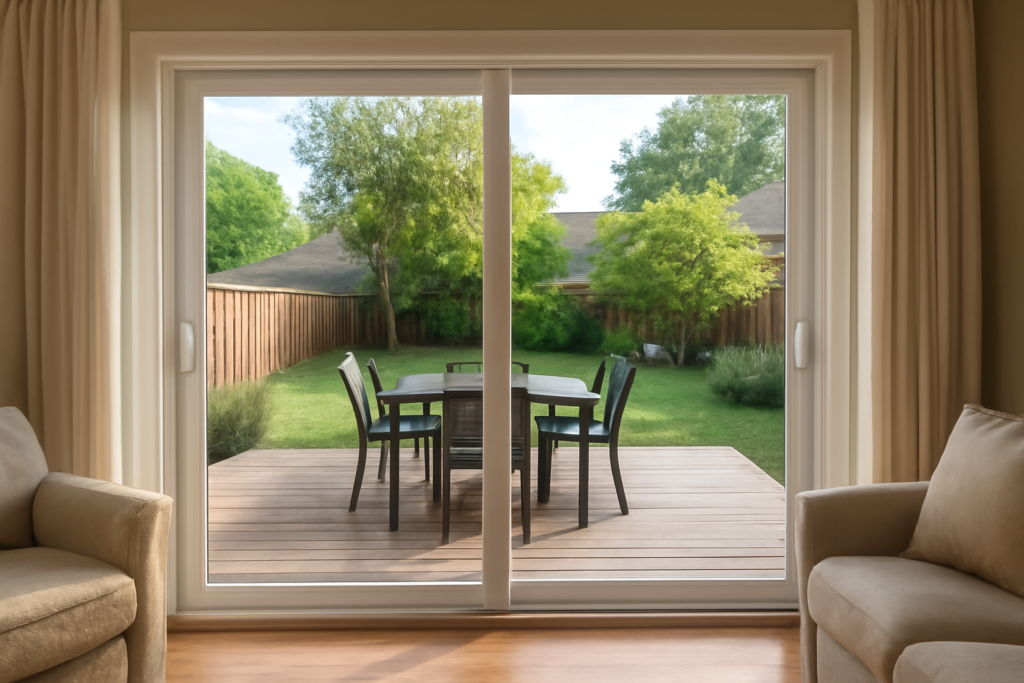
A standard two-panel slider gives you a 3-foot opening in a 6-foot frame — half the glass is wall, functionally speaking. Double sliding patio doors — four-panel units spanning 9 to 16 feet — change the equation entirely: two operating panels that part from the center, an opening of 6 to 8 feet, and a glass wall’s worth of light without stepping up to true multi-slide pricing. Here’s how the configurations work, what the panels actually cost installed, and when a French door still makes more sense.
Part of our Decks & Outdoor guide — explore the full guide →
Decoding the Letters: O’s and X’s
Door configurations are written as a sequence viewed from outside, where X = operating (sliding) panel and O = fixed panel:
- OXXO — the classic double slider. Two fixed outer panels, two center panels that slide apart to opposite sides. Symmetrical, center opening up to half the unit width. This is what most people mean by a double sliding door.
- OXXO variations by venting: some OXXO units operate only one center panel (cheaper hardware); confirm both X panels actually move if that matters to you.
- XOOX: operating panels at the outer edges, fixed glass in the middle. Rare; used when furniture placement demands edge openings.
- OXO (3-panel): one big center slider between two fixed lites, typically 9 to 12 feet wide. Not technically a double slider, but quoted alongside them and often $800 to $1,500 cheaper.
- XX (2-panel, both operating): both panels slide on parallel tracks; a compact way to get a wider clear opening in an 8-foot frame.
Beyond four panels you’re into multi-slide territory — panels stacking or pocketing into the wall, $10,000 and up — a different product category with structural header requirements to match.
Standard Sizes
| Configuration | Common widths | Height | Clear opening |
|---|---|---|---|
| OXXO 4-panel | 9 ft, 10 ft, 12 ft, 16 ft | 6 ft 8 in / 8 ft | ~45–48% of width |
| OXO 3-panel | 9 ft, 10.5 ft, 12 ft | 6 ft 8 in / 8 ft | ~33% of width |
| XX 2-panel | 5 ft, 6 ft, 8 ft | 6 ft 8 in / 8 ft | ~50% of width |
The 12-foot OXXO with a 6-foot center opening is the volume seller — wide enough to feel like a wall of glass, narrow enough to fit most existing great-room walls with a manageable header. Eight-foot-tall versions add 20 to 35 percent to the price but transform the look of rooms with 9 and 10 foot ceilings.
What Double Sliders Cost Installed
Total project pricing splits into the unit and the opening work. For the unit itself:
- Vinyl OXXO (12 ft): $2,800 to $5,500. Budget lines from regional manufacturers start lower but flex more — a 12-foot vinyl frame needs serious reinforcement to stay straight.
- Fiberglass: $4,500 to $8,000. The value pick for dark colors and dimensional stability at these widths.
- Aluminum-clad wood (Pella Lifestyle/Reserve, Andersen 400/E-Series): $6,000 to $12,000. See our Pella patio doors review for line-by-line pricing on the brand most shoppers cross-quote.
- Thermally broken aluminum: $7,000 to $14,000 — the thin-frame modern look.
Installation is where double sliders diverge from ordinary door swaps. Replacing an existing 12-foot slider with a same-size unit runs $1,200 to $2,500 in labor. But converting a window or a standard 6-foot slider to a 12-foot opening means removing studs, engineering a new header (an LVL beam sized for the span and roof load), and often a structural permit: add $2,500 to $6,000 for the carpentry, and more if the wall carries a second story. Realistic all-in numbers people actually pay: $4,500 to $8,000 for a like-for-like vinyl replacement; $9,000 to $18,000 for a wall conversion with a clad-wood unit.
Panels are heavy — a glass panel in an 8-foot-tall unit can weigh 150 to 250 pounds — so this is a two-to-three-person install with panel suction cups, not a weekend solo project. The process, flashing details, and full-frame-versus-insert decision are covered in our patio door installation guide.
Double Slider vs. French Doors
The perennial matchup, and each wins specific categories:
- Space: sliders decisively. French panels swing through a 3-to-4-foot arc that furniture must respect; sliders consume zero floor space.
- Glass area: sliders. A 12-foot OXXO is effectively all glass; a French pair with sidelites tops out around 8 feet of mostly-glass width.
- Air sealing: French doors. Compression weather stripping seals tighter than any sliding seal; in cold, windy climates a quality hinged door leaks measurably less. Worn sliding seals are also a maintenance item — the same wear covered in our weather stripping guide.
- Security: modern multi-point-locking versions of either are solid; cheap sliders with single latches are the weak case. Add a foot-operated auxiliary lock on any slider.
- Cost per foot of opening: sliders, clearly, once you pass 8 feet of width.
- Traditional aesthetics: French doors, though contemporary architecture has flipped this preference.
The honest summary: under 8 feet of wall, it’s a style choice. Over 9 feet, the double slider is the practical answer and the French door needs flanking fixed panels to compete.
Features Worth Paying For at This Size
- Multi-point locks — hooks engaging at two or three heights. Essential on tall panels that can flex.
- Stainless or tandem ball-bearing rollers. At 200 pounds per panel, roller quality is the difference between one-finger gliding and shoulder work in year five. Ask specifically; this is where budget units cheap out.
- Low-E argon glass, U-factor 0.30 or better — you’re installing 80+ square feet of glass; the energy delta is real money. In hot climates, prioritize SHGC under 0.25 on south and west walls.
- A proper sill pan. Wide sills collect wind-driven rain; a pre-formed pan under the frame with back dam is the cheapest flood insurance available.
- Between-glass blinds or exterior shading if the wall faces west — a glass wall is a greenhouse at 5 p.m. A pergola or aluminum patio cover outside the door solves what no glass coating fully can.
Mistakes to Avoid
- Assuming both center panels slide. Some budget OXXO units operate only one. Read the spec sheet.
- Skipping the header engineering on a widened opening. A sagging header pinches the track and the panels drag forever after. Get the LVL sized by the supplier or an engineer.
- Buying 12 feet of builder-grade vinyl. Frame deflection at this width causes lock misalignment and seal gaps. If budget caps at vinyl, choose a reinforced premium vinyl line or drop to an OXO with smaller spans per panel.
- Forgetting the screen plan. Four-panel units use double screens meeting at the center; cheap screen tracks are the number-one owner complaint. Sliding screens should be spec’d with the door, not added later.
- Ignoring floor transitions. A 12-foot sill meeting interior flooring needs a flat, waterproof transition — plan the threshold detail with the flooring, not after it.
Keeping a Big Slider Gliding
Four-panel doors concentrate their maintenance in one place: the track. Vacuum the bottom track monthly — grit under 200-pound panels grinds rollers and gouges the track cap. Twice a year, wipe the track clean and lubricate with a dry silicone spray (never oil or WD-40, which hold grit like flypaper). Roller height adjusters live behind small plugs on each panel’s bottom edge; a quarter-turn re-levels a panel that’s started dragging or latching poorly, and it’s a screwdriver job, not a service call. Weep holes along the exterior track edge must stay clear — blocked weeps are why sliders “leak” in the first hard rain of fall. Budget for roller replacement around year 10 to 15 ($20 to $60 per panel in parts); it restores showroom glide to almost any quality unit.
Double Sliding Door FAQs
Can I get a flush or low-profile sill? Yes, on premium lines — but flush sills trade water resistance for accessibility and demand a covered exterior. Under an open sky, keep the standard raised sill or add a patio roof.
How long does installation take? Like-for-like replacement: one day. Wall conversion with new header: two to four days plus inspection.
Are 4-panel doors less secure? Not inherently — fixed panels are anchored to the frame, and multi-point locks on the operating panels match French-door security. The vulnerability on any slider is lifting worn panels off the track; anti-lift blocks (often included, sometimes not installed) close it.
A double slider is the biggest visual upgrade per dollar you can make to a rear wall. Spec real rollers and a real header, budget honestly for the opening work, and the wall of glass earns its cost every single day.