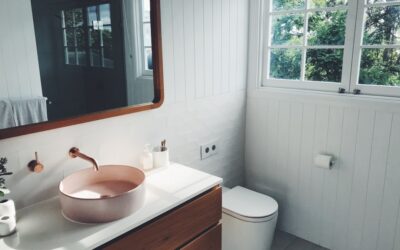
If you have inherited a bubblegum-and-black bathroom from the 1950s, you are not alone, and you do not have to gut it to live with it. Learning how to downplay a pink tile bathroom is one of the most requested home-decor problems for a reason; that vintage pink tile is often in perfect condition and expensive to remove, yet it dominates the room. The good news is that the right paint colors, fixtures, and accessories can quiet the pink dramatically, shifting it from an eyesore to a subtle retro accent. This guide walks through no-demo strategies, from choosing wall colors that tame the pink to the decor tricks that redirect the eye, so you can love the space without swinging a hammer.
Part of our Bathroom Remodeling & Flooring guide — explore the full guide →
First, Identify Your Pink
Before you fix anything, look closely at the exact shade, because pinks are not all the same and the undertone drives every other choice. Some vintage tile leans warm and peachy, some is a cool bubblegum, and some is a dusty mauve-pink. Hold a white sheet of paper against the tile to reveal whether the undertone reads warm or cool. This single observation determines which wall colors will neutralize the pink versus which will amplify it.
As a rule, you counter warmth with cool neutrals and cool pinks with warm-gray or greige neutrals. The goal is not to match the pink, which makes it louder, but to introduce a color that lets the eye rest elsewhere. Once you know your undertone, every following decision gets easier.
Paint Is Your Most Powerful Tool
Wall color is the highest-impact, lowest-cost move to downplay a pink tile bathroom, because the tile usually stops partway up the wall and leaves plenty of paintable surface. The instinct to paint everything white is often wrong; a crisp bright white can make pink tile look even more saturated by contrast. Instead, reach for sophisticated neutrals that absorb the pink’s energy.
- Warm and greige grays: a soft greige or warm gray on the walls mutes pink beautifully, making it read as a muted rose rather than a shout.
- Deep, moody tones: charcoal, navy, or forest green above the tile line pull attention up and away, and pair surprisingly well with retro pink for an intentional, styled look.
- Complex off-whites: a creamy or gray-tinted white, rather than a stark white, softens the contrast and calms the room.
Painting the ceiling, trim, and any wood in a consistent muted tone unifies the space and shrinks the visual dominance of the tile. If the pink is on the floor too, a dark wall color helps ground it.
Swap Out the Loud Fixtures
Vintage pink bathrooms often came with pink or matching sink, toilet, and tub, plus dated chrome or gold fittings, all of which reinforce the theme. You cannot easily replace a pink tub, but you can change the smaller hardware that surrounds it, and that makes a real difference. Updating the faucet, towel bars, light fixture, and mirror to a modern finish like matte black or brushed brass introduces a contemporary anchor that competes with the pink and signals the room is styled, not stuck.
Black is especially effective in a pink-and-black vintage bath, since it ties into any existing black trim tile while reading as current rather than dated. A new modern vanity in a neutral wood or painted finish, or even just a repainted existing vanity, replaces a pink or worn cabinet and gives the eye a fresh, non-pink focal point at counter height.
Redirect the Eye With Decor
Once the walls and fixtures are handled, accessories do the fine-tuning. The strategy is distraction: give the room compelling non-pink focal points so the tile becomes background. A large statement mirror, bold framed art, or a striking light fixture pulls attention to itself and away from the walls.
Textiles are your easiest lever because they are cheap and swappable. Choose towels, a shower curtain, and a bath mat in colors that intentionally downplay the pink. Deep greens, navy, charcoal, and warm neutrals all work, and a shower curtain in a bold pattern that happens to include a whisper of the pink can actually make the tile look like a deliberate design choice. Layer in natural elements, a wood stool, a leafy plant, woven baskets, to add warmth and organic texture that reads as curated rather than retro.
No-Demo Coverage Options
If paint and decor still leave you wanting less pink, a few reversible or semi-permanent options reduce the tile’s presence without a full tear-out. A large-format vinyl or peel-and-stick tile decal can cover a pink floor temporarily, and quality removable products hold up reasonably in a low-splash bathroom. A well-placed area rug or runner hides a big expanse of pink floor instantly and adds softness underfoot.
For the walls, some homeowners have success with specialty tile paint or an epoxy tile coating that permanently covers pink tile in a neutral color, though this is a bigger commitment and requires careful prep to bond and last. Consider it only if you are confident about the color and willing to do the surface preparation properly, since a failed coating is worse than the original pink.
Lean In When It Makes Sense
Sometimes the smartest way to downplay a pink tile bathroom is to stop fighting it and style it as an intentional vintage feature. Well-preserved 1950s pink tile is increasingly appreciated as retro character, and a room that embraces it with confident dark accents, brass fixtures, and playful art can look far more expensive and deliberate than a half-hearted attempt to hide it. Muted, styled, and surrounded by grown-up neutrals, that pink shifts from dated flaw to charming quirk, and you save thousands by keeping the tile you already have.
A Room-by-Room Plan
Putting it all together, tackle the room in order of impact so you see results fast without overspending. Start with paint, since it is cheap and transforms the biggest surface, choosing a muted greige or a moody dark tone based on your pink’s undertone. Next, swap the hardware and light fixture to a modern finish like matte black or brushed brass, which instantly signals that the room is intentional rather than frozen in time. Then layer in textiles, towels, a shower curtain, and a bath mat, in deliberate non-pink colors that draw the eye and soften the space.
Finish with the accessories that create new focal points, a large mirror, framed art, a plant, and a woven basket for storage. Each layer chips away at the pink’s dominance until the tile settles into the background as a subtle vintage accent. The beauty of this approach is that every step is reversible and inexpensive compared with demolition, so you can live comfortably with the bathroom now and save a full remodel for whenever the timing and budget are right. Most homeowners find that once the walls, fixtures, and decor are handled, the pink they once dreaded barely registers.
Prefer to explore on your own?
See how new flooring looks in your actual room in seconds — free, no signup.
Try the free Floor Studio →