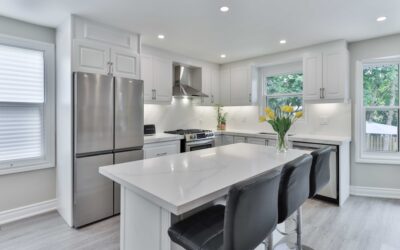
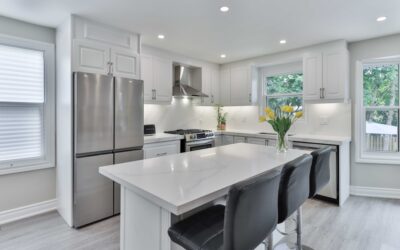
If your home was built or remodeled between 2000 and 2010, you almost certainly have an early 2000s kitchen staring back at you when you walk in: dark cherry or espresso cabinets, busy granite countertops, faux Tuscan painted walls, oil-rubbed bronze fixtures, and an arched valance above the sink window. These design choices defined an era as clearly as harvest gold defined the 1970s. They are also some of the most identifiable dated features in current real estate listings. After updating roughly 30 early 2000s kitchens for clients ranging from “refresh for resale” to “full gut renovation,” the framework below helps decide what to keep, what to update, and what to replace entirely.
Part of our Kitchen Remodeling guide — explore the full guide →
Identifying the Early 2000s Style
The defining traits of an early 2000s kitchen show up in five key areas. The cabinets are typically raised-panel cherry, dark maple, or stained alder with applied corbels under the upper cabinet boxes. The countertops are usually granite in busy patterns like Santa Cecilia, Giallo Ornamental, Tan Brown, or Verde Butterfly with a 4-inch coved backsplash.
Walls were often painted Tuscan yellow, terracotta, or sage green, with faux finishes like sponge painting or color washing common in 2002 to 2007 builds. Fixtures and hardware ran heavy in oil-rubbed bronze, often paired with travertine or tumbled stone backsplashes. The lighting almost always included recessed cans plus a single chandelier or pendant cluster over an island.
What to Keep
Cabinets from this era are usually high-quality compared to modern builder-grade options. Many were built by Wood-Mode, KraftMaid, Thomasville, or Schrock with solid wood doors, plywood boxes, and dovetail drawer construction. Replacing them with current builder-grade alternatives often downgrades the cabinet quality even if the look modernizes.
- Solid wood cabinet boxes: Worth keeping if dovetail joints and plywood sides
- Soft-close drawer slides: Easy retrofit with Blum or Salice glides at $25 to $40 each
- Lazy Susan corners: Functional storage worth preserving
- Stone countertops in good condition: Granite still has decades of life
- Real hardwood floors: Refinish rather than replace
If the cabinet quality is good, focus the update budget on doors, paint, hardware, and countertops rather than starting over.
The Cherry Cabinet Question
Cherry cabinets are the most common early 2000s feature and the hardest design challenge to navigate. The wood naturally has a reddish-pink to orange undertone that darkens with UV exposure over 5 to 10 years. By 2026, most early 2000s cherry has reached a deep reddish-brown that reads dated against modern white quartz and matte black hardware.
Three viable paths: paint them, replace just the doors, or live with them and update everything else. Painting cherry cabinets requires deglosser, primer, and two coats of cabinet enamel because the tannins in cherry wood bleed through ordinary paints. Use BIN Shellac primer ($30 per quart) before applying any color paint. Plan on $4,500 to $8,000 in materials and labor for a full repaint with proper prep.
Countertop Replacement Strategy
Busy multicolor granite from this era reads dated faster than any other element. Tan Brown, Santa Cecilia, and Giallo Ornamental all featured multicolor speckled patterns that competed with the cabinetry and dominated the visual field. Newer kitchens favor cleaner, more uniform stone and quartz patterns.
For a meaningful update without replacing cabinets, swap the busy granite for a quieter quartz like Cambria Brittanicca, Caesarstone London Grey, or MSI Calacatta Lago. Cost runs $55 to $90 per square foot installed, with most kitchen perimeters totaling $2,800 to $5,500. The new clean countertop instantly modernizes the kitchen even with the original cabinets in place.
Hardware and Lighting Refresh
Oil-rubbed bronze cabinet pulls and faucets are the second clearest early 2000s tell. Replace them with brushed nickel, matte black, or unlacquered brass depending on the overall direction of the update. A 30-cabinet kitchen needs about 30 pulls and 5 knobs, costing $150 to $400 in materials.
Lighting upgrades from this era almost always involve removing or replacing the original chandelier or pendant cluster over the island. Three matching modern pendants hung 30 inches above the counter modernize the space. The arched valance above the sink (often called a “scallop valance”) should come down entirely. Replace it with a simple flat valance or eliminate it in favor of a clean window opening.
Backsplash and Wall Updates
Travertine and tumbled marble backsplashes were everywhere in early 2000s kitchens. Both materials read dated because of their earthy beige tone and rough texture. Replace with white subway tile, large-format porcelain slab, or a quieter quartz slab backsplash that matches the countertop.
Wall colors should move away from Tuscan yellow, terracotta, and sage. Modern kitchens favor crisp whites with cool undertones, soft greys, or deep saturated colors like inky blue or hunter green for accent walls. Repainting walls is the cheapest single update at $300 to $700 for a full kitchen DIY, or $800 to $1,500 with a pro.
When to Gut and Start Over
Sometimes the early 2000s kitchen layout itself is the problem. Open-concept floor plans had not fully taken over residential design yet, so kitchens from this era often have small islands, peninsular work zones, or pocket layouts that close off from adjacent rooms. If the layout is wrong, no amount of cosmetic update fixes it.
A full gut renovation of a 200 square foot kitchen runs $45,000 to $85,000 in most US markets, with cabinets representing 35 to 50 percent of that total. Compare against a thoughtful cosmetic update at $8,000 to $20,000 that keeps the layout but refreshes all the dated finishes. For homes the owner plans to stay in for 10+ years and that have layout issues, the gut renovation pays off in daily quality of life. For 5-year horizons, the cosmetic update almost always returns more on resale. Either way, the early 2000s kitchen does not need to be torn out to feel current.