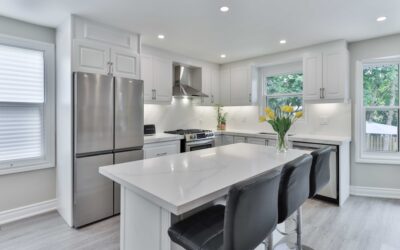
Between roughly 2002 and 2010, half of all suburban kitchens in America took inspiration from a fantasy version of rural Italy. Glazed honey-tone cabinets, faux-finished walls in sienna and terracotta, heavy granite slabs with brown tones, ornate bronze hardware, and travertine backsplashes were everywhere. Tuscan kitchen 2000s design has fallen out of favor — but the bones in these kitchens are usually excellent, and the right surgical updates produce a current-feeling kitchen without the cost of full demolition. Done thoughtfully, you can keep the warmth and craftsmanship while losing the dated finishes.
Part of our Kitchen Remodeling guide — explore the full guide →
- Recognize What You’re Working With
- What to Keep and What to Update
- The Cabinet Question
- Hardware as a Quick Wins
- Backsplash Replacement Strategy
- Countertop Decisions
- Wall Color and Faux-Finish Removal
- Lighting Layer Replacement
- Floor Updates
- Appliances and Vent Hood
- Common Update Mistakes
- Final Word
Recognize What You’re Working With
The classic Tuscan-era kitchen has several signature elements. Cabinets are usually solid wood — cherry, knotty alder, or rustic maple — with raised-panel doors, glazed corners, and decorative corbels under the upper cabinets. Granite countertops in browns, golds, and creams (Santa Cecilia, Tropic Brown, Crema Bordeaux) dominate. Backsplashes feature tumbled travertine with mosaic medallions over the range. Wall colors lean ochre, tuscan red, or olive green with a faux-finish texture.
Underneath, you typically have well-built plywood cabinet boxes with dovetail drawers, real wood doors, and a layout that often included a large island and walk-in pantry — features that still serve a kitchen well in 2026.
What to Keep and What to Update
Keep the cabinet boxes if they’re square and the doors close cleanly. Keep the layout if the work triangle still works. Keep premium granite if it’s a current style or can be paired with new finishes. Keep stone or hardwood floors if they’re in good condition.
Update the wall color, the hardware, the lighting, the backsplash, and the cabinet color or finish. These five changes alone deliver 70% of the modernization impact for under $8,000 in most kitchens.
The Cabinet Question
Painted shaker-style cabinets feel current and pair with almost any countertop. Painting your existing Tuscan cabinets — even with their decorative corbels and glazed corners — transforms the kitchen dramatically. White (Benjamin Moore Simply White or Sherwin-Williams Pure White), warm gray (Benjamin Moore Edgecomb Gray), and sage green (Benjamin Moore Saybrook Sage) are all working well in 2026.
If you can’t bring yourself to paint solid cherry, consider lightly sanding off the glaze and applying a lighter, more contemporary stain. The natural cherry wood underneath is often beautiful — much of the dated look comes from heavy glazing rather than from the wood itself.
Hardware as a Quick Wins
Swapping bronze faux-aged knobs and pulls for matte black, brushed brass, or polished nickel hardware updates a Tuscan kitchen faster than any other single change. Budget $200 to $600 for a typical kitchen’s worth of hardware — Top Knobs, Emtek, and Schaub all make options that read modern without going industrial.
Stick to one finish across all hardware, faucets, and lighting. The mixing-metals look works in some kitchens but rarely in a transitioning Tuscan space, where consistency reads cleaner.
Backsplash Replacement Strategy
The travertine medallion backsplash is the single most dated element in a 2000s Tuscan kitchen. Demo with a pry bar, patch and mud the drywall, and replace with one of these three options: classic 3-by-12 white subway with warm gray grout for traditional updates, large-format 12-by-24 honed limestone or marble for transitional warmth, or zellige-style handmade ceramic in cream, sage, or terracotta for a modern earthy take that still honors the original kitchen’s spirit.
Budget $400 to $1,200 in materials for a typical kitchen, plus $400 to $1,000 in installation labor.
Countertop Decisions
If your Tuscan kitchen has Santa Cecilia or Tropic Brown granite, you have two paths. Path one — keep the granite and let it ground a kitchen of cooler updated finishes. Brown granite paired with white painted cabinets and warm brass hardware reads sophisticated. Path two — replace with a more current quartz like Cambria Brittanicca, Caesarstone Statuario Maximus, or Silestone Eternal Calacatta Gold. Quartz runs $55 to $90 per square foot installed.
If your existing granite is the brown-and-gold variety with heavy movement, replacement usually delivers a bigger update than trying to design around it.
Wall Color and Faux-Finish Removal
The textured faux-finish walls of the era must go. Skim coat with joint compound, sand smooth, prime with a stain-blocker like Zinsser Bullseye 1-2-3, and repaint in a current color. Soft whites (Sherwin-Williams Alabaster), warm greiges (Benjamin Moore Pale Oak), and sage greens (Farrow & Ball Pigeon) all complement traditional cabinet styles without reading dated.
Avoid replacing one trendy wall color with another. The whole point of moving away from Tuscan reds and ochres is choosing colors with longer-term staying power. Soft neutrals win that test.
Lighting Layer Replacement
The Tuscan-era kitchen typically had one ornate iron-and-amber-glass chandelier over the island, undersize sconces flanking the range, and yellow-toned recessed lighting. Replace with three to five 5- or 6-inch LED recessed cans on a dimmer, two simpler pendants over the island in matte black or aged brass, and undercabinet LED strip lights at 2700K to 3000K.
The pendants matter most. Simple matte black lanterns from Hudson Valley, Generation Lighting, or Schoolhouse Electric ($150 to $400 each) update the room dramatically without going aggressively modern.
Floor Updates
Travertine and tumbled stone floors hold up well and pair with painted cabinets surprisingly nicely. Clean and reseal with Stonetech BulletProof Sealer to revive them. If the existing tile is damaged or the homeowner simply wants warmth, wide-plank engineered hardwood in oak with a matte finish reads timeless and complements both painted and stained cabinets.
Avoid stark gray LVP or laminate in a kitchen with significant Tuscan elements remaining. The cool floor against warm cabinets creates visual tension.
Appliances and Vent Hood
The custom plaster vent hood was a signature 2000s Tuscan move. If yours is in good shape, repaint it the same color as the upper cabinets to integrate it into the new palette. If it’s stained, water-damaged, or just heavy and dated, replace with a simpler stainless or matte-black hood from Vent-A-Hood, Zephyr, or Broan.
Update appliances to a single finish — stainless or matte black. Mixing slate, almond, or dated stainless with new appliances broadcasts the partial-renovation story you’re trying to hide.
Common Update Mistakes
The biggest mistake is fighting the architecture. If your home has a Mediterranean exterior, terracotta tile roof, and stucco walls, going aggressively modern in the kitchen creates dissonance. Lean into a transitional update — modernize without erasing the home’s character.
Second mistake: replacing the only original element while keeping the dated wall color. The wall color carries more visual weight than people expect. Always paint walls in any Tuscan-to-modern update.
Third: cheap hardware. Big-box generic knobs photograph fine but feel hollow in the hand. Spend $4 to $10 per knob/pull rather than $1 to $2 — the difference shows.
Final Word
A Tuscan kitchen from the 2000s deserves a thoughtful update rather than a gut renovation. Paint the cabinets, replace the backsplash, modernize the hardware and lighting, refresh the wall color, and you’ll have a kitchen that nods to its Mediterranean roots while feeling current — and you’ll have spent a fraction of what new construction would cost.