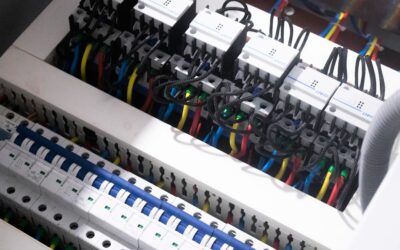
Open the gray metal door in your basement or garage and you are looking at the heart of your home’s electrical system. The electric panel box — also called the breaker panel, load center, or service panel — receives power from the utility, splits it across circuits, and shuts each one down if something goes wrong. Knowing how to read it, when to upgrade it, and which brands to avoid can prevent both fires and four-figure mistakes during a remodel.
How an Electric Panel Box Works
Power arrives from the utility through a meter and enters your panel through two hot legs (each 120 volts) and a neutral. The two hots combined give you 240 volts for large appliances; either one alone with the neutral gives you 120 volts for outlets and lights.
The main breaker controls everything downstream. Below it, branch circuit breakers feed individual rooms and appliances. A typical 200-amp panel has 30 to 42 slots for breakers; older 100-amp panels have 16 to 24. Every cable leaving the panel runs to one breaker, one neutral bar, and one ground bar.
Reading the Amperage Rating
The main breaker tells you the panel’s capacity in amps — almost always 100, 150, or 200 amps in residential service. Look at the number stamped on the largest breaker at the top or bottom of the panel.
- 100 amp service: standard until the late 1990s. Adequate for homes under 2,000 sq ft with gas heat, gas cooking, and one AC unit. Tight with electric heat or two AC units.
- 150 amp service: common in homes built 1990-2010. Comfortable margin for typical loads. Becoming undersized as homes add EV chargers and induction ranges.
- 200 amp service: the modern default for new construction. Handles heat pumps, electric ranges, EV chargers, and pool equipment without a load problem.
- 400 amp service: luxury homes, homes with multiple HVAC zones, or properties with detached workshops. Often delivered as two 200-amp panels.
If you are adding an EV charger and have 100-amp service, run a load calculation before you buy the charger. You may need to upgrade the panel before the install, which adds $2,500-$4,500 to the project.
Breaker Types You Will Encounter
Three flavors of breakers cover residential needs.
Standard thermal-magnetic breakers are the basic protection — they trip on overcurrent and short circuit. Most older breakers in your panel are this type.
GFCI breakers (Ground Fault Circuit Interrupter) trip when current escapes the intended path, protecting against shock. Required by code in bathrooms, kitchens, garages, basements, and outdoor circuits.
AFCI breakers (Arc Fault Circuit Interrupter) trip on arcing faults that could start a fire. Required by current code on all bedroom, living room, dining room, and family room circuits in new construction.
Dual-function CAFCI breakers combine both protections in a single device. They run $40-$60 each compared to $5-$10 for a standard breaker — the cost is the price of modern code compliance.
Brands to Avoid: Federal Pacific and Zinsco
Two manufacturers from the 1950s-1980s era produced electric panel boxes with documented failure rates that put homes at fire risk. Federal Pacific Stab-Lok panels and Zinsco panels (also branded GTE-Sylvania) have been the subject of class-action lawsuits and are flagged by virtually every home inspector.
If your home has either brand, plan an upgrade. Insurance carriers increasingly refuse coverage on Federal Pacific panels, and some lenders require replacement before they close on a sale. Replacement runs $2,000-$3,500 depending on amperage, location, and whether the meter base also needs work.
Signs Your Panel Needs Attention
Watch for these red flags. Any of them warrants a licensed electrician’s visit.
- Breakers that trip frequently on the same circuit even with light load.
- Breakers that feel warm to the touch.
- Burning smell or scorch marks on the panel face or breakers.
- Visible rust on the panel exterior or interior.
- Buzzing or crackling sounds when appliances run.
- A panel running hot — surface temperature noticeably above ambient.
- Breakers that have been replaced with mismatched or unbranded substitutes.
A trip that happens once and never repeats is not a problem; the breaker did its job. A trip that recurs means either an overloaded circuit or a failing component.
Panel Upgrade Costs in 2026
Pricing varies by region, but typical numbers in most US markets land in these ranges. A like-for-like replacement of a 100-amp panel with the same amperage runs $1,500-$2,500. Upgrading from 100 to 200 amps costs $2,500-$4,500 and includes a new meter base, new service entrance cable, and a permit-required inspection by the utility.
Costs climb if the panel needs to be moved (often required by current code if it is in a closet or bathroom), if the service entrance must be re-routed, or if the home’s grounding system needs upgrading. Get three quotes from licensed electricians before signing any contract.
What You Can Legally DIY
Homeowner-permitted electrical work varies by state and municipality. In most jurisdictions, a homeowner can pull a permit and do their own work on their primary residence — but the panel itself requires a licensed electrician in many states because it interfaces with utility-side equipment.
Safe DIY tasks include labeling circuits clearly, replacing standard breakers with GFCI/AFCI versions of the same brand and amperage, and verifying that your panel directory matches what each breaker actually controls. Anything involving the main breaker, the service entrance, or the meter base is licensed-electrician work in nearly every jurisdiction.
Maintenance That Actually Helps
An electric panel box is largely maintenance-free, but a once-a-year walk-around prevents small problems from growing. Check that the panel cover screws are tight. Verify nothing is stored within the 36-inch clearance zone code requires in front of the panel. Photograph the inside and the directory annually so you have a baseline if something changes.
Most importantly: never paint over a breaker, never use generic breakers from a different manufacturer (each panel is listed only with specific compatible breakers), and never store flammable materials within 3 feet of the panel. Boring rules, but they prevent the kind of failures that turn into insurance claims.