Every year roughly 400 Americans die from accidental electrocution in their own homes — and the National Fire Protection Association estimates that proper GFCI deployment prevents the majority of cases involving wet locations. The electrical outlet GFCI (ground-fault circuit interrupter) is the most important $20 piece of safety equipment in your house, yet most homeowners cannot identify which receptacles are protected, how to test them monthly, or when the unit has reached end of life. This guide breaks down GFCI technology, the current NEC requirements, brand recommendations, and a step-by-step DIY replacement walkthrough.
- What a GFCI Actually Does
- Where Code Requires GFCI Protection
- The Three Types You Need to Know
- Brand Spotlight: Leviton vs. Eaton
- How to Test Your GFCIs Monthly
- Step-by-Step DIY Replacement
- Common Wiring Mistakes That Cause Trips
- When to Call a Licensed Electrician
- Ground Fault Interrupter vs. Breaker vs. AFCI: What Each One Protects
What a GFCI Actually Does
A GFCI monitors the current flowing in the hot conductor against the current returning on the neutral. In a properly functioning circuit those two are equal. If even 4 to 6 milliamps escape — through a person’s body, a frayed cord, or a wet appliance — the imbalance trips an internal contactor inside 30 milliseconds, cutting power before lethal current crosses your heart. A standard 15-amp breaker, by contrast, does not trip until the circuit draws 15,000 to 20,000 milliamps. That speed and sensitivity difference is why GFCIs save lives where breakers cannot.
Where Code Requires GFCI Protection
The 2023 National Electrical Code (NEC) Article 210.8 mandates GFCI protection in the following locations:
- Bathrooms: All 125-volt receptacles
- Kitchens: All receptacles serving countertop surfaces
- Garages and accessory buildings: All 125-volt and 250-volt receptacles
- Outdoor locations: All exterior receptacles within 6 feet of grade
- Crawl spaces: At or below grade
- Unfinished basements: All receptacles
- Laundry rooms: All 125-volt receptacles
- Wet bars and dishwashers: All 125-volt receptacles within 6 feet of sink edge
- Boathouses and pool equipment: All
Older homes (pre-1987) may have non-compliant outlets in these locations. Code does not require retroactive replacement, but most insurance carriers now ask about GFCI coverage on policy renewals. Replacing $300 worth of outlets is cheaper than a denied claim after an electrical fire.
The Three Types You Need to Know
GFCI protection comes in three formats. The standard GFCI receptacle (Leviton SmartlockPro at $18, Eaton TRSGF15W at $19) installs in place of a normal outlet and protects itself plus any downstream outlets wired to the LOAD terminals. A GFCI breaker (Square D HOM115GFICP at $48) installs in the breaker panel and protects every outlet on the entire circuit. A portable GFCI (Hubbell GFP15M at $24) plugs into an existing outlet and protects whatever plugs into it — useful for extension cords on outdoor projects.
For most installations, the receptacle format wins on cost and ease. Breaker GFCIs become necessary on long circuits where voltage drop affects sensitivity, or in homes with aluminum wiring where copper-aluminum splicing inside the receptacle box is risky.
Brand Spotlight: Leviton vs. Eaton
Leviton and Eaton dominate the residential GFCI market and both ship UL 943 listed products. The differences come down to ergonomics and self-test features. Leviton’s SmartlockPro line (model GFTR1-W at $17.99 at Home Depot) introduced the auto-monitoring tech that runs a self-test every three seconds and locks out reset if the unit fails internally. The TEST and RESET buttons sit at the top of the faceplate with positive tactile feedback.
Eaton’s matching tech (TRSGF15W at $18.79) tests every six seconds and uses a slightly stiffer mechanism. Both meet the 2015 NEC requirement for self-testing GFCIs that lock out reset if the protection circuit has failed. For a 12-outlet home upgrade, expect to spend $220 to $280 in product plus your time — or $400 to $600 if hiring a licensed electrician.
How to Test Your GFCIs Monthly
UL recommends monthly testing of every GFCI in the house. The process takes 30 seconds per outlet:
- Plug a small lamp into the GFCI receptacle and turn it on
- Press the TEST button on the receptacle face
- The lamp should go dark immediately
- Press RESET to restore power — the lamp should come back on
If the lamp does not go dark when you press TEST, the GFCI has failed. Replace it that day. If RESET does not restore power, the unit has internal failure and locked itself out — also replace. Modern self-testing GFCIs (post-2015 models) handle this automatically and refuse to reset when end-of-life is reached. Older units can fail silently.
Step-by-Step DIY Replacement
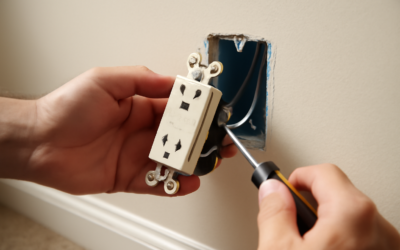
Replacing a standard receptacle with a GFCI is one of the most accessible electrical DIY tasks. You will need a non-contact voltage tester (Klein Tools NCVT-3 at $24), a flathead screwdriver, a Phillips screwdriver, and wire nuts in case existing wiring needs reconfiguring. Total time per outlet: 15 to 20 minutes once you have done the first one.
- Cut power at the breaker. Identify the correct breaker and flip it OFF. Tape over the breaker handle so nobody flips it back during the job
- Verify with the voltage tester. Hold the tester near the slot of the existing outlet. Silent equals safe. If it beeps, you killed the wrong breaker — try again
- Remove the existing outlet. Unscrew the cover plate, then the two mounting screws holding the outlet to the box. Pull the outlet out about 4 inches
- Identify the wires. You will see black (hot), white (neutral), and bare copper or green (ground). Some boxes have two of each — incoming feed and downstream load
- Determine LINE and LOAD. If only one set of wires, connect to LINE terminals. If two sets, connect the incoming feed to LINE and the outgoing downstream wires to LOAD — this protects downstream outlets too
- Wire the GFCI. Black to brass screws, white to silver screws, bare/green to green screw. Torque to 12 inch-pounds (most GFCIs have this stamped on the back)
- Tuck and mount. Fold the wires into the box, mount the outlet, attach the cover plate
- Restore power and test. Flip the breaker back on, press RESET on the GFCI, then press TEST to verify operation
Common Wiring Mistakes That Cause Trips
If your newly installed GFCI trips immediately or randomly, work through this list. First, swap LINE and LOAD terminals — wiring backward causes immediate trip on most modern units. Second, check for shared neutrals from multi-wire branch circuits common in older homes. Third, look for water in conduit running through exterior walls. Fourth, isolate downstream loads by disconnecting the LOAD terminals temporarily — if the unit holds, the problem is on a downstream outlet.
Some appliances cause nuisance tripping by design. Older refrigerators, freezers, treadmills, and pool pumps draw enough leakage current at startup to trip a sensitive GFCI. Code now allows certain refrigeration appliances on non-GFCI dedicated circuits — verify with your local inspector.
When to Call a Licensed Electrician
- Aluminum wiring present anywhere in the box (use copper-aluminum connectors and consult an electrician)
- Knob-and-tube wiring or any ungrounded two-wire system
- Multi-wire branch circuits with shared neutrals
- Receptacle box is overcrowded or damaged
- You are uncertain at any step
A licensed electrician charges $85 to $150 for a single GFCI replacement, or $250 to $400 for a whole-home upgrade of 10 to 15 outlets. The work is genuinely DIY-friendly when conditions are simple — but the cost of mistakes (fires, electrocution, code violations on resale) makes professional installation a reasonable choice for shoppers without confidence in their own electrical skills.
A well-maintained GFCI protects your family for 15 to 25 years before reaching end of life. Test monthly, replace at the first failed test, and the electrical outlet GFCI in every code-required location does the safety job it was designed for.
Ground Fault Interrupter vs. Breaker vs. AFCI: What Each One Protects
A ground fault interrupter is the same device as a GFCI. You will also see it called a ground fault outlet, a ground fault receptacle, or listed as “ground fault protection” on an inspection report. All of these names describe the same job: comparing outgoing and returning current, and cutting power when a few milliamps leak to ground. The confusion usually comes from mixing it up with two other devices in the panel that protect against completely different hazards.
| Device | Protects against | Trips when |
|---|---|---|
| Standard circuit breaker | Overloaded or overheated wiring | Current exceeds the breaker rating, such as 15 or 20 amps |
| Ground fault interrupter (GFCI) | Electric shock to people | About 4 to 6 milliamps goes missing from the circuit |
| Arc fault interrupter (AFCI) | Fires from arcing in damaged wires or cords | It detects the electrical signature of an arc |
| Dual-function (AFCI/GFCI) | Both shock and arc-fire hazards | Either condition occurs |
A breaker alone won’t protect a person. Your body can carry a dangerous current far below the level that trips a 15-amp breaker. An AFCI doesn’t reliably replace ground fault protection in a wet location either. Newer codes call for AFCI protection in many living areas and GFCI protection in wet and damp areas. Kitchens and laundry rooms may need both, which is why dual-function breakers and receptacles exist.
How to tell which outlets have ground fault protection
An outlet without TEST and RESET buttons can still be protected. It may be wired to the LOAD side of a GFCI upstream, or fed from a GFCI breaker in the panel. Look for a small “GFCI Protected Outlet” sticker on the cover plate, which installers are supposed to add. Look for breakers in the panel with a test button and a coiled white pigtail. To map protection yourself, plug a lamp into each outlet you’re checking. Then press TEST on the nearest GFCI and note which lamps go out. Press RESET when you’re done.
If you find an unprotected bathroom, kitchen, or exterior outlet and want to add protection, switch off the breaker and confirm the outlet is dead with a non-contact voltage tester before removing it. Never work on a live receptacle. If the box has no ground or holds multiple wire sets you can’t identify, or the circuit would need a new GFCI or AFCI breaker, hire a licensed electrician.