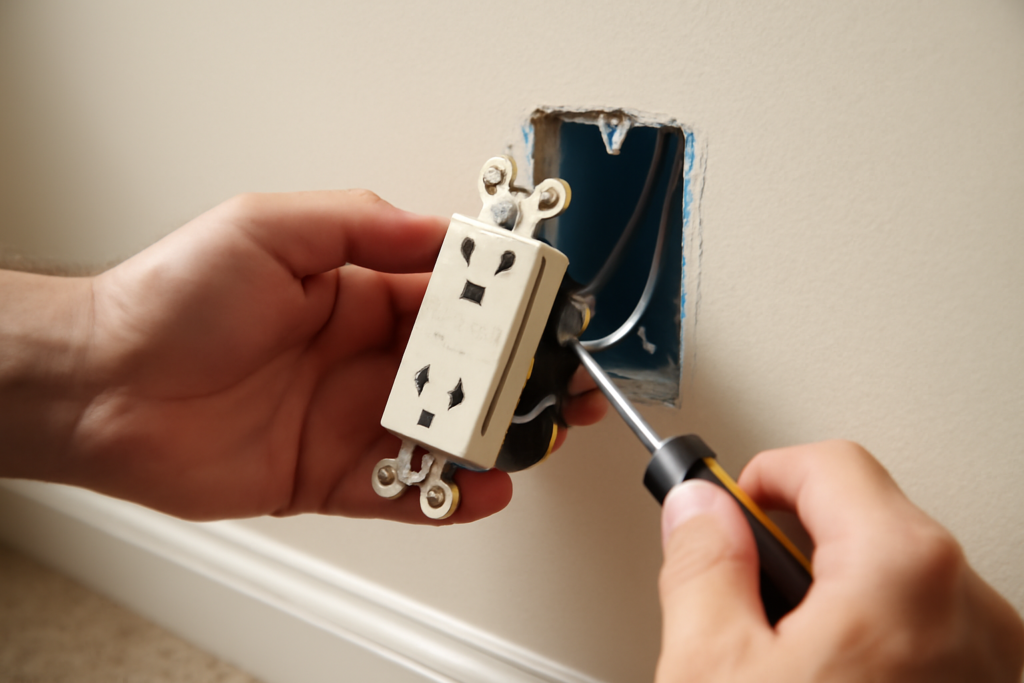
A 20 amp GFCI outlet is the workhorse receptacle of the modern home — the one that belongs on kitchen counters, in the garage, and anywhere power meets water. It combines two things: the higher current capacity of a 20-amp circuit and the shock protection of ground-fault interruption. Get the wiring and the wire gauge right and it’s one of the easiest safety upgrades you can make. Get them wrong and you’ve either got a device that won’t reset or a code violation waiting for an inspector.
- How to Spot a 20-Amp Receptacle
- The Wire Gauge Rule You Cannot Break
- Where Code Requires GFCI Protection
- 15-Amp vs. 20-Amp GFCI: Which to Buy
- How Ground-Fault Protection Works
- LINE vs. LOAD: The Wiring That Trips People Up
- Installing One Safely
- Weather-Resistant and Tamper-Resistant Versions
- Troubleshooting a GFCI That Won’t Reset
- Testing, Costs, and When to Call a Pro
How to Spot a 20-Amp Receptacle
Look at the slots. A standard 15-amp receptacle has two straight vertical slots. A 20-amp receptacle has one slot with a small horizontal notch, making a sideways “T” shape. That T-slot accepts both regular plugs and the special 20-amp plugs used by some heavy appliances. If you see the T, you’re looking at a 20A device.
The 20-amp rating means the receptacle and its circuit can safely carry 20 amps at 120 volts — about 2,400 watts maximum, or roughly 1,920 watts continuous. That extra headroom over a 15A circuit is why kitchens, garages, and workshops are wired at 20 amps.
The Wire Gauge Rule You Cannot Break
A 20-amp circuit requires 12 AWG copper wire, protected by a 20-amp breaker. This is non-negotiable. Thinner 14 AWG wire is only rated for 15 amps — put it on a 20A breaker and the wire can overheat before the breaker ever trips, which is a fire hazard.
- 15A circuit → 14 AWG wire → 15A breaker → 15A receptacles.
- 20A circuit → 12 AWG wire → 20A breaker → 15A or 20A receptacles.
Note that a 15-amp receptacle is legal on a 20-amp circuit as long as more than one outlet is on it — but a true 20 amp GFCI outlet requires the full 12 AWG / 20A setup behind it. Before buying, confirm your circuit is actually 12-gauge on a 20A breaker; don’t just assume.
Where Code Requires GFCI Protection
NEC 210.8 is the rule that drives GFCI everywhere. It requires ground-fault protection for receptacles in locations where water and electricity are likely to meet:
- Kitchens — all countertop-serving receptacles (these are 20A circuits)
- Bathrooms
- Garages and accessory buildings
- Outdoors
- Laundry areas
- Unfinished basements and crawl spaces
- Anywhere within six feet of a sink
Because kitchen counter and garage circuits are typically 20-amp, the 20 amp GFCI outlet is the natural fit for exactly these spots. When you replace an old receptacle in any of these areas, upgrading to GFCI is the correct move even if the original wasn’t protected.
15-Amp vs. 20-Amp GFCI: Which to Buy
Standing at the store, you’ll see both 15A and 20A GFCI receptacles, and the price gap is small. The deciding factor is the circuit behind the box, not preference. If the circuit is 12 AWG wire on a 20A breaker, a 20A GFCI with the T-slot is the correct match and lets you plug in a 20A appliance if one ever shows up. If the circuit is 14 AWG on a 15A breaker, install a 15A GFCI — putting a 20A T-slot device on a 15A circuit invites someone to plug in a 20A load the wiring can’t safely carry. When in doubt, check the breaker rating in the panel and read the wire gauge printed on the cable jacket. A kitchen counter or garage circuit is almost always 20A; a bedroom circuit is often 15A. Match the device to what’s actually there.
How Ground-Fault Protection Works
The GFCI compares current on the hot and neutral wires. In a normal circuit they’re equal. If as little as 4–6 milliamps escapes the intended path — through moisture, a damaged cord, or a person — the device senses the imbalance and cuts power in milliseconds. That’s fast enough to prevent electrocution, which is why these are mandated near water. The TEST and RESET buttons on the face are how you verify and restore that protection.
LINE vs. LOAD: The Wiring That Trips People Up
A GFCI receptacle has two pairs of terminals, and wiring them correctly is the make-or-break step:
- LINE — the incoming power from the panel connects here. This is what energizes and protects the GFCI itself.
- LOAD — connecting downstream outlets here extends GFCI protection to every receptacle further along the circuit, so one device can protect several outlets.
Reverse LINE and LOAD and the outlet often won’t reset, or it powers up but provides no protection. Newer GFCIs have tamper features that won’t reset if miswired, which is a helpful safeguard. If you only need to protect the single location, cap or ignore the LOAD terminals and land power on LINE.
Installing One Safely
The basic install is within reach of a careful DIYer, but treat the safety steps as mandatory:
- Switch the breaker OFF at the panel — identify the right one first.
- Verify the box is de-energized with a non-contact voltage tester, then confirm with a multimeter. Never trust the label alone.
- Note which cable is incoming power (LINE) using the tester before you disconnect anything.
- Connect the hot (black) and neutral (white) incoming wires to the LINE terminals, matching brass to hot and silver to neutral.
- Connect the bare copper or green ground to the green ground screw.
- If protecting downstream outlets, land those on LOAD; otherwise cap them.
- Use a listed device — Leviton, Eaton, and GE all make quality 20A GFCI receptacles rated for the T-slot.
- Restore power and test.
Confirm the receptacle you buy is genuinely rated 20A, not a 15A device, if the circuit and appliance require it.
Weather-Resistant and Tamper-Resistant Versions
Where you install the outlet changes which version to buy. Two ratings matter:
- Weather-resistant (WR) — required by code for outdoor and damp locations. A WR-rated 20A GFCI resists corrosion and UV, and outdoors it must sit in an “in-use” bubble cover that keeps the receptacle protected even with a cord plugged in.
- Tamper-resistant (TR) — required for most dwelling receptacles, these have internal shutters that block foreign objects unless a two-prong plug pushes both sides at once. Most new GFCIs are both TR and WR-rated; look for the stamp on the face.
For a garage, patio, or pool-area receptacle, a WR/TR 20A GFCI in a proper weatherproof box is the correct, code-compliant choice. Skipping the in-use cover outdoors is a common failure point an inspector will flag.
Troubleshooting a GFCI That Won’t Reset
If your new outlet won’t hold RESET, work through the usual suspects before assuming a bad device:
- No power to LINE — the breaker is off, or you wired incoming power to LOAD by mistake. Confirm power lands on the LINE terminals.
- Reversed LINE/LOAD — the number-one wiring error; swap them so incoming power is on LINE.
- An actual ground fault downstream — a leaking appliance or damaged cable on the protected run will trip it the instant you reset. Unplug everything and try again.
- A shared neutral — if the neutral is tied to another circuit, the imbalance trips it immediately.
Isolate one variable at a time, and you’ll usually find the cause without replacing the receptacle.
Testing, Costs, and When to Call a Pro
Test the outlet monthly: press TEST (power should cut and the button should pop), then press RESET to restore it. A plug-in GFCI tester with a trip button is a cheap way to confirm correct wiring and a working ground. If pressing TEST does nothing, replace the device — a GFCI that won’t trip offers zero protection.
Cost-wise, a 20A GFCI receptacle runs $18–$30, plus a few dollars for a box and plate. An electrician typically charges $120–$250 to replace one, more to run a new circuit. Call a licensed electrician and check whether a permit is required if the box has no ground, the wiring is aluminum or a confusing mix, you’re adding a new circuit, or anything at the panel is involved. A properly installed 20 amp GFCI outlet is simple, affordable insurance against shock — just respect the wire gauge, the LINE/LOAD rule, and the de-energizing steps every time.