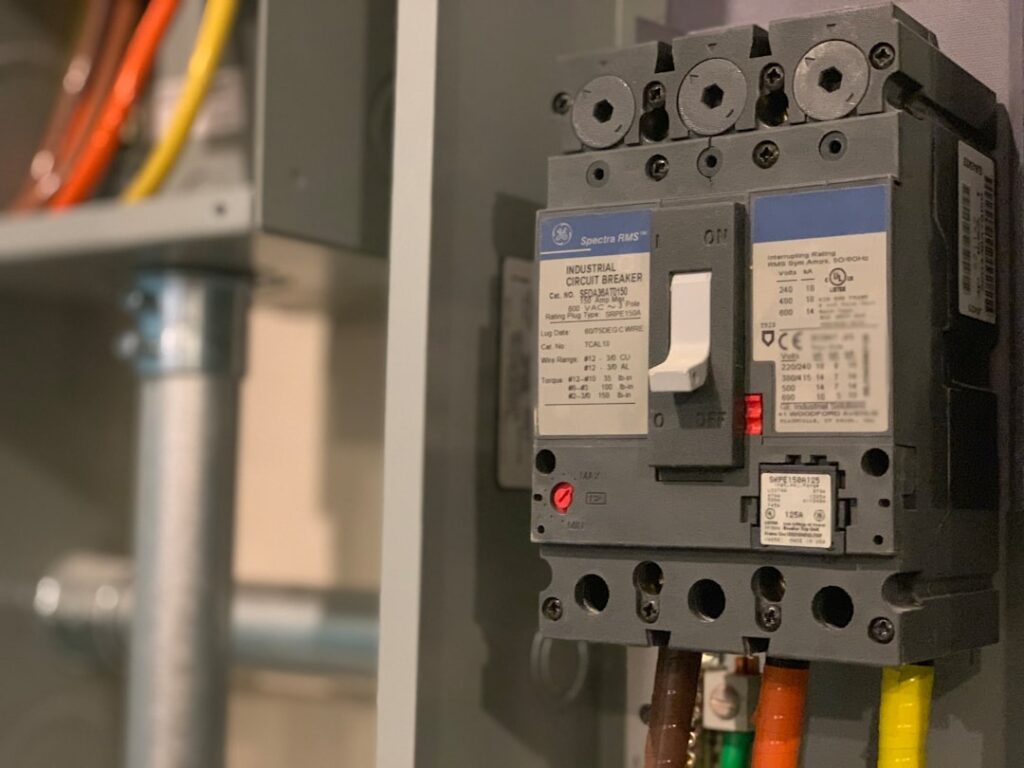
The 20 amp circuit breaker is one of the two workhorses of residential wiring, alongside the 15-amp. It protects the higher-demand general-purpose circuits in your home, kitchen counters, garages, bathrooms, laundry, and dedicated appliance outlets, that need more capacity than a 15-amp circuit can safely provide. The single most important rule to understand about it is the wire pairing: a 20-amp breaker must be wired with 12 AWG copper wire, never smaller. Get that wrong and you’ve built a fire hazard. Here’s everything that pairing implies and how the breaker is used.
- What “20 Amp” Means
- The Critical Rule: 12 AWG Wire
- Where 20-Amp Circuits Are Used
- Load Capacity: How Much You Can Actually Run
- 20-Amp Outlets vs. 15-Amp Outlets
- Single-Pole vs. Double-Pole
- How to Wire a 20-Amp Circuit (Overview)
- Common Mistakes to Avoid
- Bottom Line
- 15-Amp vs. 20-Amp: Which Do You Need?
- Aluminum Wiring Is a Different Case
What “20 Amp” Means
The amperage rating is the maximum current the breaker will allow before it trips to protect the circuit. A 20-amp breaker trips when current exceeds 20 amps, cutting power before the wire behind it overheats. That rating isn’t arbitrary, it’s matched to the safe current-carrying capacity (ampacity) of the wire it protects. The breaker’s entire job is to shut off before the wire gets hot enough to damage its insulation and start a fire. That’s why the breaker and wire size are locked together.
The Critical Rule: 12 AWG Wire
This is the rule you cannot break: a 20-amp circuit breaker must be paired with 12 AWG (12-gauge) copper wire or larger. Here’s why it matters:
- 12 AWG copper is rated to safely carry 20 amps. It’s the correct match.
- 14 AWG copper is only rated for 15 amps. If you put a 20-amp breaker on 14-gauge wire, the wire can carry up to 20 amps before the breaker trips, but 14-gauge wire overheats above 15 amps. The breaker won’t protect it. That’s a genuine fire cause.
The pairing goes both directions:
- 15-amp breaker → 14 AWG (minimum) wire.
- 20-amp breaker → 12 AWG (minimum) wire.
- 30-amp breaker → 10 AWG wire.
You can always use a larger (lower-gauge-number) wire than required, 12 AWG on a 15-amp breaker is fine, but never a smaller one. A quick field tip: 12 AWG is noticeably thicker and stiffer than 14 AWG, and cable jackets are color-coded, yellow sheathing is typically 12-gauge NM cable, white is 14-gauge. That color code is a fast way to confirm you’re not mixing them up, though you should always verify the printed gauge on the cable.
Where 20-Amp Circuits Are Used
The NEC and good practice put 20-amp circuits where higher or heavier loads live:
- Kitchen small-appliance circuits — the NEC requires at least two 20-amp circuits for kitchen counter receptacles, because toasters, microwaves, and coffee makers draw a lot.
- Bathroom receptacles — a 20-amp GFCI-protected circuit for hair dryers and other high-draw grooming devices.
- Laundry — a dedicated 20-amp circuit for the washing machine and laundry receptacles.
- Garage and outdoor outlets — 20-amp GFCI circuits for power tools, compressors, and shop equipment.
- Dedicated appliance circuits — dishwashers, disposals, and other fixed appliances often get their own 20-amp line.
- General-purpose outlet circuits in living areas where more capacity is wanted.
Load Capacity: How Much You Can Actually Run
A 20-amp/120V circuit can theoretically carry 2,400 watts (20 × 120), but you shouldn’t load it to the max. The NEC 80 percent rule for continuous loads means you plan for about 1,920 watts of usable capacity (16 amps). That’s your practical budget. To see why a circuit trips, add up what’s plugged in:
- A 1,500-watt space heater alone uses most of a 20-amp circuit.
- A 1,200-watt microwave plus a 900-watt toaster (2,100 watts) will trip it.
- Spread high-draw appliances across circuits to stay under the limit.
20-Amp Outlets vs. 15-Amp Outlets
Receptacles come in 15-amp and 20-amp versions, and there’s a rule here too:
- A 15-amp receptacle has two vertical slots. It’s permitted on a 20-amp circuit when there are multiple receptacles (the circuit can feed several 15-amp outlets), which is common and code-compliant.
- A 20-amp receptacle has one slot with a small horizontal T-shape, designed to accept 20-amp plugs. It’s required where a single dedicated 20-amp appliance connects.
- You must never put a 20-amp receptacle on a 15-amp circuit, that would advertise 20-amp capacity the wiring can’t safely deliver.
Single-Pole vs. Double-Pole
Most 20-amp breakers are single-pole, protecting one 120V hot conductor for general circuits. A double-pole 20-amp breaker (two ganged poles) is used for a 240V circuit, some smaller 240V appliances and certain equipment. For ordinary household outlet and appliance circuits, you want the single-pole 20-amp breaker.
How to Wire a 20-Amp Circuit (Overview)
Installing a new breaker and circuit is real electrical work, involves working in a live panel, and in most jurisdictions requires a permit and is best done by a licensed electrician. Here’s what the job entails so you understand it:
- Shut off the main breaker and verify the panel is de-energized with a non-contact voltage tester, remember the bus bars stay live even with the main off unless the utility disconnects, which is why panel work is hazardous.
- Run 12 AWG cable (12/2 NM for a standard 120V circuit) from the panel to the outlets or device.
- Land the wires: the black (hot) to the new 20-amp breaker, the white (neutral) to the neutral bus, and the ground to the ground bus.
- Snap the breaker into an open slot on the bus (use a breaker compatible with your panel brand and model).
- Wire the receptacles with 12 AWG, using 20-amp-rated devices, and GFCI protection where code requires it (kitchen, bath, garage, outdoor, laundry).
- Have it inspected before energizing, and restore power.
If you’re not trained to work safely in an energized panel, hire a licensed electrician. Panel work carries arc-flash and shock risk that isn’t worth improvising around.
Common Mistakes to Avoid
- Putting a 20-amp breaker on 14-gauge wire. The cardinal sin, it removes protection and can start a fire. Always 12 AWG minimum.
- Swapping a tripping 15-amp breaker for a 20-amp to stop nuisance trips. If the wire is 14-gauge, this is dangerous. Fix the overload or add a circuit instead.
- Using a breaker that isn’t listed for your panel. Breakers are brand- and model-specific; a mismatched breaker may not seat properly or trip correctly.
- Skipping required GFCI/AFCI protection on kitchen, bath, garage, outdoor, and other required circuits.
- Overloading the circuit past its ~1,920-watt practical limit.
Bottom Line
A 20 amp circuit breaker is the right protection for the higher-demand circuits in a home, kitchen counters, bathrooms, laundry, garages, and dedicated appliances, and its defining rule is simple: it pairs with 12 AWG copper wire, never anything thinner. Match the breaker to the wire, respect the ~1,920-watt working limit, use the correct receptacles and required GFCI protection, and leave panel work to a licensed electrician if you’re not trained for it. Get the wire pairing right and the 20-amp breaker does exactly what it should, deliver power safely and shut it off before anything overheats.
15-Amp vs. 20-Amp: Which Do You Need?
People often ask whether to run a 15-amp or a 20-amp circuit for a given job. The answer follows the load. General lighting and low-draw bedroom and living-room outlets are fine on 15-amp circuits with 14 AWG wire, that’s what most of a house uses. Step up to a 20-amp circuit with 12 AWG wherever code requires it or where heavy appliances live: kitchen counters, bathrooms, laundry, garages, workshops, and dedicated appliance runs. When in doubt on a general-purpose circuit, wiring it as a 20-amp with 12 AWG gives you headroom and costs only a little more in wire. What you must never do is put a 20-amp breaker on a circuit already wired with 14-gauge wire to “get more power”, the wire, not the breaker, sets the safe limit.
Aluminum Wiring Is a Different Case
Everything above assumes copper wire, which is what nearly all modern branch circuits use. If your home has older aluminum branch wiring, the gauge-to-amperage rules differ (aluminum needs a larger gauge for the same ampacity) and the connections require special handling to avoid the overheating aluminum is known for. Don’t apply the copper 12-AWG-for-20-amps rule to aluminum, and don’t mix the two at a connection without proper listed connectors. Aluminum branch wiring is a situation where bringing in a licensed electrician isn’t just advisable, it’s the safe call, because the failure mode is exactly the kind of connection overheating that starts fires.