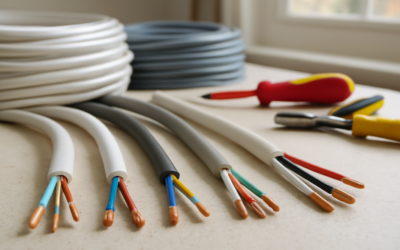
Walk through any hardware aisle and you will see a dozen labels — Romex, THHN, UF-B, MC, BX, SE — that all look superficially similar but serve completely different purposes. Specifying the wrong electrical wiring types for a circuit is one of the most common and dangerous mistakes in DIY electrical work, because the wire that handles dry interior outlets is not rated for direct burial, wet locations, or commercial installations. The National Electrical Code spells out exactly which type belongs where, and choosing correctly is straightforward once you understand the naming convention.
Here is the field guide that demystifies the alphabet soup.
Understanding Wire Names
Wire designations are not random — each letter encodes a property. T means thermoplastic insulation. H means high heat rating. W means wet location rated. N means nylon outer jacket. So THHN is Thermoplastic High Heat resistance Nylon — a single conductor with PVC insulation under a nylon sheath, rated for 90°C in dry locations. XHHW adds the X for cross-linked polyethylene and the W for wet location. Once you know the code, the name tells you exactly what the wire can and cannot do.
The other key spec is wire gauge (AWG). Smaller gauge numbers mean thicker wire and more current capacity. 14 AWG handles 15 amps, 12 AWG handles 20 amps, 10 AWG handles 30 amps, and 8 AWG handles 40 to 50 amps depending on insulation.
NM-B Cable (Romex)
Nonmetallic-sheathed cable, marketed as Romex by Southwire, is the workhorse of residential electrical. It contains 2 or 3 insulated copper conductors plus a bare ground wire, wrapped in a PVC outer jacket. NM-B is rated for 90°C insulation but limited to 60°C ampacity for safety. It can only be used in dry interior locations, stapled to or run through framing.
- 14/2 NM-B: 15-amp circuits, lighting and standard outlets. Yellow jacket on Southwire
- 12/2 NM-B: 20-amp circuits, kitchen and bathroom outlets. Yellow jacket
- 10/2 NM-B: 30-amp circuits, water heaters and dryers. Orange jacket
- 10/3 NM-B: 30-amp 240V circuits with neutral. Orange jacket
- 8/3 NM-B: 40-amp circuits, ranges and large appliances. Black jacket
- 6/3 NM-B: 55-amp circuits, electric service to subpanels. Black jacket
NM-B cannot be run in conduit (except short stub-outs), buried in soil, or used in wet locations like exterior walls without a vapor barrier.
UF-B Cable for Direct Burial
Underground Feeder, type UF-B, looks similar to NM-B but the conductors are molded into a solid PVC compound rather than wrapped in a sheath. The molded construction makes it waterproof and rated for direct burial without conduit. UF-B is the right choice for outdoor outlets, garden lighting, detached garage feeds, and well pumps.
Burial depth requirements per NEC 300.5: 24 inches for direct burial in residential, 18 inches under 4-inch concrete slab, or 6 inches under a residential driveway with GFCI protection. UF-B costs roughly 1.7 times what NM-B does — 12/2 UF-B runs $1.45 to $2.20 per linear foot versus $0.85 to $1.30 for 12/2 NM-B.
THHN, THWN, and Single Conductors
THHN is a single-conductor wire designed to be pulled through conduit. It is the standard wire for commercial installations, panel feeds, and any application where multiple individual conductors run in metal or PVC raceway. THWN (same spec but rated for wet conditions) is functionally interchangeable for most uses, and most modern wire is dual-rated as THHN/THWN-2.
Color coding for THHN follows NEC 200 and 210: white for grounded conductors (neutrals), green or bare for grounding, and black, red, or blue for ungrounded (hot) conductors in 120/240V single-phase systems. THHN is sold by the foot at home centers and by the 500-foot or 2,500-foot spool at electrical suppliers. Pricing: 12 AWG THHN runs $0.18 to $0.32 per foot.
MC and AC (BX) Cable
Metal-clad (MC) cable wraps conductors and an insulated bonding strip in a spiraled aluminum or steel armor. It is allowed in NEC for residential use but more common in commercial and industrial settings, where the metal armor provides additional mechanical protection. MC has been gaining residential use in homes with exposed conduit runs or finished basements.
Armored cable (AC), historically called BX, is older technology using an aluminum bonding strip without the dedicated ground wire — it relies on the armor itself for grounding. AC is still legal but largely superseded by MC in new construction. Both types are stripped using a roto-cut tool (Southwire Armor Cutter, $32 to $48) which protects the conductors during the spiral cut.
SE and USE for Service Entrance
Service entrance cable types — SE-U, SE-R, USE, USE-2 — connect the utility transformer to the main panel and from the main panel to subpanels in some configurations. SE-U is the most common above-ground service entrance, with two insulated conductors and a stranded bare neutral wrapped around them. USE (Underground Service Entrance) is the buried equivalent and looks similar to UF-B but is single-conductor in larger sizes.
These cables come in 4 AWG up to 4/0 (commonly written as 4-aught), with the largest residential services typically using 2/0 aluminum SER or 1/0 copper SE. Pricing for 4/0 aluminum SER runs $5 to $9 per linear foot — service entrance is rarely DIY-appropriate due to load calculations, permit requirements, and utility coordination.
Choosing the Right Type by Application
The decision tree is simpler than the product list:
- Interior dry locations: NM-B (Romex)
- Damp or wet interior (exterior walls, basements without vapor barrier): THHN in conduit, or UF-B
- Direct burial outdoor: UF-B
- Above-grade outdoor exposed: THWN in PVC or EMT conduit, or UF-B in conduit for protection
- Service entrance: SE-U overhead, USE underground
- Subpanel feed from main panel: SER (multi-conductor SE) or individual THHN in conduit
- Exposed conduit in unfinished basements: MC cable or THHN in EMT
Brand and Source Reliability
Southwire and Cerro Wire dominate the residential wire market in the US — both are reliable. Avoid no-name imports from online marketplaces; counterfeit and undersized wire is a documented problem, particularly with bulk THHN spools that should test at exact AWG diameter. A simple test with a digital caliper at the conductor strands flags undersized wire in seconds.
Tools and Code Compliance
Essential tools: Klein Tools 11055 wire stripper ($14 to $22), Klein NCVT-2 non-contact voltage tester ($28), Klein Lineman pliers ($32), and a Klein RT250 outlet tester ($14). For underground runs, a 12-volt continuity tester and a Greenlee fish tape make pulling wires through conduit dramatically easier. Always pull a permit for new circuits — local code amendments often require AFCI or GFCI protection beyond NEC minimums, and a permitted inspection is the cheapest insurance against an electrical fire.