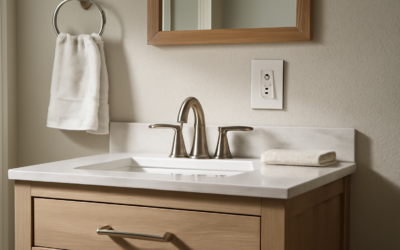
A bathroom is the most electrically hostile room in a house. Wet hands, splashing water, and humid air create the perfect conditions for a deadly shock, which is why bathroom outlets have their own dedicated section in the National Electrical Code. Get the rules wrong and you fail the inspection or, worse, you put your family one slip away from cardiac arrest. The good news: the code is straightforward, the parts cost less than a pizza, and a competent DIYer can swap an outlet in under an hour.
Part of our Bathroom Remodeling & Flooring guide — explore the full guide →
GFCI Is Non-Negotiable
Every receptacle within six feet of a sink, tub, or shower must be Ground Fault Circuit Interrupter protected. This has been NEC code since 1975 and has been expanded every cycle. GFCI outlets sense even tiny imbalances between the hot and neutral wires — as little as 5 milliamps — and cut power within 25 milliseconds. That speed is the difference between a startle and a fatality.
You have two ways to comply. Install a GFCI receptacle at the first outlet on the circuit and wire all downstream outlets to its load terminals, or install a GFCI breaker in the panel that protects the entire circuit. The breaker approach costs about $45 versus $18 for a GFCI receptacle, but it keeps your wall outlets looking standard and clean.
Dedicated Circuit Requirements
The 2023 NEC requires a dedicated 20-amp circuit serving bathroom outlets only — no shared lighting, no fans, no outlets in other rooms. A single 20-amp circuit can feed receptacles in up to two bathrooms, but it cannot also feed a hallway outlet or a closet light. If you plan to run a 1,500-watt hair dryer alongside a 1,200-watt curling iron, this rule keeps your breaker from tripping every morning.
Older homes built before 2002 often have bathroom outlets sharing a 15-amp circuit with bedroom lights. That is legal under grandfathering, but any major remodel triggers a code update. Budget $250 to $450 for an electrician to run a new dedicated circuit from the panel, including the GFCI breaker.
Placement Rules That Matter
Code requires at least one receptacle within three feet of the outside edge of every sink. The outlet must be on the side wall or the splash-back wall — never on the face of a vanity below the basin, where water collects and drips. Mounting height is typically 42 to 46 inches off the finished floor for vanity outlets, low enough for easy access but high enough to clear backsplash tile.
- One outlet within 3 feet of each sink basin
- No outlets directly above a tub or inside a shower enclosure
- Minimum 36 inches from the shower threshold for any wall outlet
- Receptacles mounted face-up on countertops are prohibited under NEC 406.5(E)
- Outlets on the front face of a vanity are not permitted
How to Replace a Bathroom Outlet
Turn off the breaker first and verify with a non-contact voltage tester. Pen-style testers from Klein or Fluke run $15 to $30 and are worth every dollar. Unscrew the old outlet from the box, pull it forward, and label each wire with a piece of tape so you remember where it went.
GFCI receptacles have two sets of terminals: LINE for incoming power and LOAD for any downstream outlets. Wire the incoming hot and neutral to LINE and the wires feeding the rest of the circuit to LOAD. Get this backward and the GFCI will not trip properly, leaving downstream outlets unprotected. Test the new outlet with a $10 plug-in GFCI tester — it should trip and reset cleanly every time.
Cost Breakdown
A standard GFCI receptacle from Leviton or Pass & Seymour runs $16 to $22 at Home Depot or Lowe’s. A weather-resistant tamper-resistant model adds $5 to $8 — required by code in all new bathroom installs since 2014. Wall plates cost $1 to $4, and a new old-work plastic box runs about $3.
Hiring an electrician to swap a single outlet typically costs $80 to $150 including parts. Adding a new circuit from the panel — including running 12/2 Romex through finished walls — pushes the total to $400 to $700. Permit fees add another $30 to $90 depending on your jurisdiction.
USB and Smart Outlets
USB-integrated bathroom outlets have become a popular upgrade. Leviton’s T5635 combines a 15-amp GFCI receptacle with two USB-A ports for about $35. The newer T5836 swaps in USB-C with 20 watts of fast charging — perfect for the toothbrush and razor crowd. Both are NEC compliant and tamper resistant.
Smart outlets with Wi-Fi and voice control are tempting but rarely worth it in a bathroom. The humidity shortens the life of the radio module, and most homeowners do not need to schedule their hair dryer. If you want connected lighting, install a smart switch instead and leave the outlets boring and reliable.
Common Mistakes to Avoid
Wiring an extension cord or surge strip into a bathroom outlet is the most common safety violation we see. Strips are not rated for damp locations and most have no GFCI protection of their own. Bathroom appliances draw enough current to overheat cheap power strips quickly.
Another frequent issue: replacing a tripped GFCI with a standard receptacle because the homeowner thinks the GFCI is broken. The GFCI is doing its job — it sensed a fault somewhere. Replace it like-for-like and test the downstream wiring for moisture intrusion or a frayed appliance cord.
When to Call a Pro
Anything beyond a like-for-like outlet swap warrants a licensed electrician. Adding a circuit, moving an outlet to a new location, or upgrading the panel all require permits and inspection in most jurisdictions. The fines for unpermitted electrical work in California run $500 to $5,000, and home insurance routinely denies claims tied to DIY wiring issues. Spending $400 on a pro to do it once and do it right is cheap insurance.