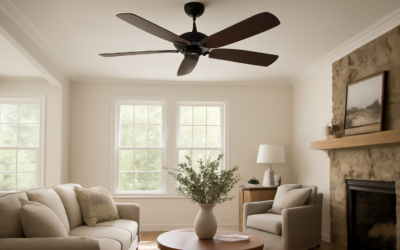
A ceiling fan does not cool a room. It cools people, by moving air across skin so you feel 4 to 8 degrees cooler, which lets you raise the thermostat. Energy Star ceiling fans are certified to move more air for every watt they use, so you get that cooling effect while spending less to run the fan itself. The label is not about how strong a fan is; it is about how efficient it is.
So how much does it actually save? On the fan alone, a certified model typically saves a household somewhere around $10 to $30 per fan per year compared with an older, inefficient fan, depending on hours of use and your electricity rate. The bigger payoff comes indirectly: running a fan lets most people set the air conditioner 3 to 4 degrees higher, and each degree can trim cooling costs by several percent.
- What Energy Star Ceiling Fans Are Rated On
- Reading the Box: CFM, Watts and Efficiency
- DC vs AC Motors
- Yearly Savings by Room Size
- Is It Worth Replacing a Working Fan?
- How to Get the Most From an Efficient Fan
- Installation and Electrical Safety
- Troubleshooting Efficiency Problems
- When to Call a Licensed Electrician
- Frequently Asked Questions
To judge a fan properly, you need to understand three numbers on the box: airflow in CFM, power in watts, and the ratio between them.
What Energy Star Ceiling Fans Are Rated On
The certification focuses on airflow efficiency, measured in cubic feet per minute (CFM) of air moved per watt of electricity used. A fan that moves 6,000 CFM on high while using 30 watts scores 200 CFM per watt. An old fan moving 5,000 CFM on 75 watts scores only about 67.
Under the current program, Energy Star ceiling fans must meet minimum efficiency levels at low, medium and high speeds, with thresholds that vary by fan type and diameter. Standard-size fans generally need to clear well over 100 CFM per watt on high, and many certified DC models exceed 250. The program also sets limits on standby power for fans with remotes or receivers, and integrated light kits must meet efficient lighting requirements, which effectively means LED.
Federal efficiency standards now apply to all ceiling fans sold in the US, so even uncertified new fans are better than models from 15 years ago. The label signals a fan that beats that baseline by a meaningful margin.
Reading the Box: CFM, Watts and Efficiency
Every fan package carries an airflow efficiency label, similar to a nutrition panel. Look for these numbers:
- Airflow (CFM): How much air the fan moves on high. For comfort, look for at least 4,000 CFM in a medium bedroom and 5,000 to 7,000 CFM in a large living room.
- Electricity use (watts): Power draw on high, not counting lights. Efficient DC fans often draw 15 to 35 watts; older AC fans can draw 60 to 100.
- Airflow efficiency (CFM per watt): The ratio that matters most for operating cost. Higher is better.
- Estimated yearly energy cost: Based on a standard set of daily hours and an average electricity rate. Your number will differ, but it is useful for comparing fans side by side.
A low watt fan is not automatically efficient. A 20 watt fan moving only 2,000 CFM will not keep a room comfortable, so you may end up running the air conditioner harder. Balance airflow against watts, and match both to the room.
DC vs AC Motors
Motor type is the single biggest factor behind efficiency. Traditional AC fans use an induction motor that runs directly off household current. DC fans use a brushless direct-current motor with an electronic driver that converts household AC to DC.
| Feature | AC motor | DC motor |
|---|---|---|
| Typical watts on high | 50 to 90 | 15 to 40 |
| Speed settings | Usually 3 | Often 5 or 6, plus reverse via remote |
| Noise | Can hum at low speeds | Very quiet |
| Upfront cost | Lower | Higher, often $50 to $150 more |
For a fan running many hours a day, such as a bedroom fan used all night, a DC motor ceiling fan pays for its higher price faster. For a fan in a guest room that runs a few hours a month, a certified AC model is often the more sensible buy.
Yearly Savings by Room Size
These estimates assume the fan runs about 8 hours a day for 6 months of the year and electricity costs around 15 to 17 cents per kWh. Your local rate will change the totals.
- Small room up to 144 sq ft (42 to 44 inch fan): An old 55 watt fan costs about $12 to $14 per season; a 15 watt DC fan costs about $3 to $4. Savings: roughly $9 to $10 per year.
- Medium room 144 to 225 sq ft (50 to 54 inch fan): An old 70 watt fan costs about $15 to $17; a 25 watt DC fan costs about $5 to $6. Savings: roughly $10 to $12 per year.
- Large room 225 to 400 sq ft (56 to 60 inch fan): An old 90 watt fan costs about $20 to $22; a 35 watt DC fan costs about $7 to $8. Savings: roughly $13 to $15 per year.
- Great room over 400 sq ft (60 inch plus, or two fans): Savings can reach $20 to $30 per year when replacing older high-wattage fans that run long hours.
Fans with old incandescent light kits add much more. Swapping a three-bulb kit using 180 watts for an integrated LED kit using 15 to 20 watts can save more each year than the motor upgrade itself. Across a whole house with four or five fans, an energy saving ceiling fan upgrade plus smarter thermostat settings can add up to well over $100 a year.
Is It Worth Replacing a Working Fan?
If your current fan is less than about 10 years old, has an LED light kit, and runs only a few hours a day, the yearly savings from replacing it rarely justify the cost. The math changes for fans that run 10 or more hours a day, older fans that wobble or hum, and fans with incandescent or halogen light kits. In those cases, an efficient DC model can recover its price difference within several years while also running quieter and offering finer speed control. A practical approach is to upgrade the most-used fans first, typically the main bedroom and living room, and leave rarely used rooms for later.
How to Get the Most From an Efficient Fan
- Size the fan to the room. An undersized fan on high wastes energy and still leaves the room stuffy.
- Mount at the right height. Blades work best 8 to 9 feet above the floor and at least 18 inches from walls. Use a downrod on tall ceilings.
- Raise the thermostat. Set cooling 3 to 4 degrees higher when the fan is running. This is where most real savings come from.
- Turn it off when you leave. Fans cool people, not rooms. An empty room with a fan running only wastes power.
- Use reverse in winter. Running blades clockwise on low gently pushes warm air down from the ceiling without creating a draft.
- Keep blades clean and balanced. Dust and wobble add drag and noise. Wipe blades monthly during heavy use.
Installation and Electrical Safety
Replacing an existing fan with a new one on the same box is a common DIY job, but a few rules are not optional. Turn off the breaker for that circuit, then confirm power is off with a non-contact voltage tester before touching any wires. Never work on wiring that is still powered. Make sure the ceiling box is marked as fan-rated; ordinary light boxes are not designed for a fan’s weight and vibration and can loosen over time.
DC fans contain an electronic receiver and driver, so follow the wiring diagram exactly and keep connections inside the canopy tidy. If the existing box is not fan-rated, there is no ceiling box at all, or you want a new switch or circuit, hire a licensed electrician. Outdoor and covered-patio fans must carry a damp or wet rating for their location.
Troubleshooting Efficiency Problems
- Fan feels weak: Check that the direction is set to counterclockwise for summer and that the fan is not too small for the room.
- Humming noise: Common with AC motors on dimmer switches. Use the fan’s own speed control instead of a light dimmer.
- Remote stops working: Replace the battery and re-pair the receiver per the manual. A wall control with a matching receiver avoids lost remotes.
- Wobble: Tighten blade screws and use the balancing kit. Persistent wobble can mean a loose mounting bracket, so shut off power and check it.
When to Call a Licensed Electrician
Call a licensed electrician for any new circuit, new switch location, aluminum wiring, a missing or non-fan-rated ceiling box, or ceilings higher than you can safely reach from a stable ladder. Permits may apply for new wiring in many areas. A pro can also add a dedicated wall control that runs the fan and light separately, which makes it easier to use the fan efficiently every day.
Frequently Asked Questions
Do Energy Star ceiling fans really save money?
Yes. The fan itself typically saves $10 to $30 per year compared with older models, and the bigger savings come from raising your thermostat while the fan runs.
What is a good CFM per watt rating?
Older fans often score under 100 CFM per watt. Efficient AC models land around 100 to 200, and many DC models exceed 250.
Are DC motor ceiling fans worth the extra cost?
For fans used many hours a day, yes. They use far less power, run quieter and offer more speeds. For rarely used rooms, a certified AC fan is often fine.
Does the light kit affect a fan’s energy use?
Significantly. Old incandescent kits can use several times more power than the motor. Integrated LED lights cut that sharply.
Can I install an energy efficient ceiling fan myself?
Swapping a fan on an existing fan-rated box is a common DIY project if you turn off the breaker and confirm power is off. New circuits or boxes call for a licensed electrician.