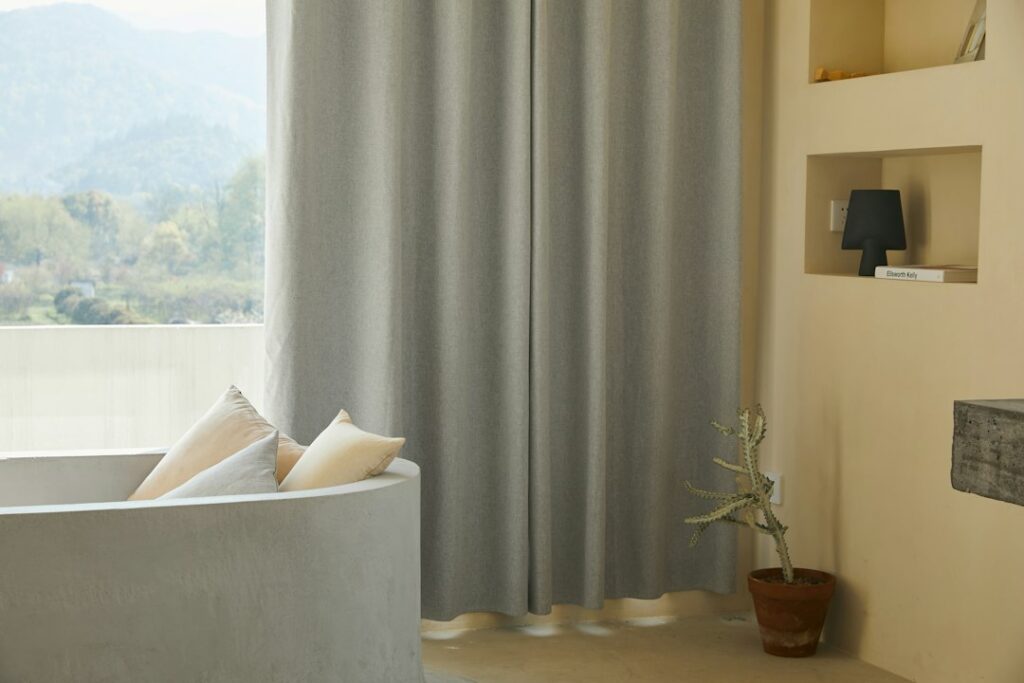
Standard 84- and 96-inch panels look stubby once ceilings climb past 8 feet. Extra long curtains fix that, but only if the panel length matches where the rod actually sits. Buying by ceiling height alone is the most common mistake, because the rod is rarely at the ceiling and the rings or clips add length of their own.
Here is the fast answer. For a 9-foot ceiling, 102- or 108-inch panels usually work. For a 10-foot ceiling, 108 or 120 inches. For an 11-foot ceiling, 120 inches with the rod set lower, or hemmed 132- to 144-inch panels with the rod high. For a 12-foot ceiling, 144-inch panels, often hemmed. Ceilings of 14 feet and two-story rooms usually need custom lengths or 144-inch panels hung from a rod set well below the ceiling.
- Extra Long Curtains Size Chart by Ceiling Height
- Float, Break or Puddle: Choosing the Finish
- How to Measure for Extra Long Panels
- Common Stock Lengths Explained
- Fabric, Weight and Blackout Choices
- Troubleshooting Long Curtain Problems
- Ladder Safety and When to Call a Pro
- Cost Ranges
- Frequently Asked Questions
The method is simple: measure from the bottom of the rod rings or clips to the floor, then add or subtract for the look you want. Every recommendation here follows from that one measurement.
Extra Long Curtains Size Chart by Ceiling Height
The chart assumes the rod is mounted a few inches below the ceiling or crown molding, with rings that add about 1 to 2 inches. Your measurement will vary, so use it as a starting point.
| Ceiling height | Typical rod height | Panel for float (just above floor) | Panel for break or puddle |
|---|---|---|---|
| 9 ft (108 in) | About 103 to 105 in | 102 in (hung with rings) | 108 in |
| 10 ft (120 in) | About 110 to 116 in | 108 in | 120 in |
| 11 ft (132 in) | About 120 to 128 in | 120 in (rod near 122 in) | 132 in custom or 144 in hemmed |
| 12 ft (144 in) | About 132 to 140 in | 144 in hemmed, or 132 in custom | 144 in |
| 14 ft (168 in) | About 145 to 160 in | 144 in (rod near 146 in) or custom | Custom length |
| Two-story (16 to 20 ft) | Varies widely | Custom, or 144 in from a mid-height rod | Custom |
Float, Break or Puddle: Choosing the Finish
The hem style decides how much length to add. Each option has a practical side as well as a look.
- Float: The hem hovers about 1/2 inch above the floor. It is the cleanest, most modern look and the easiest to vacuum around. Subtract about 1/2 inch from the rod-to-floor measurement.
- Kiss: The hem just touches the floor. It looks tailored but is unforgiving; any unevenness in the floor shows.
- Break: Add 1 to 3 inches so the fabric bends slightly at the floor. It looks relaxed and hides small measuring errors.
- Puddle: Add about 6 to 10 inches so fabric pools on the floor. It is formal and romantic, but collects dust and pet hair and is a poor choice for doors and busy walkways.
For drapes extra long enough to puddle in a 10-foot room, a 120-inch panel on a rod at about 112 inches gives a puddle of about 8 to 10 inches once the rings are counted. The same panel on a rod at about 119 inches gives a soft break instead.
How to Measure for Extra Long Panels
Measure before buying, ideally with the rod already installed. You will need a steel tape, a pencil, a level and a helper.
- Decide the rod height. Hanging the rod closer to the ceiling than to the window frame makes the room look taller. A common choice is 2 to 6 inches below the ceiling or just under crown molding.
- Decide the rod width. Extending the rod 8 to 12 inches past each side of the window lets panels stack off the glass and makes the window look wider.
- Install the rod brackets level, anchored into studs or with anchors rated for the weight of long, lined panels.
- Measure from the bottom of the ring or clip (where the curtain hooks on) to the floor. For rod-pocket or grommet panels, measure from the top of the rod.
- Adjust for the finish: subtract 1/2 inch for float, add 1 to 3 inches for break, add 6 to 10 inches for puddle.
- Round to the nearest stock length, then plan to hem or adjust rod height to close any gap.
Grommet, rod pocket and ring-top differences
Panel length is usually measured from the top edge of the fabric to the hem. Grommet panels sit with the top edge above the rod, which shortens their effective drop by an inch or two. Ring and clip panels hang below the rod by the ring drop. Back-tab and rod-pocket panels sit close to the rod. Check the product’s measuring note, since this changes the result.
Common Stock Lengths Explained
102 inches fits 9-foot ceilings with the rod a few inches below the ceiling and rings adding length, or 10-foot rooms where the rod is mounted lower. 108 inches is a very common search, often written as curtains length 108; it suits 9-foot rooms for a break and 10-foot rooms for a float. 120 inches handles most 10- and 11-foot ceilings. 144 inches is the longest widely stocked length and covers 12-foot ceilings, or taller rooms with a lower rod.
Anything longer usually means custom or made-to-measure panels. Some stores carry 132-inch options, but availability is spotty. For a curtain 102 length that is slightly too long, a simple hem or iron-on hem tape works; for one that is too short, lower the rod or add a contrasting band at the hem.
Fabric, Weight and Blackout Choices
Long panels weigh more, which affects rods, brackets and how fabric hangs. Lined panels drape more evenly and resist sun fading. Extra long blackout curtains are popular in bedrooms with tall windows, but they are heavy, so use a sturdy rod of at least 1 inch diameter and add a center support bracket for spans over about 5 to 6 feet.
Sheers and linen-look fabrics are lighter and forgiving to hang, though linen blends can grow or shrink with humidity. Leave linen panels hanging for a few days before hemming. Pre-washing cotton panels before hemming avoids surprises after the first wash.
Troubleshooting Long Curtain Problems
- Panels too short. Lower the rod, switch to rings with a longer drop or add a fabric band at the hem.
- Panels too long. Raise the rod, hem the panels, or turn the extra into a deliberate break or puddle.
- Uneven hems. Floors are rarely perfectly level. Measure each panel location separately before hemming.
- Rod sagging. Add a center bracket, use a thicker rod, and anchor brackets into framing.
- Fabric dragging on a door. Choose float length on patio and French door panels.
Ladder Safety and When to Call a Pro
Mounting rods 9 to 12 feet up puts you high on a ladder while holding a drill and a heavy rod. Use a stepladder rated for your weight plus tools, set it fully open on a level floor, never stand on the top two steps, and keep three points of contact. Have a helper hold the other end of the rod and steady the ladder. Locate studs before drilling and stay clear of wiring near windows and wall switches.
For two-story rooms, high windows above stairs, or any job that needs extension ladders or scaffolding, hire a professional installer. They bring proper equipment and can mount motorized rods or tracks, which are worth considering when windows are too high to reach. Professional installation generally runs from a modest fee per window to more for tall or motorized setups, and is often bundled with custom drapery orders.
Cost Ranges
Ready-made extra long curtains in 102- to 120-inch lengths are widely available at moderate prices per panel, with 144-inch and blackout-lined versions costing more. Custom panels for very tall windows can cost several times as much as stock panels. Budget for a rod long enough to extend past the window, center brackets and quality anchors, since long, heavy panels stress hardware.
Frequently Asked Questions
What length curtains for a 9-foot ceiling?
Most 9-foot rooms take 102-inch panels for a float or 108-inch panels for a slight break, with the rod a few inches below the ceiling.
What length curtains for a 10-foot ceiling?
Use 108-inch panels for a float with the rod around 110 inches high, or 120-inch panels for a break or puddle with the rod closer to the ceiling.
Are 144-inch curtains too long for a 12-foot ceiling?
Usually not. With the rod a few inches below the ceiling and rings added, 144-inch panels often need only a small hem or end in a soft break.
How much extra length do I need for puddled curtains?
Add about 6 to 10 inches beyond the rod-to-floor measurement for a puddle, and 1 to 3 inches for a gentle break.
Should I measure from the rod or the rings?
Measure from where the curtain attaches: the bottom of the ring or clip for ring-top panels, and the top of the rod for grommet or rod-pocket panels.
What do I do for a two-story window?
Order custom-length panels or hang 144-inch panels from a rod mounted lower on the wall. Hire a pro for mounting at that height.