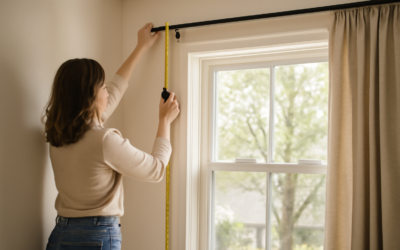
Hanging curtains right on top of the window trim is the single fastest way to make a room look shorter than it is. Knowing how high to hang curtains is less about rules and more about trickery. Designers mount rods 4 to 12 inches above the casing for a reason. The eye reads the rod as the top of the wall, so raising it raises the ceiling. Get the height wrong and even $800 linen panels look cheap. Get it right and basic Target curtains read like a designer install.
- The Standard Rule of Thumb
- The Modern Designer Rule
- Special Ceiling Heights
- Width Matters Just as Much
- Puddle, Kiss, or Float
- Step-by-Step Install
- Common Mistakes to Avoid
- Ceiling-Mounted Curtains
- Layering With Sheers and Blackouts
- Bay Windows and Odd Shapes
- How High to Hang Curtains 9 Foot Ceiling Rooms: Measuring for Real Windows
The Standard Rule of Thumb
Mount the rod 4 to 6 inches above the window trim for a clean, traditional look. That is the default for 8-foot ceilings with a standard-sized window. Measure from the top of the casing up and mark with a pencil. If you have any doubt, err an inch higher rather than an inch lower.
Do not mount flush to the ceiling by default. That only works in specific situations covered below.
The Modern Designer Rule
For a more dramatic, taller-looking room, split the difference between the window casing and the ceiling. If you have 8 inches between casing and ceiling, mount the rod 4 inches up. If you have 24 inches, you have a choice: mount 12 inches up for a balanced look, or go within 3 inches of the ceiling for maximum drama.
The modern rule of thumb is simple: curtains should hang 85 to 90 inches off the floor in a room with 9-foot ceilings, and 96 to 108 inches in a room with 10-foot ceilings. Panel length (84, 96, 108, or 120 inches) guides the math as much as taste does.
Special Ceiling Heights
- 8-foot ceilings: Rod 4 to 6 inches above trim. 84-inch panels usually work
- 9-foot ceilings: Rod 8 to 12 inches above trim. 96-inch panels
- 10-foot ceilings: Rod mounted at 96 to 108 inches off the floor. 108-inch panels
- Vaulted or 12+ ceilings: Rod at 108 to 120 inches. Custom 120 to 144-inch panels
Width Matters Just as Much
Curtains should extend 8 to 12 inches past each side of the window frame. That lets the panels stack off the glass when open, makes the window look bigger, and keeps direct light off the edges of the pane. On a 36-inch window, run a rod 54 to 60 inches wide. Buy rods with 12 inches of adjustable extension so you can fine-tune after mounting brackets.
Puddle, Kiss, or Float
Where the hem meets the floor changes the entire feel of the room:
- Float (1/2 inch above the floor): Easy to vacuum under, most practical, reads casual
- Kiss (just touching the floor): Tailored, crisp, looks like a custom install
- Break (1 to 2 inches puddled): Soft, slightly relaxed. Good for linen
- Full puddle (4 to 8 inches pooled): Formal, dramatic, catches dust quickly
For everyday rooms, kiss or break looks best. Full puddles belong in formal dining rooms and master bedrooms where vacuuming under them every week is not a problem.
Step-by-Step Install
- Measure from the floor to your target rod height on both sides of the window
- Mark with a pencil, then use a level across the two marks to confirm they match
- Find studs where possible. A 96-inch rod with heavy blackout panels needs a third center bracket anchored into a stud or toggle anchor
- Pre-drill pilot holes and install brackets with 2-inch screws (or heavy toggle anchors for drywall-only mounts)
- Hang panels on the rod before seating the rod on the brackets to save a step
- Adjust finials and gently style the pleats by running your hand down each fold
Common Mistakes to Avoid
The biggest mistake is buying 84-inch panels when your room has 9-foot ceilings. Panels have a finished length; they do not adjust. If you mount the rod 12 inches above an 80-inch window casing, you are at 92 inches off the floor, and 84-inch panels will float 8 inches off the ground. Either return them for 96-inch panels or accept the short look.
The second mistake is mounting rods too narrow. Brackets inside the window frame cut your visual width in half and block light even when open.
The third is ignoring rod weight capacity. Heavy velvet or blackout drapes can pull a lightweight tension rod out of the drywall. A 50-pound pair of blackout curtains needs a 1-inch or 1 1/4-inch rod with center support.
Ceiling-Mounted Curtains
Mounting rods directly to the ceiling works in two cases: floor-to-ceiling glass (sliders, picture windows, or wall-of-glass installations) and rooms with low ceilings where even 4 inches of wall space above the window would look cramped. Use ceiling-mount brackets rated for your rod weight, and anchor to joists or use heavy toggle bolts.
For a truly dramatic ceiling mount, recess a drapery track into the ceiling drywall. Total cost runs $300 to $800 for a custom drywall pocket but gives the cleanest possible high-end finish.
Layering With Sheers and Blackouts
Double rods let you layer a sheer or linen behind a heavier blackout panel. Mount the rear rod at your target height and the front rod 2 inches below and 4 inches further out. Layered windows add visual weight and dress the room up without buying new furniture.
Bay Windows and Odd Shapes
Bay windows need either a custom bent rod ($150 to $400) or separate rods on each wall segment. Mount all segments at the same height. Arched windows look best with tension or medallion-style rods inside the arch and straight rods on the rectangular portion below. Trust the right angle of the top of the window casing as your height reference rather than following the curve.
How High to Hang Curtains 9 Foot Ceiling Rooms: Measuring for Real Windows
A 9-foot ceiling is 108 inches from floor to ceiling, which gives you more room above the window than a standard 8-foot room and more choices to get wrong. The right answer for how high to hang curtains 9 foot ceiling spaces depends on the height of your window head, whether there is crown molding, and the panel lengths you can actually buy.
Start From the Window Head Height
Measure from the floor to the top of the window trim. In many 9-foot rooms that lands somewhere between about 82 and 96 inches, depending on the window and the house. Subtract that number from 108 to see how much wall you have to work with. With a lower window head, you have plenty of space, and raising the rod closer to the ceiling makes the window feel taller. With tall windows, the casing may sit only 10 or 12 inches below the ceiling, and the cleanest choice is to place the rod halfway between the casing and the ceiling, or just below the ceiling line.
Work Around Crown Molding
Crown molding changes the math. Mount the brackets so the top of the rod sits about an inch below the bottom edge of the crown, never tucked up into it. Measure down from the crown rather than the ceiling, because the molding can eat 3 to 5 inches of wall. If the window casing is close to the crown, mounting directly onto the casing’s top edge can look cramped; mounting just under the crown usually reads better.
Do the Panel Length Math
Panels come in set lengths, so measure from the point where the curtain will hang, not from the rod itself. Rings, clips, and pinch-pleat hooks add drop, often 1 to 2 inches, which means you should measure from the bottom of the ring eyelet to the floor. A rod placed around 100 inches off the floor in a 9-foot room usually pairs with 96-inch or 108-inch panels, depending on whether you want the hem to float or touch. If the math falls between sizes, move the rod an inch or two.
Align Mixed Windows in One Room
Rooms often have windows of different heights, such as a picture window beside a smaller side window or a doorway with a transom. Set every rod in the room at the same height, based on the tallest window, so the line around the room looks deliberate. The extra wall in a 9-foot room makes mismatched rods obvious.
Hanging curtains on a 9-foot wall means working near the top of a step ladder. Set the ladder on level flooring, keep the spreaders locked, and do not stand on the top steps. Scan for studs and wiring before drilling, and if a traverse rod or shade has pull cords, choose cordless options or keep loops well out of children’s reach. Once you know how high to hang curtains 9 foot ceiling rooms need, the right height looks obvious in hindsight.