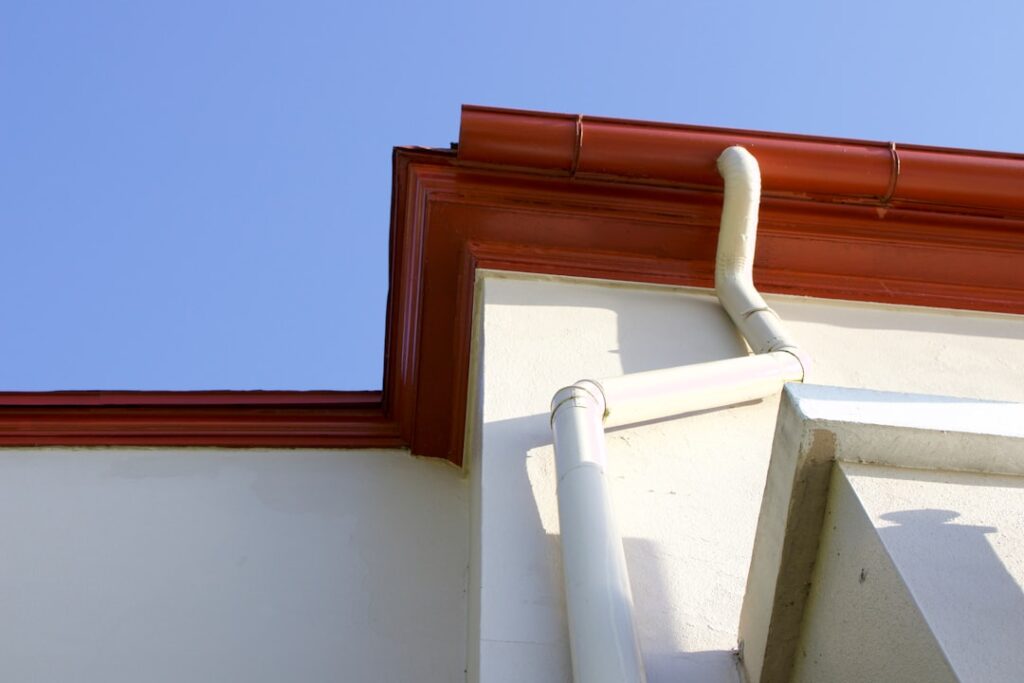
Water sheeting over the front edge of a clean gutter in a hard rain isn’t a clog problem — it’s a capacity problem, and the fix is size. Extra wide gutters in 6- and 7-inch profiles move dramatically more water than the standard 5-inch K-style that most installers hang by default, and the upcharge is smaller than most homeowners guess. The trick is knowing when your roof actually needs them, because oversizing is wasted money on a small ranch and undersizing is a slow-motion foundation problem on a big steep colonial. Here’s the sizing math and the buying details.
Part of our Roofing guide — explore the full guide →
Why 5-Inch Gutters Run Out of Capacity
A gutter’s job is to accept everything a roof plane delivers during the design storm — not the average drizzle, but the 5-year, 5-minute cloudburst, which in much of the country dumps rain at 6 to 10 inches per hour of intensity. Three factors overwhelm a 5-inch K-style:
- Roof area. Each gutter run drains a specific plane. A 5-inch K-style handles roughly 5,500 sq ft of drainage area in mild-rain regions but only about 2,500 sq ft where cloudbursts are intense — and that’s per correctly-pitched run with adequate downspouts.
- Pitch. Steep roofs accelerate water. Sizing methods multiply roof area by a pitch factor — around 1.05 for 4:12-5:12, 1.1 for 6:12-8:12, 1.2 for 9:12-11:12, 1.3 for 12:12 and up. A 10:12 slope effectively adds 20 percent more water than its footprint suggests, and the velocity makes water jump the gutter’s front lip.
- Rainfall zone. Gulf Coast, Florida, and parts of the Southeast see design intensities double those of the Pacific Northwest’s long gentle rains. The same house needs different gutters in Houston than in Portland.
Metal roofs and slate deserve special mention: water leaves them faster and in sheets, overshooting standard gutters — one reason installers in metal-roof country default to 6-inch with wider spacing off the fascia.
Capacity: 5 vs 6 vs 7 Inch
Capacity scales with cross-sectional area, and the gains are nonlinear:
- 5-inch K-style: ~1.2 gallons per foot of run; the baseline.
- 6-inch K-style: ~2.0 gallons per foot — roughly 40 to 50 percent more capacity than 5-inch.
- 7-inch K-style: approaching double the 5-inch capacity; commercial territory that’s migrated onto large homes.
- Half-round: a 6-inch half-round carries meaningfully less than a 6-inch K-style (the semicircle has less area than the K profile), which is why half-round houses often need to upsize to 6 inches just to match 5-inch K-style performance. Choose half-round for looks on historic homes, then size up one step.
As a practical screen: a 6-inch K-style with 3×4 downspouts handles most roofs up to roughly 7,000-8,000 sq ft of adjusted drainage area in moderate rain zones. If your house has large uninterrupted planes feeding single runs — common on farmhouses, barndominiums, and homes with 40-foot eaves — the 6-inch is the correct default, not an upgrade.
Downspout Pairing: Where Systems Actually Choke
Most “gutter overflows” are downspout failures. A standard 2×3 downspout drains about 600 sq ft of roof; a 3×4 drains about 1,200 sq ft and clogs far less because leaves that enter actually exit. Rules that work:
- Pair 6-inch gutters with 3×4 downspouts always — a 2×3 on a 6-inch gutter is a funnel into a straw. 7-inch gutters take 4×5 or round 4-inch leaders.
- One downspout per 30 to 40 feet of run maximum in heavy-rain zones.
- Add a downspout before adding gutter size if the gutter only overflows near the middle of a long run — it’s cheaper ($100 to $250 installed) and often solves it.
- Kick water 4 to 6 feet from the foundation with extensions; oversized gutters concentrating discharge at an undersized splash block just relocates the problem.
Cost Delta
Seamless aluminum pricing, installed, runs roughly: 5-inch, $6 to $12 per linear foot; 6-inch, $8 to $15; 7-inch, $12 to $20. On a typical 160-foot perimeter, stepping from 5-inch to 6-inch adds about $300 to $600 total including the larger downspouts — usually under 20 percent on the invoice for 40-plus percent more capacity. Material matters too: aluminum (.027 minimum, .032 preferred in 6-inch, which resists ladder dents and snow load), steel for hail country, and copper at $25 to $50 per foot for the historic-home crowd. Note that 6-inch has become the standard machine on many crews’ trucks in the South and on metal-roof jobs, so quotes may already reflect it — ask which size is being bid.
Retrofit Considerations
Upsizing existing gutters is straightforward but has details worth checking:
- Fascia height: a 6-inch K-style stands taller; verify the fascia board gives full backing and that the gutter top edge still tucks under the drip edge. Roofs with short fascias may need a furring strip.
- Drip edge relationship: the back of the gutter must sit behind the drip edge flashing or water will run behind the gutter and rot the fascia — the most common retrofit error.
- Hanger schedule: hidden hangers every 24 inches (18 in snow country), screwed into rafter tails, not just fascia board. A water-filled 6-inch gutter weighs about 17 lbs per foot.
- Existing downspout holes: new outlet locations rarely match; plan on new leader routing and wall straps.
- Guards: micro-mesh guards (LeafFilter, Raptor, and similar) come in 6-inch versions; wider gutters actually shed debris better under guards because the trough carries more water at lower depth.
Sizing Worked Example
Numbers make the decision concrete, so run one house through the method. Say the rear roof plane of a two-story colonial measures 44 feet wide with a 24-foot slope run — 1,056 sq ft of plan-view footprint — at an 8:12 pitch, in a Midwest city with a design intensity around 7 inches per hour. Apply the pitch factor of 1.1 and the adjusted drainage area is roughly 1,160 sq ft feeding one 44-foot gutter run. Checking capacity tables at that intensity, a 5-inch K-style with a single 2×3 downspout is marginal — the downspout alone (about 600 sq ft of service) is the choke point, and the run will sheet over in every summer thunderstorm, which is exactly the symptom the homeowner reports. Two legitimate fixes: keep the 5-inch gutter and add a second 3×4 downspout at the far end (cheap, probably adequate), or step up to 6-inch with two 3×4 leaders and never think about it again. Now add the real-world complication — a valley from the garage roof dumps another 300 sq ft into the last 8 feet of that run. Concentrated valley discharge overwhelms local capacity even when totals look fine on paper, so the 6-inch trough with a downspout placed within a few feet of the valley outlet becomes the clearly correct answer. That’s the whole method: adjusted area per run, downspout service area, then a sanity check for valleys and metal-roof velocity. Ten minutes with a tape measure beats guessing, and it’s exactly the math a good gutter bid should show you.
Who Actually Needs Extra Wide
Skip the upsize on a single-story ranch with a 4:12 roof and short runs — 5-inch with good downspouts is fine. Order 6-inch when any of these apply: roof planes over ~2,500 sq ft feeding one run in a heavy-rain region, pitch of 8:12 or steeper, a metal or slate roof, valleys concentrating two planes into one short gutter section, or a history of overflow with clean gutters. Go 7-inch for very large homes, barndominium eaves, and commercial-scale planes. Sized this way, extra wide gutters are one of the cheapest insurance policies on the house: a few hundred dollars against the basement, the landscaping, and the fascia — all of which cost more than the gutters the first time they lose. One last verification step before signing any quote: stand outside during the next honest downpour and watch each run for two minutes. Overflow location, mid-run versus at the valley versus everywhere at once, tells you whether the fix is a downspout, a resize, or simply a re-pitch of sagging hangers — and it’s diagnostic data no estimator standing in your driveway on a sunny Tuesday actually has.