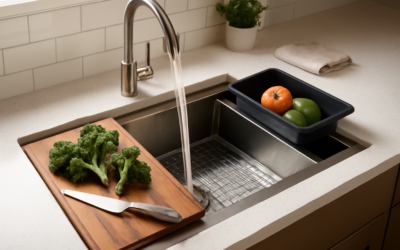
A big apron-front sink looks great until you realize there is nowhere to set wet dishes except a towel on the counter. A farmhouse sink with drainboard fixes that by adding a sloped, grooved surface that sends water straight back into the bowl. You can get the drainboard molded into the sink itself, the old-school approach seen in vintage cast iron and fireclay sinks, or you can choose a modern workstation sink with a built-in ledge that holds slide-on drying racks, cutting boards and colanders.
Both designs solve the same problem, but they fit kitchens very differently. An integrated drainboard adds 15 to 24 inches of sink length and has to be ordered left or right hand. A workstation ledge sink keeps a standard footprint and lets you move the accessories wherever you need them. The right choice comes down to your counter length, your cabinet size, and how you actually wash dishes.
- Farmhouse Sink With Drainboard: The Two Main Styles
- Left Hand vs Right Hand Drainboards
- Counter and Cabinet Length You Need
- Which Style Fits Small vs Large Kitchens
- Materials Compared
- Installation and Support Requirements
- Troubleshooting Drainboard Problems
- Cost Ranges
- When to Call a Pro
- Frequently Asked Questions
Farmhouse Sink With Drainboard: The Two Main Styles
Integrated Drainboard Apron Sinks
These are one-piece sinks with the bowl on one side and a ribbed, gently sloped drainboard on the other. Fireclay and cast iron versions are the classic choice for period kitchens, and stainless steel versions are common in modern and commercial-inspired designs. The drainboard is part of the sink, so there is no gap for water to sneak under, and there is nothing to store when you are done.
- Pros: no seams, very easy to wipe down, strong vintage character, no accessories to lose
- Cons: long footprint, fixed hand orientation, heavy (fireclay and cast iron often weigh 100 to 200 pounds), fewer size options
Workstation Ledge Sinks
A farmhouse workstation sink, sometimes called a workstation farmhouse sink, has one or two small ledges set just below the rim. Accessories ride on those ledges: a roll-up or slide-on drying rack, a farmhouse sink with cutting board insert, a colander, and sometimes a bottom grid. The drying rack acts as a drainboard over the bowl, so you get the function without the extra length.
- Pros: standard 30 to 36 inch footprint, flexible layout, accessories can be moved or removed, lots of size and material choices
- Cons: accessories need storage and cleaning, the rack covers part of the bowl while in use, ledges can collect grime if not wiped
Left Hand vs Right Hand Drainboards
With an integrated drainboard, “left hand” or “right hand” describes which side the drainboard sits on when you face the sink. Manufacturers are not always consistent, so confirm with the product drawing before ordering. Most people put the drainboard on the side away from the dishwasher, so the flow goes: scrape and rinse in the bowl, load the dishwasher on one side, and set hand-washed items on the drainboard on the other side.
If you are right handed and prefer to hold dishes with your left hand while scrubbing with your right, many cooks find a left-side drainboard more natural, since you pick up a dirty item with your left hand from the counter and pass it to the drainboard on the same side. There is no single correct answer. Stand at your current sink and mime your routine before committing.
Counter and Cabinet Length You Need
Integrated drainboard sinks demand planning. A typical model runs 48 to 60 inches long, and the bowl portion usually needs to sit over a dedicated sink base cabinet while the drainboard spans the neighboring cabinet. That can mean a 36-inch sink base plus the top of a 15 to 24 inch adjacent base or drawer unit.
| Sink type | Typical sink length | Cabinet run needed |
|---|---|---|
| Standard apron sink | 30 to 36 in | 33 to 36 in sink base |
| Workstation apron sink | 30 to 36 in | 33 to 36 in sink base |
| Single drainboard apron sink | 48 to 60 in | 60 to 72 in total |
| Double drainboard apron sink | 72 in or more | 84 in or more |
Leave at least 15 inches of countertop landing area on at least one side of the sink, and ideally 18 to 24 inches on the dishwasher side. If the drainboard eats up the only landing space between the sink and a range or wall, the kitchen will feel cramped every day.
Which Style Fits Small vs Large Kitchens
Small kitchens and galleys: A workstation ledge sink is usually the better pick. You keep a 30 or 33 inch footprint and still get a drying area when you need it, then roll the rack away to reclaim the full bowl. In a small space, counter length is precious, and a fixed drainboard can swallow a third of it.
Medium kitchens: Either works. If you have a 10-foot or longer sink wall, a single integrated drainboard can be the visual anchor of the room. If the sink wall is shorter, go with a 33 or 36 inch workstation model.
Large kitchens and farmhouse layouts: Long runs of counter make integrated drainboards shine. Double drainboard sinks, with a board on each side, suit big households and anyone who hand-washes large pots, canning equipment or garden harvests. Pair them with a second prep sink elsewhere if you cook a lot.
Materials Compared
- Fireclay: glossy, hard, stain resistant, classic look; heavy and can chip if struck with a cast iron pan. Drainboards are usually ribbed.
- Enameled cast iron: very durable, quiet, holds heat; the heaviest option and needs reinforced support.
- Stainless steel: lighter, forgiving of dropped dishes, most workstation sinks are stainless; choose 16 or 18 gauge with sound pads.
- Composite granite: matte, scratch resistant, available in colors; fewer integrated drainboard models, many workstation options.
Installation and Support Requirements
Apron-front sinks sit on a support frame inside the base cabinet rather than hanging from the countertop, and a heavy fireclay or cast iron drainboard sink demands serious support. Build a frame from 2x4s fastened to the cabinet sides and, where possible, to the wall framing behind the cabinet, with vertical legs down to the floor so the weight bears on the floor rather than on screws alone. The sink should sit level front to back and side to side, and the drainboard needs its built-in slope toward the bowl preserved, so shim carefully.
- Confirm the sink model and get the template or cutout drawing before the countertop fabricator measures.
- Modify or order an apron-front sink base; the face frame must be cut to the apron profile.
- Build and level the support frame, rated well above the weight of the sink filled with water.
- Set the sink, check level and apron alignment, and confirm drain location against the existing plumbing.
- Have the countertop templated with the sink in place, then install counters and seal the joint with silicone.
- Connect the drain, strainer, disposal and faucet, then run water and check for leaks.
Moving a drain more than a few inches, adding a vent, or relocating the supply lines is plumbing work that may need a permit. If you are unsure, hire a licensed plumber. Always shut off the water supply and open a faucet to relieve pressure before disconnecting anything.
Troubleshooting Drainboard Problems
Water pools on the drainboard. The sink is not level or the support frame has sagged. Re-shim so the drainboard slopes toward the bowl.
Water runs behind the apron or onto the cabinet. The silicone joint between counter and sink has failed. Cut out the old bead, clean with isopropyl alcohol, and re-caulk.
Workstation accessories wobble or rattle. Check that the ledge is clean and the accessory is the correct width for your model. Many makers offer rubber feet or bumpers.
Fireclay chips on the board. Small chips can be filled with a porcelain repair kit; larger damage may need professional refinishing.
Cost Ranges
As general ranges, stainless workstation apron sinks commonly run about $400 to $1,200, while fireclay workstation models land around $700 to $1,800. Integrated drainboard fireclay or cast iron sinks usually cost roughly $1,000 to $3,000 or more, with double drainboard models at the high end. Installation, including cabinet modification and a support frame, typically adds $300 to $900, and countertop fabrication and plumbing are separate.
When to Call a Pro
Heavy apron sinks are a two or three person lift, and a support frame that fails can crack a countertop or flood a cabinet. Hire a carpenter or kitchen installer to build the support and modify the cabinet, especially for fireclay or cast iron drainboard models over 100 pounds. Call a licensed plumber for any drain relocation, vent changes or new supply lines, and let the countertop fabricator template with the sink already set. If the project involves structural changes, such as removing a wall to fit a longer sink run, get a permit and a licensed contractor involved.
Frequently Asked Questions
Is a farmhouse sink with drainboard worth it?
If you hand-wash often and have the counter length, yes. An integrated drainboard keeps water off the counter and looks great. In a small kitchen, a workstation sink with a slide-on drying rack gives similar function in less space.
How do I know if I need a left or right hand drainboard?
Face the sink and note which side the drainboard should sit on. Most people place it on the side opposite the dishwasher. Confirm the maker’s definition on the product drawing before ordering.
What size cabinet does a drainboard apron sink need?
Many single drainboard sinks are 48 to 60 inches long and span a 36-inch sink base plus a neighboring cabinet. Check the maker’s specifications for the exact run.
Can a workstation sink replace a drainboard?
Yes, a roll-up or slide-on drying rack on the sink ledge works like a drainboard, draining straight into the bowl. You can remove it when you need the whole bowl.
Do fireclay drainboard sinks need extra support?
Yes. They can weigh 100 to 200 pounds before water, so they need a sturdy frame inside the cabinet that bears on the floor and ties into the framing.