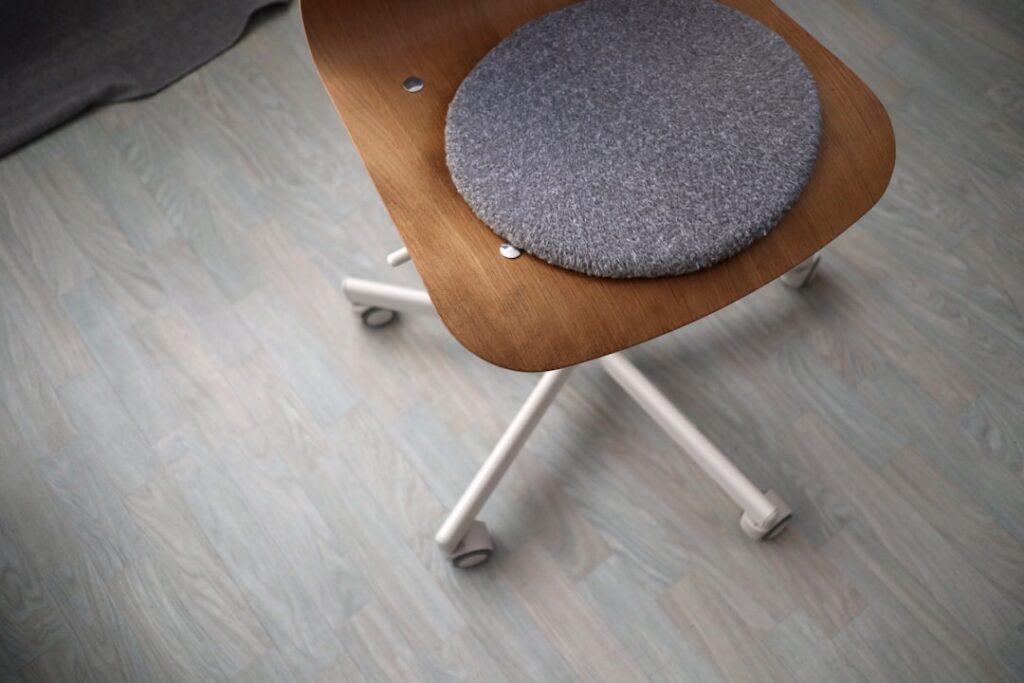
Nothing wrecks a beautiful hardwood or laminate floor faster than a rolling desk chair grinding grit into the finish eight hours a day, which is why a good floor protector for office chair setups pays for itself. As a flooring contractor, I have replaced too many planks scarred by caster wheels, and the fix is usually a simple floor protector for office chair use, either a chair mat or a set of upgraded caster wheels. This guide walks through mat materials, sizes, hard-floor versus carpet options, and costs so you can protect your floor without overthinking it.
Why Rolling Chairs Damage Floors
The problem is not the chair itself; it is the concentrated load and the grit. A person plus chair puts 200-plus pounds on four or five small hard caster wheels, and every crumb of dirt those wheels pick up becomes sandpaper. On hardwood and LVP, that means fine scratches and worn finish. On carpet, the wheels crush fibers and dig ruts along your most-used paths. A protector spreads the load and gives the wheels a clean surface to roll on.
Chair Mat Materials
Mats are the most common solution, and the material determines durability, looks, and price.
PVC and Vinyl
The standard budget choice at $25 to $60. Clear PVC mats are light, roll out easily, and protect most floors well. The downside is they can crack in cold rooms, dent under heavy use, and yellow over a few years.
Polycarbonate
A step up at $60 to $150. Polycarbonate is far more rigid and scratch-resistant than PVC, will not curl or crack, and stays clear longer. It is my top pick for daily use over nice hardwood.
Tempered Glass
The premium option, $100 to $250. Glass mats are virtually indestructible, never dent or scratch from the chair, wipe clean instantly, and let your floor show through. They are heavy and pricey but effectively permanent.
Bamboo and Wood
Bamboo mats, roughly $40 to $120, look handsome, resist dents, and suit a warm office. They are rigid and durable, though they can be slick and are best on hard floors rather than carpet.
Choosing by Floor Type
Match the protector to what is underneath.
- Hardwood and LVP: Any smooth-backed hard-floor mat works. Avoid mats with spikes on the underside, which are made for carpet and will scratch wood.
- Laminate: Same as hardwood; a smooth polycarbonate or glass mat is ideal since laminate wear layers scratch easily.
- Tile: Durable already, but a mat smooths out grout lines so the chair rolls freely and grit does not grind into the glaze.
- Carpet: Use a mat with a studded or gripper backing so it bites into the pile and stays put.
Hard-Floor vs. Carpet Mats
This is the mistake I see most: buying the wrong backing. Hard-floor mats have a smooth, flat underside so they do not scratch or trap grit against wood, tile, or LVP. Carpet mats have small studs or cleats on the bottom that grip through the pile to keep the mat from sliding. Put a studded carpet mat on hardwood and those cleats will scratch the finish; put a smooth hard-floor mat on carpet and it will slide out from under you. Read the label and match the backing to the surface.
Sizes and Shapes
Buy for the whole travel zone, not just the seat. A mat that is too small forces the wheels off the edge, which defeats the purpose and creates a trip lip.
- 36 x 48 inches: Fits a compact desk where you mostly stay seated.
- 45 x 53 inches: The most popular size, covering a standard desk plus room to roll and reach a side cabinet.
- 48 x 60 inches or larger: For big desks, L-shaped setups, or standing-desk zones where you move a lot.
Many mats include a lip or tongue that extends under the desk to cover the area beneath your feet and the keyboard tray. Measure your rolling range with a tape before buying.
Caster Wheels as an Alternative
If you dislike the look of a mat, swap the wheels instead. Rollerblade-style caster wheels use soft polyurethane tires, the same material as inline skate wheels, and glide smoothly without scratching hard floors. A set of five runs $20 to $50 and pops into the standard 11-millimeter stem that fits most office chairs.
These are excellent on hardwood, laminate, LVP, and tile because they distribute weight over a softer contact surface and do not grind grit the way hard nylon wheels do. On thick carpet, though, soft wheels roll too easily and you may prefer the standard hard casters or a mat. You can also add stem-mount felt or rubber glides for chairs you rarely move.
Cleaning and Caring for Your Protector
A protector only works if you keep it clean, because trapped grit under a mat or lodged in a wheel scratches just as badly as no protector at all. Lift a chair mat every couple of weeks, sweep or vacuum the floor beneath it, and wipe the underside so no debris grinds into the finish. Clear PVC and polycarbonate mats wipe down with a damp cloth and a drop of mild dish soap; skip abrasive pads that leave a cloudy haze. Glass mats clean with standard glass cleaner and stay crystal clear for years.
Rollerblade-style casters need attention too. Hair and thread wrap around the axles and pick up grit, so pop the wheels off every month or two and clear the debris. Clean wheels roll smoother, spin freely, and stop dragging particles across your hardwood, which is the whole point of upgrading them in the first place.
Thickness, Grip, and Everyday Use
A few details separate a mat you love from one that annoys you daily. Thickness on hard-floor mats usually runs 1/8 inch for glass and polycarbonate; anything thinner in PVC tends to curl at the edges. Look for a beveled or tapered edge so you do not catch your toe or snag the vacuum. On slick hardwood, a mat with a lightly textured or micro-gripped underside stays put without any spikes.
Let a rolled PVC or vinyl mat relax before you judge it. Unroll it and leave it flat in a warm room for 24 to 48 hours, or lay it upside down for a few hours, and the curl settles out. Store-cold mats are stiff and want to spring back, which is why so many reviews complain about edges lifting. Give it time and warmth and most of that disappears.
Cost and Value
Protecting your floor is cheap compared to refinishing it. A basic PVC mat costs $25 to $60, polycarbonate $60 to $150, glass $100 to $250, and a bamboo mat $40 to $120. Rollerblade casters add just $20 to $50. Compare that to refinishing hardwood at $3 to $8 per square foot or replacing scratched laminate entirely, and the math is obvious.
My advice for a daily-use home office over hardwood is a polycarbonate mat sized 45 by 53 inches, or upgraded rollerblade casters if you want the floor fully exposed. Either one, kept swept clean of grit, will keep your floor looking new for years and costs a fraction of a single repair.
Prefer to explore on your own?
See how new flooring looks in your actual room in seconds — free, no signup.
Try the free Floor Studio →