
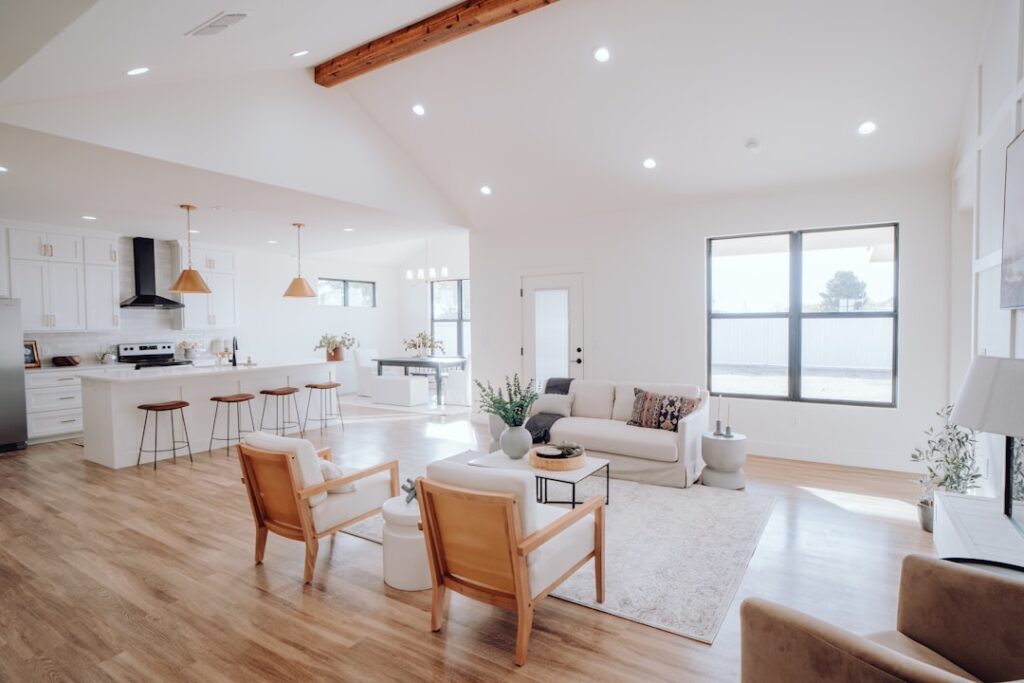
Thomastown sits in Melbourne’s northern flooring hub, with warehouse showrooms lining Settlement Road and Mahoneys Road serving builders, renovators, and DIY homeowners from Reservoir to Epping. If you are shopping for flooring Thomastown retailers, the choices feel overwhelming — every store seems to push a different product as the answer. Here is what actually performs in Melbourne’s climate, what each category really costs once installed, and where the warehouse pricing hides traps.
- Melbourne Climate Sets the Specification
- Hybrid and SPC: The Volume Sellers
- Engineered Timber: The Premium Pick
- Tile for Wet Areas and Open-Plan Living
- Carpet: Still Worth It in Bedrooms
- Subfloor and Moisture Realities
- Where to Buy in Thomastown
- Costing a Real Renovation
- Installer Verification in the North
- Maintenance Realities
Melbourne Climate Sets the Specification
Melbourne indoor relative humidity swings from around 35 percent during dry July evenings to 70 percent in late summer storms. That 35-point swing is too much for solid Australian hardwoods like spotted gum or blackbutt without serious acclimatisation. Engineered timber and rigid hybrid flooring have taken over the Thomastown showroom floor for this exact reason — they move about a third as much across the same humidity arc.
Slab homes north of Thomastown into Mernda and Doreen present an additional challenge: high residual moisture in newer concrete pours. Any installer who skips a moisture test before laying a floating floor is gambling with your warranty.
Hybrid and SPC: The Volume Sellers
Hybrid flooring — rigid SPC core with a printed vinyl wear layer — dominates Thomastown sales. Pricing tiers run roughly: entry hybrid at AU$25-40 per square metre, mid-range at AU$45-65, premium at AU$75-110. Look for a wear layer of at least 0.55 mm for living areas and 0.7 mm if you have dogs. Anything under 0.3 mm is bedroom-only and will scratch under chairs within months.
Brands stocked locally include Quick-Step, Godfrey Hirst, Premium Floors Clix, Airstep, and Choices Flooring private labels. The visual difference between AU$35 and AU$75 product is real — registered embossing (where the texture aligns with the printed grain) is the giveaway of a quality plank.
Engineered Timber: The Premium Pick
For homeowners who want real timber underfoot, engineered European oak with a 3-mm to 6-mm wear layer is the safer specification than solid Australian hardwood in Melbourne. Pricing runs AU$80-150 per square metre supply, plus AU$35-60 installation including glue, underlay, and trims. Brands like Hurford Genuine Oak, Quick-Step Compact, Boral Metallon, and Preference Floors Oakleaf are common across northern suburbs showrooms.
Solid Australian timbers — spotted gum (Janka 11), blackbutt (Janka 9.1), brushbox (Janka 9.5) — remain available but are typically specified for renovations matching existing flooring. Site finishing with a polyurethane like Bona Mega or Synteko Pro 25 adds AU$45-70 per square metre on top of the supply cost.
Tile for Wet Areas and Open-Plan Living
Large-format porcelain in 600×600 and 600×1200 has taken over open-plan kitchens and living rooms across new builds in Melbourne’s growth corridor. Look for PEI Class 4 or 5 for living areas and DCOF of at least 0.42 for wet zones and external alfresco areas. Pricing runs AU$30-90 per square metre for material, with installation between AU$45-90 depending on tile size and pattern complexity.
Glue down over a self-levelling screed flat to 3 mm over 3 m. Older Thomastown homes with timber subfloors need an uncoupling membrane like Schluter Ditra or Ardex DPM to absorb deflection — without it, grout lines crack and tile lips lift.
Carpet: Still Worth It in Bedrooms
Carpet has lost ground to hybrid flooring across the broader floor but still makes sense in bedrooms and theatre rooms. Solution-dyed nylon (SDN) like Godfrey Hirst Cottesloe and Feltex Origins handles stains and traffic better than polyester or PET options. Expect AU$45-90 per square metre for material plus AU$15-25 installation and an AU$8-15 underlay charge. Rebond underlay at 90 ounces or higher gives the soft, durable feel buyers expect.
Subfloor and Moisture Realities
Melbourne’s growth-corridor new builds often have residual slab moisture above 80 percent RH at handover. Most hybrid manufacturers cap installation at 75-80 percent RH per AS 1884 guidelines. A proper in-situ RH probe test costs AU$200-350 and protects your warranty.
For existing homes with timber subfloors, check flatness to 3 mm over 3 m. Self-levelling compound from Ardex, Mapei, or Davco runs AU$15-30 per square metre installed. Skip this step on a long living-dining run and you will hear clicking joints within weeks.
Where to Buy in Thomastown
The Settlement Road and Mahoneys Road corridor hosts Carpet Court, Choices Flooring, Floorworld, Andersens, and several independent warehouses. Pricing varies sharply between national chains and independents — get three quotes for the exact same brand and SKU, and ask each to itemise underlay, beading, doorways, and rubbish removal.
National Tiles, Beaumont Tiles, and Di Lorenzo all have nearby showrooms for tile. For specialty European oak, drive into Brunswick or Collingwood — the inner-north showrooms carry deeper wear-layer options than the chain stores.
Costing a Real Renovation
A 100 square metre Thomastown home rebuild using mid-range hybrid at AU$50 per square metre, AU$25 installation, and AU$1,500 for skirting and prep lands around AU$9,000 supply and fit. The same area in engineered European oak at AU$110 plus AU$45 install runs closer to AU$17,000. Tile through wet areas and kitchen on top adds AU$3,500-6,500 depending on layout.
Always get the manufacturer name, SKU, and wear-layer spec in writing on the quote. Verbal promises about “premium European product” mean nothing once the planks are down.
Installer Verification in the North
The northern suburbs have a wide range of install crew quality. Some warehouse showrooms employ subcontractors who chase price rather than craft, leaving gaps, hollow spots, and uneven trim cuts. Ask any installer for three references on jobs completed two-plus years ago, then drive past one or two. A floor with visible gaps after two Melbourne summers tells you exactly what your floor will look like in two years.
Check that the installer carries current public liability insurance and complies with WorkSafe Victoria requirements. Cash-only operators with no paper trail leave you exposed if the floor fails or if someone gets hurt on site.
Maintenance Realities
Hybrid and SPC floors need only a microfiber dust mop daily and a damp mop with pH-neutral cleaner weekly. Avoid steam mops — most manufacturers void the warranty if you use them. Engineered timber with oiled finishes needs an annual recoat with the manufacturer’s oil (Bona Care, Rubio Monocoat Maintenance, or Synteko Domo) to keep the wear layer protected. Lacquered finishes are lower maintenance but cannot be spot-repaired.
Prefer to explore on your own?
See how new flooring looks in your actual room in seconds — free, no signup.
Try the free Floor Studio →

