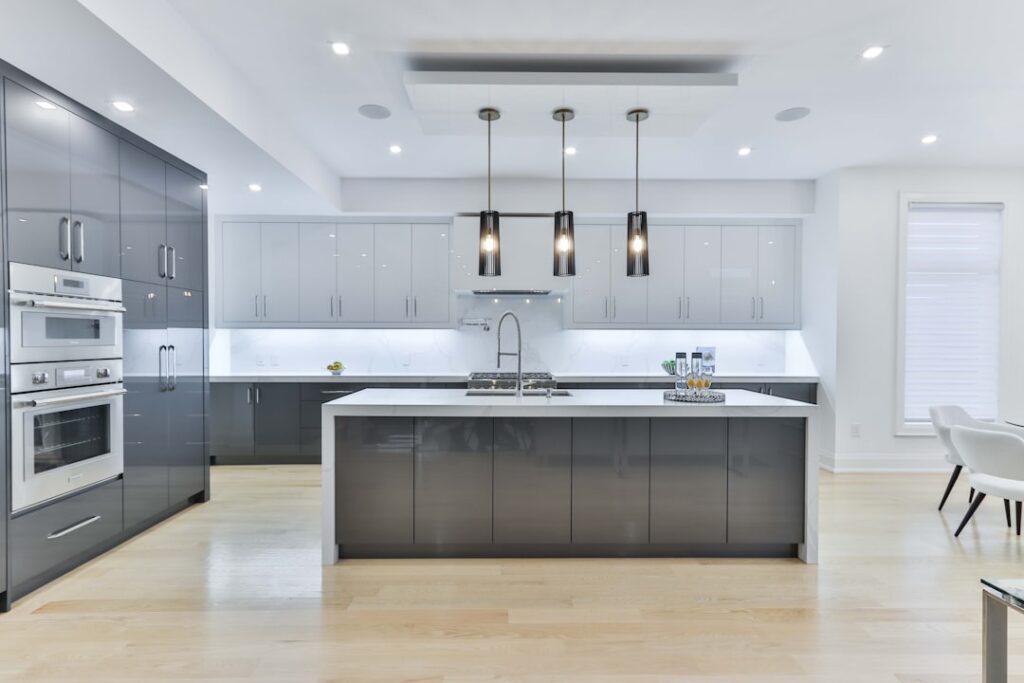
The biggest mistake homeowners make when pairing floors with espresso, navy, or charcoal cabinets is matching them too closely. Choosing the right flooring with dark cabinets comes down to contrast theory, undertone matching, and one practical question — how much natural light does the room actually get at noon? Get those three variables right and the kitchen feels grounded and editorial; get them wrong and it reads as a windowless box no matter how much recessed lighting you install.
Part of our Kitchen Remodeling guide — explore the full guide →
- Why Contrast Matters More Than Color
- Best Flooring Options by Cabinet Color
- Wood Species and Tones That Work
- LVP and Tile Alternatives
- The Lighting Variable Most Homeowners Skip
- Grain Direction and Plank Width
- Budget Tiers and What to Expect
- Stain Choice and Custom Finishing
- Common Pairings That Fail
Why Contrast Matters More Than Color
Dark cabinets at 10 to 30 percent light reflectance value (LRV) need a floor at a sharply different LRV to read as intentional. Designers generally aim for at least a 30-point LRV gap between cabinet and floor. Pairing espresso cabinets (LRV around 8) with dark walnut floors (LRV around 14) creates visual mud — both surfaces blur together and the cabinet detail disappears.
The gap can go either direction. A bleached white oak floor at LRV 60 against navy lower cabinets at LRV 12 reads as crisp and Scandinavian. A rich Brazilian cherry floor at LRV 22 against off-white uppers and charcoal lowers reads as transitional and warm. Both work because the contrast is deliberate.
Best Flooring Options by Cabinet Color
The right material depends on the cabinet undertone. A few combinations that consistently photograph well and live well:
- Espresso cabinets — wide-plank white oak with a natural matte finish, French oak in a wheat or sandstone stain, or LVP in a light honey color like COREtec Lanier Hickory.
- Navy blue cabinets — wire-brushed white oak, light gray porcelain tile in 12 by 24-inch format, or warm-toned LVP to balance the cool blue.
- Charcoal or black cabinets — medium hickory with strong grain, beige limestone-look porcelain, or a herringbone LVP in chestnut.
- Walnut cabinets — pale white oak, terrazzo porcelain, or a creamy travertine-look tile.
Wood Species and Tones That Work
White oak has dominated the dark-cabinet pairing market since 2018 and shows no sign of fading. The species has a neutral undertone that complements both warm and cool cabinets, takes stain predictably, and runs 1,360 on the Janka hardness scale — durable enough for daily kitchen traffic. Expect $7 to $13 per square foot for engineered white oak in 7 to 9-inch widths from Hallmark, Provenza, or DuChateau.
Hickory is the second strong option, particularly with darker cabinet finishes that need a busier floor to break up monotony. Hickory hits 1,820 Janka and shows dramatic light-to-dark color variation that adds movement under cabinet shadows. Avoid Brazilian cherry, dark walnut, and red oak with dark cabinets — all three create the muddy, too-similar look that ages poorly.
LVP and Tile Alternatives
If hardwood is out of budget or the kitchen sits on a slab with marginal moisture readings, premium LVP delivers the same visual outcome. Look for 20 to 22-mil wear layers, planks at least 7 inches wide, and matte EIR (embossed-in-register) textures that hide foot traffic. COREtec Pro Plus Galaxy Oak, Mohawk SolidTech Plus in Limed Oak, and Mannington Adura Max in Margate Oak all pair well with dark uppers and lowers.
Tile makes sense for full-sun kitchens in southern climates. A 24 by 24-inch porcelain in a warm beige or wood-look pattern, DCOF rated above 0.42, runs $5 to $9 per square foot installed and stays cool against west-facing afternoon sun.
The Lighting Variable Most Homeowners Skip
A kitchen with two south-facing windows and 200 lumens per square foot of overhead lighting can carry darker floors. A galley kitchen with one north window and 80 lumens per square foot cannot — and pairing dark cabinets with dark floors there is the single fastest way to make a space feel claustrophobic.
Measure ambient lighting honestly. If overhead and under-cabinet lighting fall short of 75 lumens per square foot at counter height, lean light on the floor regardless of cabinet color. Light floors bounce roughly 60 to 75 percent of incident light back into the room compared to 8 to 15 percent for dark floors, and the difference is dramatic at dusk.
Grain Direction and Plank Width
Run hardwood and LVP planks parallel to the longest wall or perpendicular to the main window. In a kitchen with dark cabinets on both sides of a galley, running planks lengthwise visually extends the room and pulls the eye past the cabinet shadows. Plank width matters too — 7 to 9-inch boards read modern and quiet, while 3 to 5-inch strips read busy and traditional.
Budget Tiers and What to Expect
The same dark-cabinet aesthetic can be hit at three price points. Knowing what each tier delivers prevents disappointment:
- $3 to $5 per sq ft installed — mid-tier LVP, 12-mil wear layer, click-lock floating install.
- $6 to $10 per sq ft installed — premium LVP at 20 to 22-mil or entry engineered white oak.
- $11 to $18 per sq ft installed — wide-plank French oak, custom-stained hickory, or large-format porcelain.
Stain Choice and Custom Finishing
Pre-finished hardwood limits color options to whatever the mill offers. Site-finished hardwood opens the full custom color range. Common stain pairings that hold up against dark cabinets include Bona DriFast Special Walnut 224, Minwax Classic Gray 271 over white oak, and Rubio Monocoat Pure with a light-tinted Maintenance Oil for a Scandi finish. Site-finishing adds $3 to $5 per square foot but produces a result no pre-finished product can match for color customization. Plan 4 to 6 additional days of timeline for sanding, staining, and three coats of finish to fully cure before walking on the floor.
Common Pairings That Fail
Three combinations show up repeatedly in regret posts on flooring forums — orange-toned red oak with espresso cabinets, gray-washed pine with navy cabinets in a low-light kitchen, and high-gloss black tile with dark walnut cabinets. All three either fight on undertone, drop the room into a cave, or amplify scuff and dust visibility. Pick a floor that contrasts the cabinet, complements the undertone, and matches the available light, and the flooring with dark cabinets pairing will hold up for the full life of the kitchen.
Prefer to explore on your own?
See how new flooring looks in your actual room in seconds — free, no signup.
Try the free Floor Studio →