Most foundation problems are not caused by bad concrete. They are caused by the soil underneath it shrinking, swelling, washing out, or compressing, and the right fix depends entirely on which of those is happening. Understanding the main foundation repair methods helps you read a contractor’s proposal, spot an oversold job, and ask the questions that separate a permanent repair from a cosmetic patch. A $900 crack injection and a $28,000 pier installation can both be “foundation repair,” yet they solve completely different problems.
- How Foundation Repair Methods Are Matched to the Problem
- Steel Push Piers
- Helical Piers
- Concrete Piers, Pilings, and Spread Footings
- Slabjacking and Polyurethane Foam Lifting
- Basement Wall Stabilization Methods
- Crack Repair and Moisture Control
- Comparing Costs and Timelines
- When to Call a Licensed Professional
- Choosing the Right Repair for Your Home
How Foundation Repair Methods Are Matched to the Problem
Before anyone recommends a repair, the damage has to be diagnosed. A good evaluation includes an elevation survey with a digital manometer or laser level, a walk-around to check grading and gutters, and a look at crack patterns inside and out. Stair-step cracks in block walls, doors that no longer latch, and sloping floors of more than 1 inch over 20 feet all point toward different causes.
Foundation repair methods fall into four broad groups:
- Underpinning — transferring the home’s weight to deeper, stable soil or bedrock using piers or piles.
- Slab lifting — raising sunken concrete with injected grout or expanding polyurethane foam.
- Wall stabilization — stopping bowing or leaning basement walls with anchors, braces, or carbon fiber straps.
- Crack and moisture repair — sealing non-structural cracks and controlling the water that caused the movement.
Many real-world jobs combine two or more. A settling corner might get three helical piers plus a crack injection and a regraded downspout discharge.
Steel Push Piers
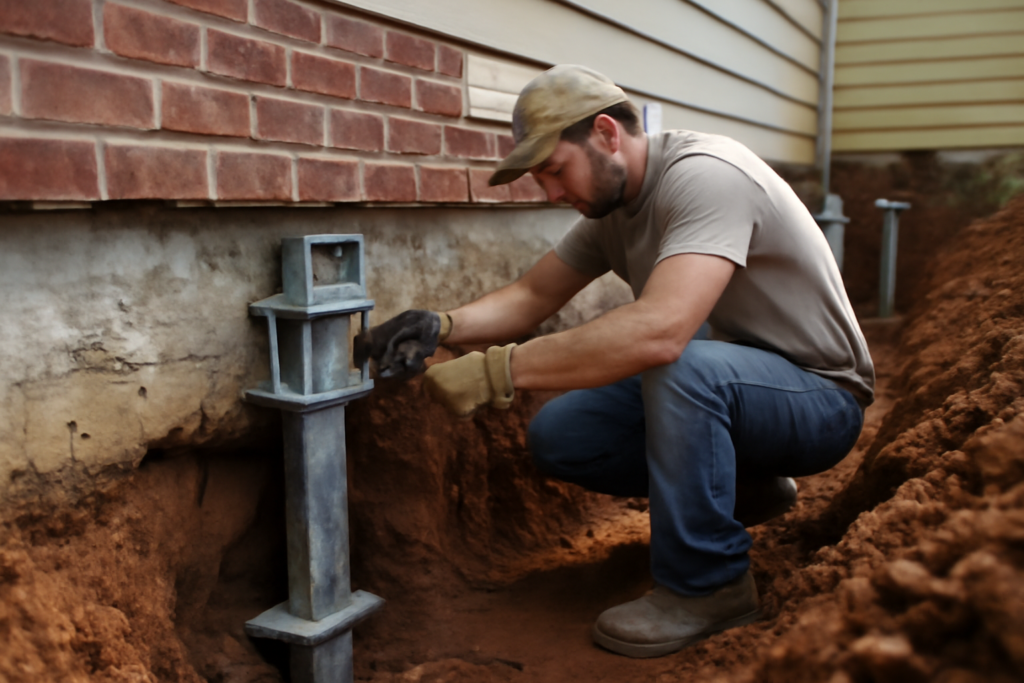
Push piers, sometimes called resistance piers, are the workhorse of settlement repair. Crews excavate beside the footing, bolt a steel bracket to it, and hydraulically drive sections of 2.875-inch or 3.5-inch galvanized steel pipe into the ground using the weight of the house as resistance. Driving continues until the pier hits load-bearing strata, which can be 15 feet down in some regions and more than 50 feet in others.
Once every pier reaches refusal, the crew uses synchronized jacks to lift the structure back toward level. Expect roughly $1,200 to $2,500 per pier, with piers spaced about 6 to 8 feet apart. A typical corner repair uses 4 to 8 piers, so budgets of $8,000 to $18,000 are common. Push piers work best on heavier homes with continuous perimeter footings, because the structure itself provides the driving force.
Where push piers struggle
Light single-story homes, garages, and porches may not weigh enough to drive the pipe to competent soil. In those cases the pier can stop short, and the repair may not hold long term.
Helical Piers
Helical piers look like giant screws: a steel shaft with one or more spiral plates welded near the tip. They are rotated into the ground with a hydraulic torque motor, and the installation torque is used to verify capacity, roughly 10 pounds of capacity for every foot-pound of torque on a common 2-7/8-inch shaft. Because they do not rely on the building’s weight, helicals suit lighter structures, new additions, deck footings, and new construction on poor soil.
Costs run about $1,500 to $3,000 per pier installed. Helicals can also be loaded immediately, so there is no curing wait. The trade-off is that rocky or cobble-filled soil can deflect or damage the helix plates, which is why your contractor should review local soil conditions before choosing them over push piers.
Concrete Piers, Pilings, and Spread Footings
In clay-heavy regions like Texas and Oklahoma, pressed concrete pilings are common. Precast cylinders about 6 inches in diameter and 12 inches long are stacked and hydraulically pressed into the soil beneath the beam, then capped. They are less expensive, often $500 to $1,000 per piling, but they rarely reach the depths steel can, so they depend on stable soil below the active clay zone.
Drilled bell-bottom piers take the opposite approach. A crew drills a shaft 8 to 12 feet deep, flares the bottom into a bell, sets rebar, and pours concrete. They are strong and durable but require several days of curing and more excavation. For pier-and-beam houses with crawl spaces, contractors may instead add new concrete spread footings and adjustable steel shims or screw jacks under sagging girders, which can cost as little as $300 to $800 per support point.
Slabjacking and Polyurethane Foam Lifting
When a concrete slab has sunk but the house structure above it is fine, lifting is often the answer. This is common with garage floors, basement slabs, patios, and sidewalks. The two main methods are:
| Method | How It Works | Typical Cost |
|---|---|---|
| Mudjacking | Cement slurry pumped through 1.5–2 in holes | $3–$6 per sq ft |
| Polyurethane foam | Expanding foam through 5/8 in holes | $5–$25 per sq ft |
Polyurethane weighs around 2 to 4 pounds per cubic foot compared with roughly 100 pounds for mudjacking slurry, so it adds almost no load to already weak soil. It also cures in about 15 minutes. Mudjacking is cheaper and works well for large voids, but the heavier material can cause further settlement over time. Neither method fixes a structural footing failure; they only restore the slab.
Basement Wall Stabilization Methods
Horizontal cracks and inward bowing in basement walls are caused by lateral soil pressure, usually from saturated or expansive clay backfill. The repair choice depends on how far the wall has moved.
- Carbon fiber straps — epoxied to the wall every 4 to 6 feet, about $500 to $1,000 per strap. Best for walls that have deflected less than 2 inches.
- Steel I-beam braces — anchored to the floor and floor joists, roughly $600 to $1,200 each. Useful where exterior digging is impractical.
- Wall anchors — steel rods run through the wall to plates buried in stable soil 10 or more feet out, about $600 to $1,200 each. Anchors can be tightened over time to gradually pull a wall back.
- Excavation and rebuild — for walls that have moved more than about 3 inches or are sheared at the base, the soil is dug out and the wall is straightened or rebuilt, often $15,000 to $30,000 or more.
Wall anchors need clear yard space. If a neighboring house, driveway, or property line is within about 12 feet, braces or carbon fiber are usually more practical.
Crack Repair and Moisture Control
Hairline vertical cracks in poured walls are usually shrinkage cracks, and on their own they are not structural. They still leak, though. Low-pressure epoxy injection bonds the crack back together and restores some strength, while polyurethane injection stays flexible and is better for stopping water in cracks that may move slightly. Either typically runs $400 to $900 per crack.
Moisture control is the part of foundation repair that homeowners most often skip, and it is the reason many repairs fail. Gutters should discharge at least 4 to 6 feet from the house, the soil should slope away at about 6 inches over the first 10 feet, and plumbing leaks under slabs need to be found and fixed. In expansive clay areas, soaker hoses or root barriers can help keep moisture levels consistent. Without those fixes, the soil that moved once will move again.
Comparing Costs and Timelines
Here is a practical overview of what to expect from the most common approaches:
- Crack injection: 1 day, $400–$900 per crack.
- Slab lifting: 1 day, $600–$3,000 for a typical garage or patio.
- Carbon fiber or bracing: 1–2 days, $3,000–$10,000 per wall.
- Push or helical piers: 2–5 days, $8,000–$30,000 depending on pier count and depth.
- Wall excavation or full underpinning: 1–3 weeks, $20,000–$75,000 or more.
Ask every contractor for a written plan showing pier locations, target depth or torque, lift expectations, and a transferable warranty. Lifetime warranties on piers are standard with reputable installers, but read whether they cover the pier only or the lift as well.
When to Call a Licensed Professional
Foundation work is structural. You can safely handle gutter extensions, regrading, and caulking hairline cracks, but you should call a licensed structural engineer and a licensed foundation contractor if you see any of the following:
- Horizontal cracks in a basement wall or cracks wider than 1/4 inch
- Walls bowing inward or leaning at the top
- Doors and windows that suddenly stick or show diagonal drywall cracks at the corners
- Floors that slope noticeably or a gap opening between the wall and the floor or ceiling
- Chimneys pulling away from the house
An independent engineer’s report typically costs $400 to $800 and is worth every dollar, because the engineer has nothing to sell you. Use that report as the scope when you collect bids from at least three contractors. Permits are required for most pier and wall work, and a properly permitted repair with engineer sign-off protects your home’s resale value.
Choosing the Right Repair for Your Home
Start with the cause, not the symptom. Settlement on soft or washed-out soil usually calls for push or helical piers. Sunken slabs with an otherwise stable structure are a job for foam or mudjacking. Bowing walls get anchors, braces, or carbon fiber based on deflection. And every one of these repairs should be paired with drainage improvements so the soil stops misbehaving.
If you are weighing bids, compare them on the same basis: number of piers, depth or torque targets, whether lifting is included, what happens to landscaping and interior finishes, and warranty terms. The lowest bid often skips piers or leaves drainage untouched. A clear diagnosis, the right method for the soil, and a contractor who stands behind the lift will give you a foundation you can stop worrying about.