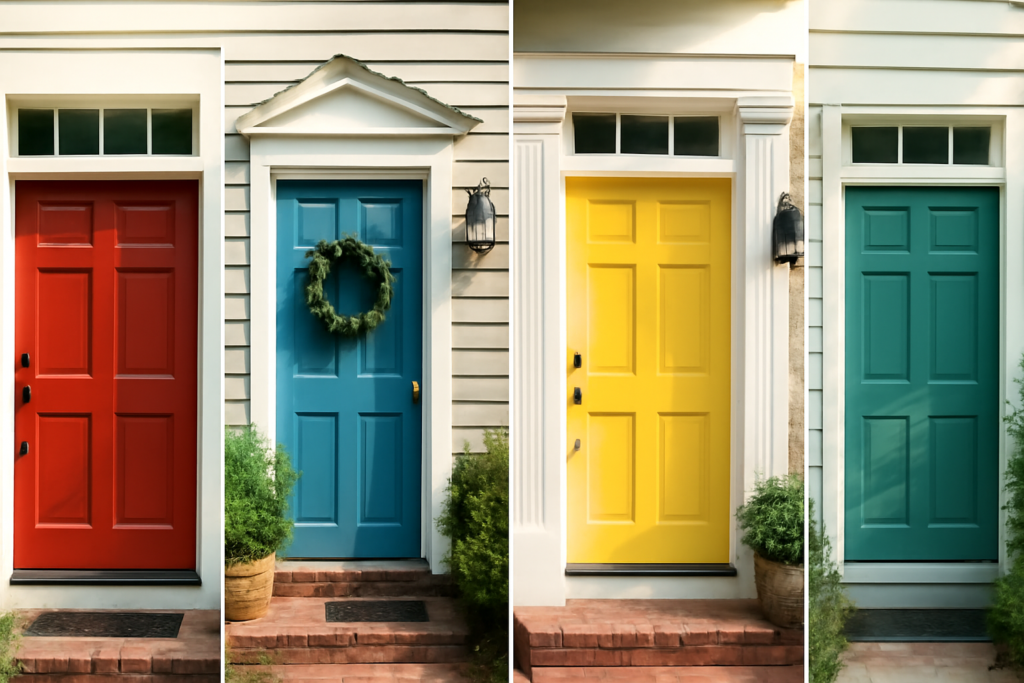
Searching for front door paint colors pictures usually means one thing: you are staring at a tired door, you know a bold new color would transform your curb appeal, and you want to see how the options actually look before committing. A front door is the single highest-impact, lowest-cost exterior upgrade you can make — a quart of paint and an afternoon can add real perceived value and make a house look cared for and current. The challenge is that the “right” color depends entirely on your siding, your architecture, and the mood you want to project. This guide walks through the standout colors, what pairs with what, and how to get a finish that lasts.
Part of our Paint & Walls guide — explore the full guide →
- Why the Front Door Color Matters So Much
- The Most Popular Front Door Colors
- Matching the Door to Your House Color
- Bold Versus Neutral
- Finish and Sheen
- Prep and Painting Tips
- Color Psychology and What Your Door Says
- Matching Hardware and Accents
- Weather and Longevity Considerations
- Choosing With Confidence
Why the Front Door Color Matters So Much
Your front door is the focal point of the entire facade — the eye goes straight to it. A well-chosen color signals personality and care, and real estate agents consistently cite a fresh, on-trend door as a quick win before listing. Because the surface is small, you can be far bolder than you would with siding; a color that would overwhelm a whole house looks striking on a single door.
That small footprint is also why experimentation is low-risk. If you tire of it, repainting a door takes one quart and a couple of hours, unlike repainting the whole exterior. This is the place to be brave.
The Most Popular Front Door Colors
Certain colors have proven themselves across countless homes and photo galleries. Here are the perennial winners and the vibe each sends.
Navy Blue
The reigning favorite. Deep navy reads classic, sophisticated, and welcoming, and it flatters nearly every siding color from white to gray to red brick. Benjamin Moore “Hale Navy” and “Naval” by Sherwin-Williams are go-to shades that photograph beautifully in real homes.
Black and Soft Black
Timeless and elegant, black adds instant contrast and a modern-classic edge. It suits white, gray, and brick homes and pairs perfectly with brass or matte-black hardware. Softer near-blacks like “Tricorn Black” avoid the flatness of pure black.
Red
The traditional statement color, associated with warmth and welcome. A true red pops against white, gray, and natural wood. Skip the fire-engine tone in favor of a slightly muted brick or garnet red for a more current look.
Green
Deep forest and olive greens are having a major moment, feeling both grounded and fresh. They shine against white, cream, and brick, echoing landscaping and evergreens. “Essex Green” and sagey mid-tones both photograph beautifully.
Yellow and Warm Tones
A cheerful yellow or warm mustard door signals optimism and stands out against gray and blue homes. It is a bolder choice that reads friendly and unexpected.
Matching the Door to Your House Color
The picture that sells you online was shot on a specific house. The trick is choosing a door color that harmonizes with your own siding. Use these reliable pairings as a starting point.
- White or light gray siding: Almost anything works — navy, black, red, and green all pop dramatically.
- Dark gray or charcoal siding: Try a warm contrast — yellow, teal, or a natural wood-stain door.
- Red brick: Navy, black, sage green, and creamy off-white all complement without clashing with the brick’s warm tones.
- Beige or tan siding: Deep blues, reds, and rich browns add the contrast a neutral facade craves.
- Blue siding: White, natural wood, or a warm coral for unexpected contrast.
A helpful rule: pull a color from something already on your house — the roof, the stone, the landscaping — and echo it in the door for a cohesive look, or choose a deliberate high-contrast color for drama.
Bold Versus Neutral
Not every home wants a statement door. If your architecture is ornate or your HOA is strict, a sophisticated neutral — soft black, deep greige, or a muted navy — adds polish without shouting. If your facade is simple and you want personality, that is your cue to go bold with green, red, or teal.
Consider the light your entry gets, too. A door in deep shade can swallow a dark color, so a slightly brighter or warmer shade keeps it from looking like a black hole. A door in full sun can handle deeper, richer tones that would feel heavy in shadow.
Finish and Sheen
The sheen you choose affects both looks and durability, and it is easy to overlook when you are focused on color. For front doors, semi-gloss is the classic choice — it highlights panel detail, reflects light attractively, and stands up to weather, hands, and cleaning far better than flat finishes. Satin is a slightly softer alternative that still cleans well and hides minor imperfections.
Avoid flat and matte finishes on an exterior door; they show every fingerprint and are hard to wipe down. For the toughest results, use a paint formulated for doors and trim, or a urethane-fortified enamel that cures rock-hard and resists sticking to the weatherstripping in summer heat.
Prep and Painting Tips
A gorgeous color fails without proper prep. Follow these steps for a finish that looks professional and lasts years.
- Remove the door or hardware — take off the knob, knocker, and kick plate, or tape carefully. Painting a door flat on sawhorses gives the smoothest result and prevents drips.
- Clean and sand — wash off grime, then scuff-sand the whole surface so new paint bonds.
- Prime bare or drastic-change areas — especially over old dark colors or bare wood.
- Paint in the shade on a mild, dry day (60°F to 85°F); direct sun makes paint dry too fast and show lap marks.
- Two thin coats beat one thick one — apply in the direction of the panels and let each dry fully.
Let the paint cure a full day before closing the door against the weatherstripping, or you risk the fresh finish sticking and peeling.
Color Psychology and What Your Door Says
The color you choose sends a message before anyone knocks, and it is worth thinking about the impression you want to make. Different hues carry well-established associations that shape how visitors and passersby perceive your home.
- Blue: Trust, calm, and stability — the most universally appealing and safe statement color.
- Red: Warmth, energy, and welcome; historically a sign that a home is a place of refuge.
- Green: Growth, harmony, and connection to nature; feels grounded and healthy.
- Black: Sophistication, elegance, and authority; a timeless, upscale signal.
- Yellow: Optimism and friendliness; cheerful and memorable.
If you plan to sell soon, lean toward the broadly appealing options — navy, black, and soft neutrals photograph well and rarely alienate buyers. If you are painting for yourself and love your home, let your personality lead.
Matching Hardware and Accents
The door color is only part of the picture; the hardware finish either completes or undercuts it. Matte black hardware pairs crisply with white, gray, and green doors for a modern-classic look. Brass and gold add warmth and a touch of luxury against navy, black, and deep green. Oil-rubbed bronze suits warmer and traditional palettes. Coordinate the door color with your house numbers, light fixtures, and porch accents so the entry reads as one intentional composition rather than a collection of unrelated pieces.
Do not overlook the trim and storm door. Painting the door casing a clean white or a color that contrasts the door itself frames it and makes the color pop. If you have a full-view storm door, choose a door color rich enough to read clearly through the glass.
Weather and Longevity Considerations
A south- or west-facing door takes brutal sun and will fade faster, so lean toward fade-resistant, UV-stable exterior paints and expect to refresh bold or dark colors every few years. Dark colors also absorb heat, and on metal or fiberglass doors in direct sun they can get hot enough to affect the finish or warp cheaper doors — check that your door and paint are rated for dark colors before going near-black on a sun-baked entry. Choosing a quality exterior enamel formulated for doors and trim is the single best way to make your new color last.
Choosing With Confidence
Browsing front door paint colors pictures is the fun part, but the winning move is testing your top two or three on a sample board held against your actual siding, in your actual light, at different times of day. Navy, black, and deep green are nearly foolproof across most homes; bolder reds, yellows, and teals reward the right facade. Pick a durable semi-gloss enamel, prep the surface properly, and you will have a front door that stops people on the sidewalk — the best return on a single quart of paint you will ever get.