
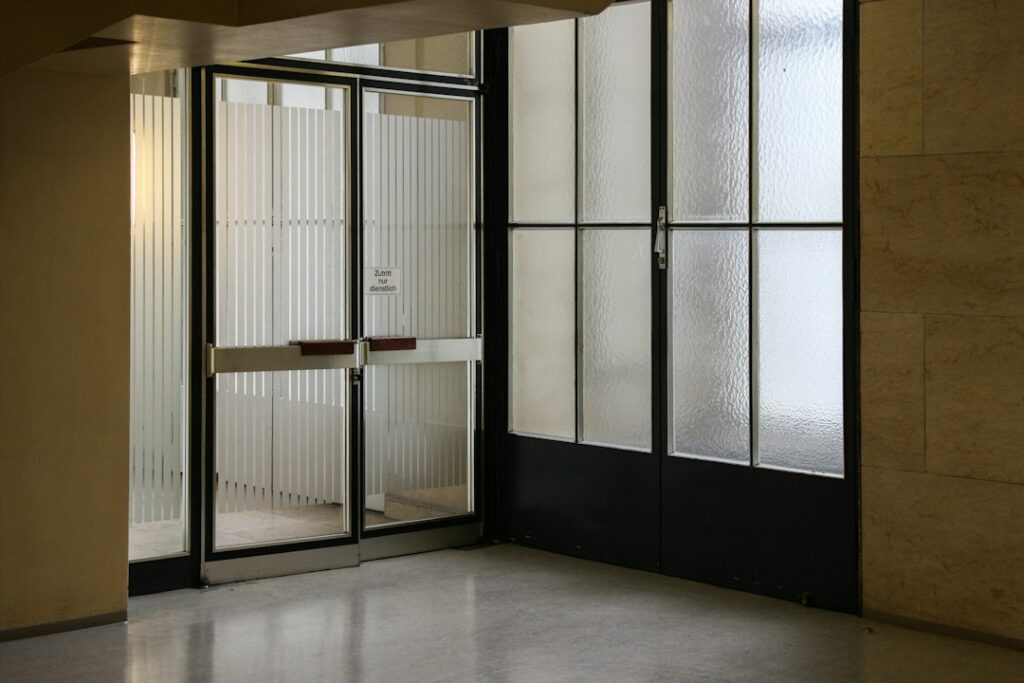
Swap a solid slab for a full glass interior door and a dim hallway or windowless office can gain the equivalent of a small window overnight. Homeowners often assume a full glass interior door means zero privacy, but frosted, reeded, and seeded glass options let you borrow daylight while still blocking a clear line of sight. Whether you are dividing a home office from a living room or opening up a butler’s pantry, the right glass door changes how a space feels without moving a single wall. This guide walks through glass types, frame materials, real pricing, and a step-by-step install so you buy once and hang it correctly.
Part of our Windows & Doors guide — explore the full guide →
- Why Homeowners Choose Glass Over Solid Slabs
- Glass Types: Clear, Frosted, Reeded, and More
- Frame Materials and Door Styles
- Privacy Without Losing the Light
- What a Full Glass Interior Door Costs Installed
- Step-by-Step: Installing a Pre-Hung Glass Door
- Care and Long-Term Maintenance
- Best Rooms for a Glass Door
- Sound and Insulation Trade-Offs
- Getting the Look Right With Trim and Hardware
Why Homeowners Choose Glass Over Solid Slabs
Light is the headline benefit. A standard 30-by-80-inch slab blocks roughly 16 square feet of potential daylight transfer; a glazed version reclaims most of it. That matters in interior rooms that touch a bright hallway but have no exterior window of their own. Home offices see the biggest payoff, followed by pantries, laundry rooms, and basement dens.
There is a design angle too. Glass doors read as modern and intentional, and they make small rooms feel larger because the eye travels through them. Real estate agents frequently cite glass French doors on a home office as a feature that photographs well and helps a listing stand out. Beyond looks, glazing lets you keep an eye on kids or pets in an adjoining room without leaving a door propped open.
Glass Types: Clear, Frosted, Reeded, and More
Not all glazing is created equal, and the type you pick drives both privacy and price. Here is how the common options compare:
- Clear tempered glass — maximum light, zero privacy. Best for offices you want to feel open or pantries where nothing needs hiding. Expect $180 to $350 for a pre-hung unit.
- Frosted or acid-etched — the most popular choice. Blurs shapes while passing about 80 percent of the light. Ideal for offices, bathrooms adjacent to hallways, and bedrooms.
- Reeded or fluted glass — vertical ribs that distort the view and add a vintage, mid-century texture. Trending hard in 2026 renovations.
- Seeded or rain glass — organic bubbles or a wavy pattern that scatters light and hides clutter behind it.
- Laminated privacy glass — two panes with an interlayer; quieter and safer if broken.
Whatever you choose for an interior door, insist on tempered safety glass. Most building codes require it for any glazing within 24 inches of a door edge and below 60 inches from the floor, and a full-lite door qualifies. Tempered glass breaks into blunt pebbles instead of dagger shards, which is exactly what you want in a busy hallway.
Frame Materials and Door Styles
The stile-and-rail frame around the glass sets the tone. Solid wood, usually pine, poplar, or oak, takes paint and stain beautifully and holds up to slamming. Expect to pay $250 to $600 for a quality wood-frame full-lite door. Steel frames deliver the black-grid industrial look that has dominated Pinterest for years, and they range from $400 to well over $1,000 for a true divided-lite steel unit.
Aluminum and MDF-clad frames sit in the budget lane, often $120 to $280, and they resist warping in humid rooms. If you want the black steel look without the steel price, several manufacturers now sell MDF or wood doors with a thin dividing grid applied over a single tempered pane. From six feet away, few guests can tell the difference.
Single Door vs. French Pair
A single glazed slab fits a standard 30-, 32-, or 36-inch opening. For wider entries, a French pair of two 24- or 30-inch glass doors creates a dramatic, symmetrical entrance to a study or dining room. Just confirm you have swing clearance; two doors need roughly the combined width of the opening to open fully into the room.
Privacy Without Losing the Light
The biggest hesitation people voice is privacy, and it is easily solved. Frosted and reeded glazing handle most rooms. For situations that occasionally need full privacy, such as a guest room or a home office used for confidential calls, add an inexpensive fix:
- Removable frosted film — $15 to $30 per roll, applies with soapy water, peels off cleanly. Great for renters.
- Sidelight curtain rods — slim rods top and bottom hold a gathered sheer against the glass.
- Smart switchable film — electrochromic film turns clear glass opaque at the flip of a switch, though it runs $50 to $100 per square foot installed.
For bathrooms, frosted or rain glass paired with a solid lower rail keeps sightlines blocked at seated height while daylight still spills over the top.
What a Full Glass Interior Door Costs Installed
Budget the whole project, not just the slab. A slab-only door means you reuse the existing jamb and hinges, which keeps costs low but demands precise mortising. A pre-hung unit arrives already mounted in its own frame, squared and ready to drop into a rough opening.
- Slab only: $120 to $500 depending on frame material and glass.
- Pre-hung unit: $220 to $900.
- Professional installation: $150 to $400 per door, more for French pairs or out-of-square openings.
- Hardware: $25 to $120 for a lever set and hinges.
All in, a DIY slab swap can land under $250, while a contractor-installed steel-frame French pair can climb past $2,500. Get the tempered glass certification stamp etched in a corner; it is your proof the door meets code if an inspector or future buyer asks.
Step-by-Step: Installing a Pre-Hung Glass Door
A pre-hung unit is the friendliest DIY path because the door is already hung true in its frame. Plan for two to three hours per door and grab a helper; glass doors are heavier and less forgiving than hollow-core slabs.
- Remove the old door and jamb, then vacuum the rough opening. Confirm the opening is roughly two inches wider and taller than the new frame.
- Set the new unit into the opening and slide tapered shims behind the hinge-side jamb. Check plumb with a 4-foot level on both faces.
- Drive two 3-inch screws through the hinge jamb and shims into the framing. Do not overtighten and bow the jamb.
- Adjust the strike-side reveal to a consistent 1/8-inch gap top to bottom, shim, and fasten.
- Test the swing. A properly hung glass door should hold position anywhere in its arc without drifting.
- Trim shims flush, install casing, and caulk the seams before painting.
Because the panel carries real weight, use the long screws that reach the studs, not just the jamb. That single detail prevents the sag that plagues heavier doors after a year of use.
Care and Long-Term Maintenance
Glass doors are refreshingly low-maintenance. Wipe the glazing with a streak-free glass cleaner or a 50-50 vinegar-water mix and a microfiber cloth. Skip ammonia on frosted or coated glass, since it can cloud the finish over time. Check the hinge screws once a year and snug any that have backed out from daily use.
Wood frames benefit from a fresh coat of paint or a wipe of furniture wax every few years, especially in humid laundry rooms. If a tempered pane ever breaks, replace the entire lite rather than trying to reglaze a fragment; tempered glass cannot be cut after tempering, so you order a new pane sized to the frame. Handled well, a quality full glass interior door outlasts the paint on your walls and keeps borrowing daylight for decades.
Best Rooms for a Glass Door
Not every doorway is a good candidate, so it pays to target the spaces where glass earns its keep. Home offices top the list, since a glazed door lets borrowed hallway light in while frosted or reeded glass keeps video calls private and the room feeling connected rather than boxed in. Pantries and butler’s pantries benefit enormously, turning a dark closet into a bright, functional space and adding a designer touch that photographs beautifully.
Laundry rooms, mudrooms, and basement dens all gain from the light transfer, especially when they lack an exterior window of their own. Glass doors also shine between a living room and a sunroom or between a kitchen and a dining room, where you want to define separate spaces without blocking sightlines or daylight. The rooms to think twice about are those needing total privacy and sound isolation, like a primary bedroom or a bathroom shared by guests, though frosted glass plus a solid lower rail can make even those work.
Sound and Insulation Trade-Offs
Glass is worth understanding honestly on one front: it transmits more sound than a solid-core slab. A single-pane full-lite door does little to muffle noise, which is fine for a pantry but a real consideration for an office where you take confidential calls or a room next to a noisy living space. If sound matters, choose a laminated glass door, where a plastic interlayer between two panes dampens noise considerably, or a thicker glass with a quality weatherstripped frame.
Insulation follows the same logic. Interior doors are not about thermal efficiency the way exterior doors are, so this rarely matters for heating and cooling. But if the glass door separates a heated space from an unconditioned one, like a door to a chilly sunroom, a solid slab may serve better. For the typical interior application dividing two conditioned rooms, the modest sound trade-off is the only real downside, and laminated glass largely solves even that.
Getting the Look Right With Trim and Hardware
The finishing details separate a glass door that looks custom from one that looks like a builder special. Choose hardware that suits the door’s style: a sleek lever in matte black or brushed nickel for a modern steel-look door, or an oil-rubbed bronze knob for a traditional wood-frame version. Because a glass door reads as more architectural than a plain slab, it rewards a slightly more substantial casing and trim around the opening.
Coordinate the frame paint or stain with your existing doors and trim so the glass door feels integrated, not bolted on. A black steel-look frame makes a bold statement against white walls and light floors, while a painted wood frame in the same color as your other doors keeps the room cohesive and lets the glass itself be the feature. Add a quality lever set rated for interior use, confirm the strike plate aligns for a clean latch, and caulk and paint the casing for a seamless finish. With the right room, the right glass, and attention to trim and hardware, a full glass interior door transforms a dim, closed-off space into a bright, open, and distinctly upscale part of your home, all for a fraction of the cost and disruption of adding an actual window.


