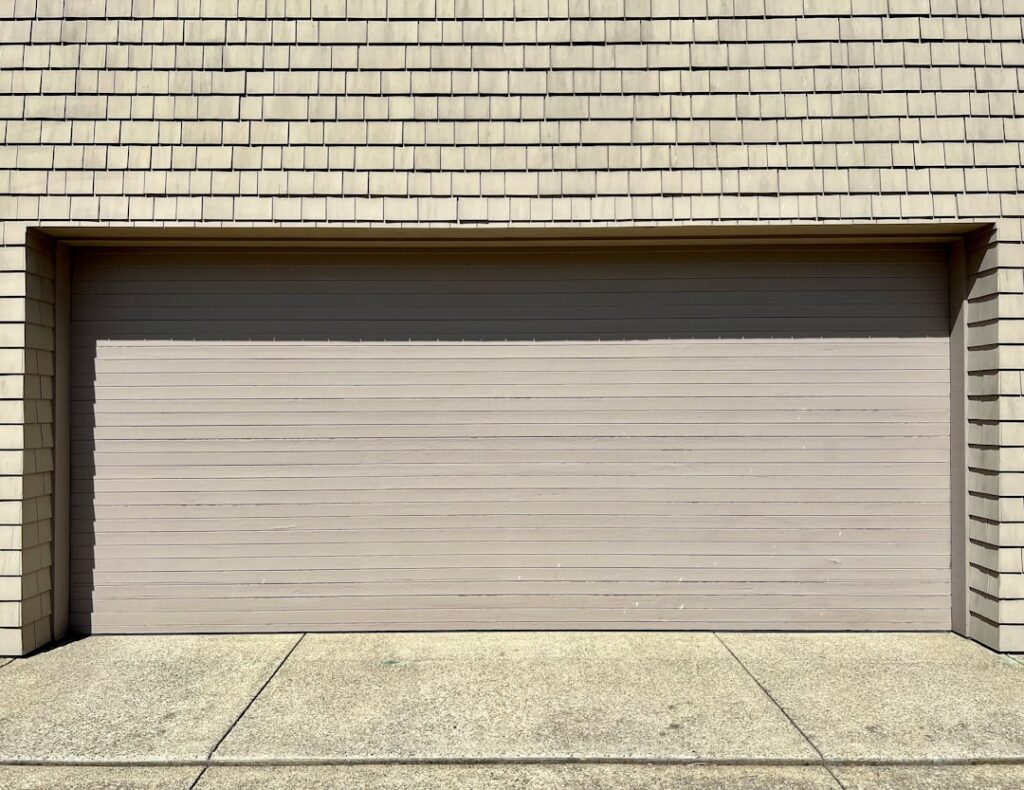
A garage door that jerks, binds, or grinds halfway up almost always has a track problem, not a motor problem. Garage door track replacement is one of the more approachable repairs a handy homeowner can tackle, but it comes with a hard safety line: never touch the tracks near a torsion spring under tension without understanding what you’re doing. A single-car door weighs 130 to 150 pounds, and a double runs 200 to 250 pounds, so the tracks and rollers are doing real work every time the door cycles, which is often 1,500 times a year.
Part of our Garage Doors guide — explore the full guide →
- Signs You Need a Garage Door Track Replacement
- What Track Replacement Costs
- Tools and Parts to Gather First
- Step-by-Step Vertical Track Replacement
- The Horizontal Track and Spring Warning
- Aligning and Testing the New Tracks
- Reconnecting the Opener and Maintenance
- Diagnosing Whether the Track Is Really the Problem
Signs You Need a Garage Door Track Replacement
Before you buy parts, confirm the track is actually the culprit. A proper garage door track replacement is warranted when you see a visibly bent, crimped, or kinked rail, deep rust that flakes when scraped, or a track that has pulled away from the wall so the door scrapes the frame. Lay a level along the vertical track; anything more than a slight lean out of plumb throws the rollers off. If the door only sticks at one spot, sight down the track for a dent where a bumper or ladder likely struck it. Rollers popping out of the horizontal section usually trace back to a widened or spread track rather than the rollers themselves.
What Track Replacement Costs
Tracks come in standard 2-inch residential widths, with 1-3/8-inch used on lighter doors. A full pair of vertical and horizontal tracks costs $60 to $180 in parts for a single door and $120 to $300 for a double. If you hire a pro, expect $150 to $400 in labor on top, so a complete professional job typically lands between $200 and $600. Compare that to a full door replacement at $750 to $2,000, and repairing the track is clearly the frugal move when the door panels are still sound.
- Single vertical track pair: $40 to $90
- Horizontal track with curve: $50 to $120
- New rollers (10 pack, nylon): $20 to $45
- Track brackets and lag bolts: $15 to $30
Tools and Parts to Gather First
Set yourself up before the door is apart. You’ll want a cordless drill, a 7/16-inch and 1/2-inch socket set, a nut driver, an adjustable wrench, a 4-foot level, locking pliers, and a sturdy step ladder. Buy tracks that match your door’s brand and radius if possible; Clopay, Wayne Dalton, and Amarr use slightly different curve geometries. Grab a bag of 5/16-inch self-tapping track bolts and matching nuts, since the old ones are often rusted. Nylon rollers with sealed bearings are a cheap upgrade that makes the whole door quieter for years.
Step-by-Step Vertical Track Replacement
Work on one side at a time so the door stays supported. Here is the safe sequence for the vertical (side) tracks, which carry no spring tension:
- Disconnect the opener by pulling the red emergency release cord, then close the door fully.
- Clamp locking pliers onto the track just above a roller on both sides so the door cannot rise.
- Loosen the bolts connecting the vertical track to the horizontal track and to the wall brackets.
- Lift the rollers out of the old track and slide the new track into place, seating the bottom on the floor bracket.
- Set the track plumb with your level, snug the wall bracket bolts, then reconnect to the horizontal section.
- Repeat on the opposite side, keeping both tracks the exact same distance from the door edge.
Take your time on plumb and spacing. Even a quarter-inch of difference side to side will make a door hesitate.
The Horizontal Track and Spring Warning
The horizontal tracks bolt to the vertical tracks and hang from ceiling brackets, and they sit right beside the torsion spring and cables. Here’s the rule every pro lives by: leave the spring, the cables, and the cable drums alone unless you own winding bars and know the winding count. A torsion spring stores enough energy to break bones or worse. If your track replacement requires releasing spring tension to get the horizontal rail off, that job crosses into professional territory. Many homeowners replace the verticals themselves and pay a technician $100 to $150 to handle the horizontal and spring side.
Aligning and Testing the New Tracks
With everything bolted, remove the locking pliers and lift the door by hand about halfway. It should glide and stay put where you leave it, a sign the springs are still balanced. Watch the rollers travel through the curve; they should never bind or climb the flange. Check the gap between the door and the track flange, which should be a consistent 1/2 inch or so along the whole run. Adjust the wall brackets in or out to dial it in. Finally, spray the tracks and rollers with a lithium or silicone garage-door lubricant, not WD-40, which attracts grit.
Reconnecting the Opener and Maintenance
Once the manual test passes, re-engage the opener carriage and run a full cycle. Test the auto-reverse by laying a 2×4 flat under the door; it must reverse on contact, per federal safety rules. Going forward, inspect the tracks twice a year, tighten any loose bracket bolts, and wipe the rails clean before re-lubricating. A well-installed track set outlasts the door itself, so getting this repair right protects a component that opens and closes thousands of times before you’ll think about it again.
Diagnosing Whether the Track Is Really the Problem
Before you spend a dime on parts, rule out the components that mimic track trouble, because a bad track and worn rollers produce similar symptoms. Pull the emergency release and lift the door by hand. If it feels heavy or won’t stay put halfway, the springs are the issue, not the track, and that’s a job for a technician. If it rises smoothly but a roller catches at one spot, sight down the rail for a dent or a spot where the track has spread wider than the rest. Grab each roller and wiggle it; excessive play means worn rollers, a $20 fix, rather than a bent track.
Check the track brackets where they bolt to the framing. Loose lag bolts let the whole track shift under load, producing binding that looks like a bent rail but is really just a loose mount you can snug in five minutes. Look at the horizontal track’s ceiling hangers for the same looseness. Rust that only discolors the surface is cosmetic and cleans up, but rust that has pitted and flaked through the steel weakens the track and justifies replacement. Working through this checklist keeps you from replacing a perfectly good track when the actual culprit costs a fraction as much.
Preventing future track damage
Most bent tracks trace back to preventable events, so a little habit-building protects your new install. The number one cause is backing or bumping the door with a vehicle or a ladder, so give the closed door clearance and never park tight against it. The second is a door forced to operate against an obstruction, which is why keeping the auto-reverse safety sensors clean and aligned matters; a door that won’t stop when something’s in the way puts enormous stress on the track and rollers.
Twice a year, spend ten minutes on maintenance. Tighten every track bracket and hanger bolt, since the constant vibration of daily cycling works them loose over time. Clean the tracks of dirt and old grease with a rag, then apply a lithium or silicone garage-door lubricant to the rollers, hinges, and springs, never the tracks’ running surface where it would attract grit. Watch and listen through a full cycle for new grinding or hesitation that signals a developing problem. This simple routine keeps rollers gliding smoothly and spares the track the abuse that leads to the next replacement.
When to call a professional and what it costs
Knowing your limits keeps this repair from turning into an injury. Call a technician whenever the job requires releasing torsion-spring tension, when the horizontal track and cables are involved, when the door is badly out of balance, or when the tracks are bent because a vehicle struck the door hard enough to also twist the door sections or bow the framing. Those situations combine stored spring energy with structural damage, exactly the combination that sends DIYers to the emergency room. A door that has come completely off its tracks with the cables unwound is a stop-and-call situation, not a wrestle-it-back-in one.
Professional pricing is predictable enough to judge a quote against. A straightforward track replacement runs $150 to $400 in labor plus parts, a spring replacement $200 to $350, and a full track-and-roller overhaul $300 to $600. Get the technician to quote the specific parts and confirm they carry the correct track width and radius for your door brand. If a company pushes a full door replacement when only the track is damaged, get a second opinion, since replacing sound door panels over a bent rail is a costly upsell. Whether you handle the vertical tracks yourself and hire out the spring side or turn the whole job over to a pro, the goal is a door that runs smooth, balanced, and safe on tracks that will outlast several openers.